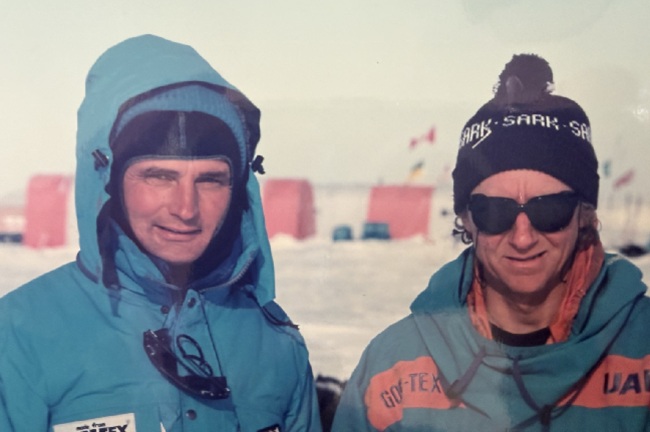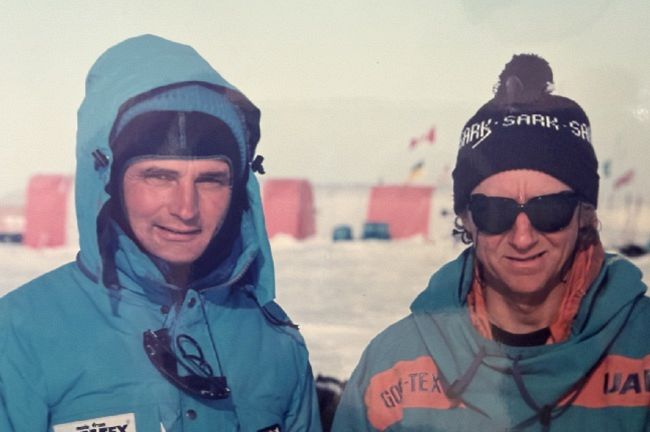
Thirty-six years ago, Dr Jeff McMullen encountered the remarkable British adventurer, Geoff Somers, on the latter’s historic trek across Antarctica.
ON HUSKY-DRAWN SLEDGES, a 6,450-kilometre journey across the widest axis of Antarctica had long been hailed as ‘the impossible crossing'.
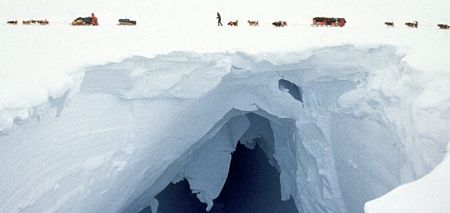
Below-freezing temperatures, blizzards and gale-force winds, as well as deep crevasses in the ice in the so-called Area of Inaccessibility, posed a daunting challenge.
On March 3, 1990, Geoff Somers, a renowned British expeditioner, was among six men from six different nations who completed the gruelling 220-day trek.
Their intention always was to make history with another human first.
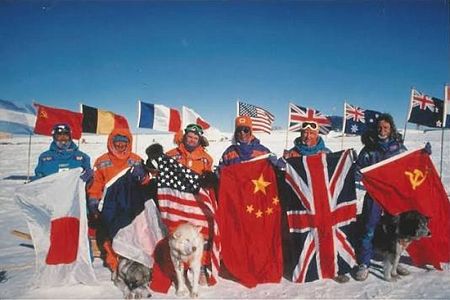
They also wanted to show the world that people of diverse cultures, experience and skills – American, Russian, Chinese, French, Japanese and British – could cooperate in a necessary effort to preserve Antarctica’s great white wilderness...a place of astonishing, unforgettable majesty and beauty.
Geoff Somers’ death at the age of 76 in the U.K. after a long illness (July 17, 2026) stirred my memories of his extraordinary calm, courage and skill.
His band of brothers who will be celebrated forever as the International Trans-Antarctic Expedition (1989-1990) also illustrates how much is possible with unity and how our world has changed.
Geoff Somers took charge of logistics on the expedition because of his vast experience with the British Antarctic Survey.
The American, Will Steger and Frenchman, Dr Jean-Louis Etienne, were already highly experienced polar expeditioners. Steger was the first to reach the North Pole on an unsupported dog-sledge trek. Etienne was first to ski solo to the North Pole.
Remarkably, the Russians allowed a scientist, Victor Boyarsky, to join the team. He would measure the alarming hole in the ozone above Antarctica, a contribution leading to the later banning of the release of dangerous chlorofluorocarbons.
China permitted a glaciologist, Qin Dahe, to go along to study levels of industrial pollution that had drifted onto one of the Earth’s last pristine surfaces. No one thought Qin Dahe would last the seven-month marathon, as he had none of the experience of the Japanese expeditioner, Keizo Funatsu.
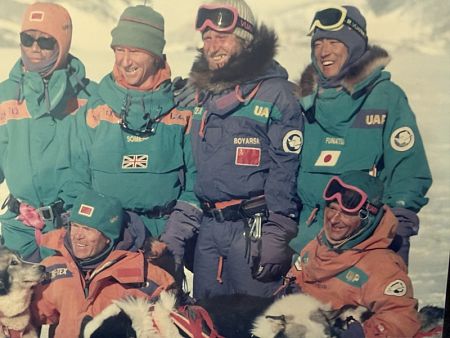
Top row left to right: Qin Dahe (China), Geoff Somers (UK), Victor Boyarsky (Russia), Keizo Funatsu (Japan) Bottom: Will Steger (USA) and (from France) Dr Jean-Louis Etienne (Photo by Jeff McMullen at Patriots Hills, October 1989)
To understand how people from these rival great powers could work closely together and at times push one another beyond normal human limitations, remember the world’s season of optimism.
Mikhail Gorbachev’s perestroika reforms in 1985 opened his closed society for a time. The Antarctic expedition offered some prospect of genuine international cooperation.
In July 1989, when the international expedition headed out from Punta Arenas in southern Chile, the Russians flew the men and their 38 huskies in a massive Soviet Ilyushin-76. This Red Army military transport landed on an icy field on King George Island. The six men were then ferried in Twin Otter aircraft to their starting point at the tip of the Antarctic Peninsula.
Three-and-a-half months later, I climbed aboard an old Canadian fire-fighting DC-6 dubbed the "Albatross" in Punta Arenas, Chile, with the plan of intercepting the expedition at Patriot Hills near Antarctica’s Ellsworth Mountains.
I was hitching a ride with a team of fresh huskies to relieve some that badly needed rest after slogging through ice and snow for 104 days in a row. It was a risky flight because the DC-6 was not fitted with skis and the pilot would have to bring it down on a sheet of ice.
As I noted in my memoir, A Life of Extremes – Journeys and Encounters:
'Four times the Albatross lumbered off towards Drake Passage and four times it failed to make it all the way. One engine faltered, one engine caught fire, there was a small electrical fire in the cockpit, a generator problem, faulty spark plug and on it went.’
On our fifth attempt, the huskies were nervous and whimpering. We comforted them for nine hours in the darkness of the DC-6’s freezing cabin until we had passed the point of no return with ice floes down below.
With unreliable radar, the plane finally circled for an hour until the pilot spotted coloured markers and tents down below. Powering in between mountain peaks, the DC-6 dropped rapidly, clipped a ledge of ice and bounced at least four storeys into the air. The right wing tipped loose snow, but the 70-year-old pilot kept control.
The "Albatross" had landed and the six expeditioners stood cheering.
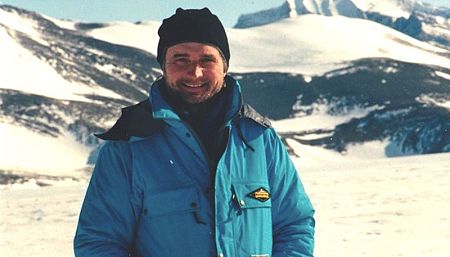
My introduction to Geoff Somers was to hand him letters and taped messages from his family. His brother Chris, a photographer who lived in Australia, organised our schools to track the progress of the entire history-making expedition.
The Antarctic winter showed on the faces of all six expeditioners with patches of frostbite on noses and cheeks. After months of isolation, seeing no other human being and only a few very high-flying birds, there was memorable camaraderie.
I am certain the expeditioners were grateful that we had finally made it to Antarctica with the fresh huskies who were now running in circles, piddling with relief to be on the ground again.
The Frenchman, Jean-Louis Etienne, gave me a bear hug and introduced me to the others.
The co-leader, Will Steger, said with a twinkle that he had covered his eyes when the DC-6 bounced, fearing a disastrous crash could have killed us. That would have ruined the entire expedition, he added. Everyone laughed, and we cracked a bottle of vodka, which the Russian, Victor Boyarsky, kept pouring.
It was cold, minus 45 degrees Celsius. The wind cut like a knife in the back. No matter how many layers you wore, you still felt cold as the sheets of blue ice that ran ahead to the awesome Ellsworth Mountains.
Sleeping in small tents, we found by morning that our breath had frozen around a chin full of stubble. Even double sleeping bags were cold and sodden.
All the huskies slept out in the open, curled up and usually half-buried in snowdrifts.
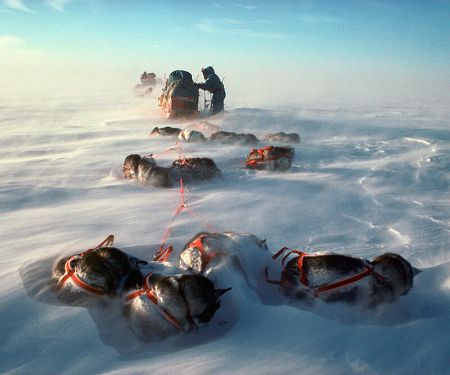
Several times huskies harnessed to sledges plunged into deep and dark crevasses. Somers, Steger and Etienne lowered themselves on ropes to save these beloved animals. They lost only one on their entire journey.
I watched the Englishman, Somers, taking care of a husky’s frozen paws with a gentleness and understanding that in this wilderness a dog was truly a man’s best friend.
"The dogs are the real heroes in Antarctica," Somers said, as he fitted their harness and we loaded his sled. "It is only the spirit and endurance of these magnificent animals that will get us to the South Pole by Christmas."
Geoff Somers would become the first Briton to cross Antarctica at its widest axis by foot and on sledge.
Born in Khartoum in Sudan in 1950, Geoff was the son of an English doctor and a very resilient mother who had served as an Army Radio operator during World War Two.
He left school without the grades to fulfil a dream of learning to fly a plane. Instead, he hitchhiked across the world, picking up skills that came from interacting with different cultures in far-flung places.
You need many layers of survivalist knowledge to operate in Antarctica.
Somers had mastered the practice of wind-walking, hunched over and guiding your body between tents. As Antarctica has the most powerful recorded winds of any place on earth, if you lose your footing in a storm, you could easily be blown to your death.
I had never experienced the temperatures these men endured. The cold simply peeled the metal thread from a frozen camera lens or made fingers stick to the metal film magazines.
Geoff Somers showed me his split hands and cracked fingers, painful and taped up. He had struggled with a frostbitten toe and a tooth that cracked off. "We have to finish the journey," he said, "so we all just keep going."
Jean-Louis Etienne, a medical doctor and environmental scientist, tried to treat their injuries and look after their mental state under such extreme pressure.
Etienne questioned each expeditioner as the journey progressed, trying to assess how people of such different cultures could operate best under enormous stresses.
With foresight, the Frenchman anticipated that his study would assist those planning future long space missions by international teams of astronauts.
Geoff Somers laughed about mind matters. He was a practical man, masterful at fitting out their gear, repairing broken sledges and settling nerves when the great white outs descended. Although they had some radio contact and satellite navigation, Geoff navigated using a sextant and wristwatch.
He told me at Patriot Hills:
"There are so many ways Antarctica can kill you...Not tying your tent down in high winds, setting it alight with your little stove, maybe not being tethered together by rope during a blizzard and falling into a crevasse or getting separated from the others in a whiteout…any of these little missteps and you are gone."
The expedition was on day 218, just 25 kilometres from their final destination of Mirnyy, a Russian base, when the Japanese expeditioner, Keizo Funatsu, fed his huskies and then went missing in one of their fiercest snowstorms.
Keizo survived 13 hours in the whiteout by digging a hole in the ice and snow, just like the huskies.
When their epic journey was finished, Geoff Somers went quietly to his team of huskies, patted each animal and, as he put it, "congratulated them" on their extraordinary feat.
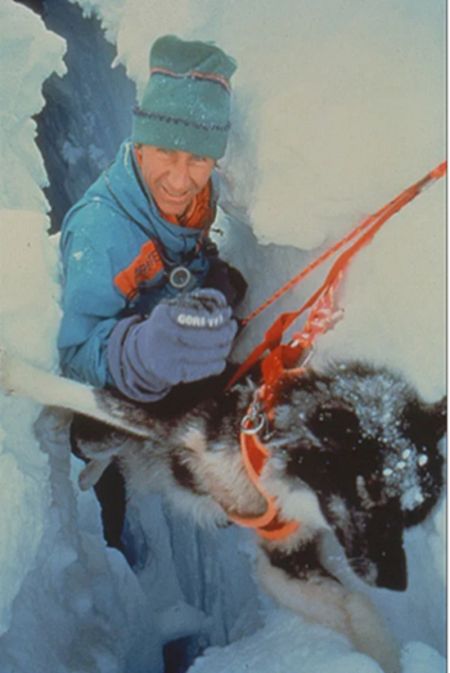
Soon after, all huskies were banned from Antarctica, in an attempt to prevent them spreading canine viruses to seal populations.
I came away thinking man and future mining were undoubtedly far greater threats.
I spent 17 days in Antarctica because the old "Albatross" ditched into a snowbank and had to be dug out on King George Island.
I wrote then in my journal:
I know of no man or woman who has seen Antarctica and not been changed forever. It is the closest experience I have had to making a journey to another star. For in this world of ice, all of the shapes are beautifully disorienting — a magnificent iceberg, an awesome crevasse, cliffs of blue ice that refract the light and seem to flow like a frozen waterfall, great pyramid mountains perfectly sculpted, vast fields of ice gleaming in the midnight sun, and always the whiteness of the snows, the swirling blizzards of blinding white.
Vale Geoff Somers.
Dr Jeff McMullen AM is a journalist, author and filmmaker, former ABC foreign correspondent and Four Corners and Sixty Minutes reporter, and recipient of the United Nations Media Peace Prize.
 This work is licensed under a Creative Commons Attribution-NonCommercial-NoDerivs 3.0 Australia License
Support independent journalism Subscribe to IA.