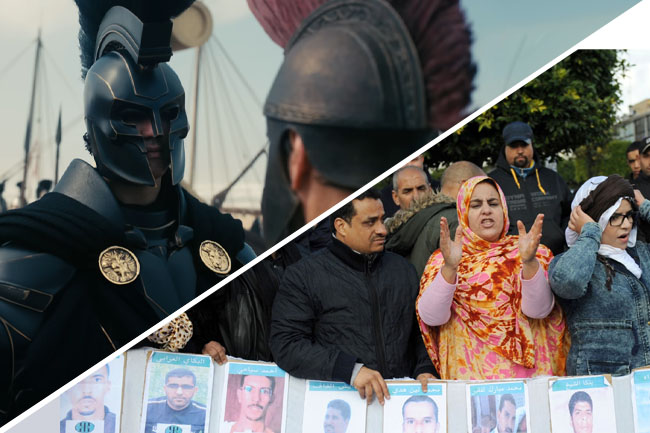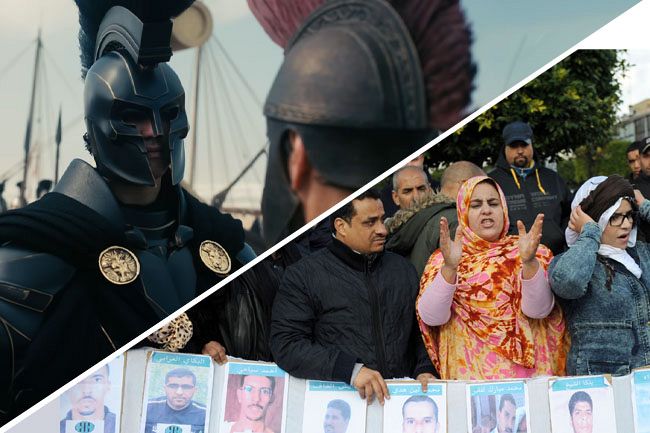
By filming a story of exile and homecoming in Western Sahara, Christopher Nolan’s The Odyssey turned an unresolved homeland into scenery — and exposed the need for ethical standards governing film locations.
Nolan has built much of his career around men confronting forces larger than themselves: time, war, memory, guilt, gravity and the consequences of ambition. In The Odyssey, he turns to one of Western literature’s foundational stories: Odysseus’s struggle to return to Ithaca after the destruction of Troy.
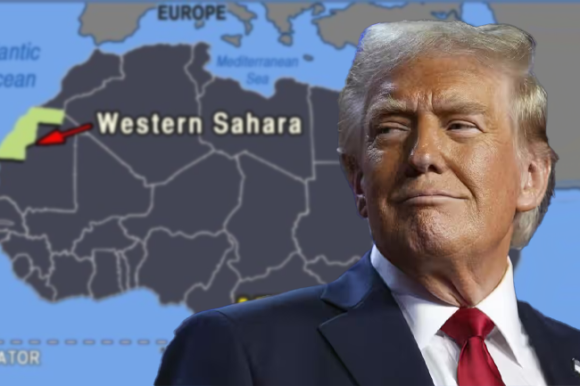
Yet one of the production’s most consequential choices occurred outside the narrative. Part of the film was shot near Dakhla, in Western Sahara, a territory controlled by Morocco but still listed by the United Nations as a Non-Self-Governing Territory whose final status remains unresolved.
That choice creates a contradiction cinematic spectacle cannot conceal. Nolan filmed a story about exile, separation and the struggle to return home on the land of a people who have spent half a century divided between refugee camps, exile and life under Moroccan control.
In Homer’s epic, Ithaca is more than a destination. It represents belonging, family, memory and political legitimacy. Odysseus’s return is not simply the end of a journey; it is an attempt to recover a home transformed during his absence.
For Sahrawis, these themes are not ancient mythology. They are part of a living reality.
We Sahrawis live a reality that echoes Nolan’s story: exile, separation, longing for home, the search for a route back and the struggle to preserve land and identity. This is the central irony — a filmmaker searching the ancient past for a universal story of return while overlooking a people living a comparable drama in the present, on the very land selected for his cameras.
Sahrawis welcome art, creativity and cinema. We welcome everything that enriches culture and brings places into the world’s imagination. But we also ask that our story be understood, and that we be seen as a people with memory, voice and rights — not as a silent backdrop or an exotic natural set from which cameras take their images and depart.
The issue is not whether deserts, dunes or coastlines may appear in films. Nor does artistic freedom require filmmakers to endorse every political position associated with every location.
The question is whether a major international production can enter an unresolved territory with the permission and logistical support of the power controlling it, extract the landscape’s visual value and then act as though the decision carries no political meaning.
It does.
Western Sahara has been on the UN list of Non-Self-Governing Territories since 1963. In its 1975 advisory opinion, the International Court of Justice found no territorial-sovereignty ties capable of overriding self-determination through the free and genuine expression of the will of the territory’s people.
In October 2024, the Court of Justice of the European Union reaffirmed Western Sahara’s separate and distinct status and ruled that EU-Morocco trade and fisheries agreements affecting the territory required the consent of the Sahrawi people.
A film production is not legally identical to a trade agreement. It would therefore be imprecise to declare, without examining permits, contracts and applicable law, that Nolan’s filming was necessarily illegal.
But the legal record removes any serious basis for treating Dakhla as an ordinary, uncontested Moroccan location. A permit may provide physical access to the land, but it does not automatically provide political legitimacy or meaningful consent. Administrative approval from the authority controlling a territory cannot replace the people whose right to determine its future remains internationally recognised.
Morocco considers Western Sahara part of its “southern provinces” and has invested heavily in presenting Dakhla as a destination for tourism, business, sport and investment. Attracting major film productions fits within that strategy. A global blockbuster can reinforce a territorial narrative without containing a single explicitly political line.
Cinema does not merely show places. It frames them, names them and assigns them a political reality.
When an international audience sees Western Sahara detached from its unresolved status, the absence of context produces its own message: nothing is contested here; no people are missing; no consent is required; this is simply another location within the state that opened the road to the cameras.
That is not neutrality. It is normalisation through omission.
The contradiction becomes sharper because of the moral structure of The Odyssey. Odysseus is granted a face, a voice, a history and a right to return. The audience is asked to understand his longing for Ithaca and the injustice of his separation from home.
But the Sahrawi relationship to the land used by the production remains outside the frame. Western Sahara becomes a universal landscape while the people whose historical and legal claims give that landscape its contemporary meaning are rendered invisible.
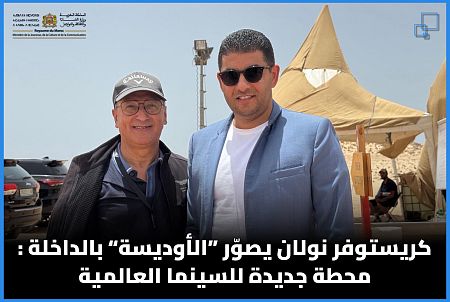
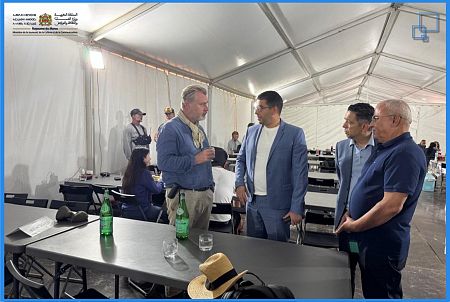
'Christopher Nolan Films "The Odyssey" in Dakhla: A New Milestone for Global Cinema': Morocco's Minister of Youth, Culture and Communication, Mehdi Bensaid, on the set of The Odyssey (Image via X | @mjcc_gov)
There is also an inequality in who is permitted to create images. International productions may arrive with budgets, permits and institutional support, while Sahrawi journalists, artists and filmmakers face restrictions when documenting their own society and political reality. Outsiders can take images from the territory while its people struggle to control how their history and present are represented.
The controversy should prompt the international film industry to develop clearer standards for working in occupied, colonised or internationally disputed territories.
Studios already conduct financial, security and reputational assessments before selecting locations. Territorial status and human rights due diligence should become equally routine. Productions should identify a location’s international legal status, disclose which authority issued permits, examine whether state incentives form part of a territorial propaganda strategy and consult credible representatives of the affected people.
They should also identify contested locations accurately in credits and publicity. A disputed territory should not disappear into the national branding of the state that controls access to it.
None of this requires Nolan or Universal Pictures to resolve the Western Sahara conflict. It requires something more limited: recognising that filmmakers with enormous cultural influence cannot enter an unresolved territory, accept the support of one party and then treat the resulting images as politically innocent.
Cinema’s power lies not only in what it shows, but also in what it trains audiences not to see.
Before celebrating Odysseus’s return to Ithaca, audiences should be told whose homeland became his film set.
Mohamed Elbaikam is an independent activist from Western Sahara.
 This work is licensed under a Creative Commons Attribution-NonCommercial-NoDerivs 3.0 Australia License
Support independent journalism Subscribe to IA.


Related Articles
- Autonomy is not the answer for Western Sahara
- Fortescue's Moroccan venture is deeply concerning
- The time is now: Western Sahara must gain independence
- Trump and U.S. betray the people of Western Sahara