Political pressure, protest crackdowns and reputation management are threatening to steer universities away from their pursuit of truth and fairness, writes Kim Sawyer.
THESE ARE TESTING TIMES for universities, not just because of end-of-semester examinations. The tests are coming from outside the ivy walls.
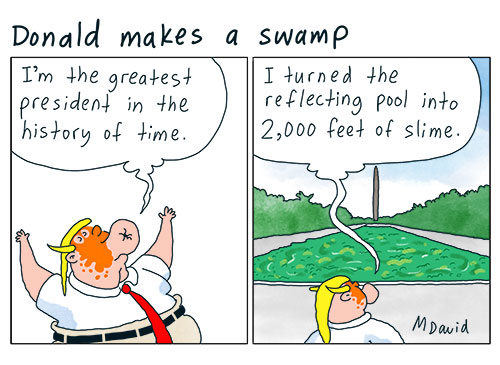
U.S. President Donald Trump is the face of the political interference that is compromising universities in their pursuit of truth. The barbarians are at the gates.
In 2007, I co-authored a paper lamenting the decline in academe. We reflected that when universities become corporations, they begin to behave like firms with no shareholders, operating with a declining government subsidy and trying to maximise sales in a market with excess demand.
For a corporate university, what matters is the number of students enrolled, their fees, how they are perceived by benefactors and how they are perceived by politicians. Reputation matters.
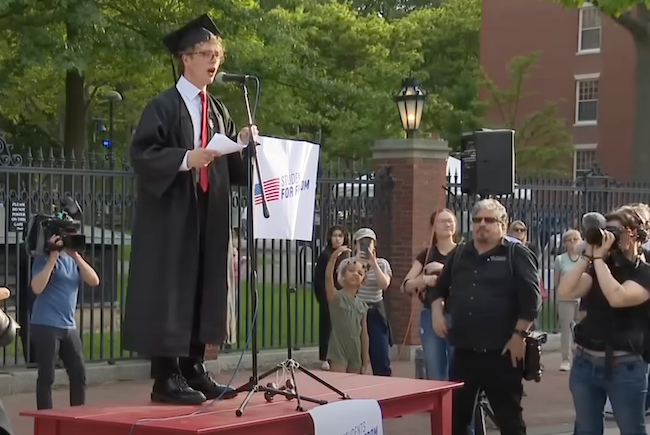
The conflict in Gaza has led to political interference in universities, not only from the outside. The legitimacy of anti-Israel protests has been subordinated by perceptions of antisemitism. The word antisemitism is being used deceptively, stigmatising those who criticise Israel just as the Jews were stigmatised for being Jews. Stigmatisation is the root of antisemitism. Stigmatisation, whatever the context, is prejudice.

The founder of Zionism, Theodor Herzl, wanted a homeland for the Jews, but not a theocracy. Herzl was a humanitarian who understood the golden rule of to do unto others as you would have them do unto you. Herzl was different to the Zionists who violate the rights of others. Herzl understood that the prejudice of exclusion is the prejudice of immorality.
He once wrote:
'It would be immoral if we were to exclude anyone, whatever his origin, his descent, or his religion, from participating in our achievements… There is only one way to do it, the highest tolerance. Our motto must therefore be, now and ever: "Man, you are my brother.'"
What would Herzl think now?
In December 2023, the presidents of the University of Pennsylvania, Harvard University and MIT appeared before Congress. Within a month, two of the Presidents resigned their presidencies, presumably because they were not strong enough in combating the perception of antisemitism.
In January this year, Columbia University's interim president resigned only one week after Columbia agreed to change policies to satisfy the Trump Administration. In 2024, the previous president resigned over her handling of anti-Israel protests. Universities rely on benefactors. Some are more influential.
Political interference is not restricted to antisemitism. The Trump Administration is pursuing an agenda against diversity, equity and inclusion (DEI). There have been some notable casualties.
The case of Dr Santa Ono demonstrates the risks in being the CEO of the corporate university. Santa Ono was formerly president of the University of Michigan and a candidate for president of the University of Florida. The University’s board unanimously approved Dr Ono last week, but Florida’s Board of Governors, which oversees the State University System, voted against him. Dr Ono was seen as too lenient with pro-Palestinian protestors and too accommodating of DEI. In transitioning to Florida, Dr Ono tried to manage his reputation by writing an opinion essay disavowing diversity programs, but too late. The agenda was too strong for the flip-flopper.
No Australian vice chancellor has been subjected to the inquisition to which presidents of U.S. universities are subjected, yet Australian vice chancellors are manipulating reputation risk. The recent decision by the University of Melbourne to expel two pro-Palestine student activists and to suspend two others suggests that universities are cognisant of risks to their reputation.
The University’s student disciplinary committee found the four students had engaged in improper conduct by occupying the office of an academic who oversees the university’s joint PhD program with the Hebrew University of Jerusalem. They were calling on the university to disband programs with Israeli universities, consistent with divestment and sanctions of Israel. The vice chancellor upheld the committee’s decision.

A vice chancellor is like a CEO managing the risks of a firm. However, universities are special. Universities are underwritten by principles of natural fairness, at least they are supposed to be. I have served on several disciplinary committees. In one case, a student plagiarised a thesis. They were not suspended, but their degree was downgraded to a diploma.
In another case, a student brought cheat notes into an exam. They maintained they had not cheated until forced to admit they had. They were suspended, but the suspension did not appear on their transcript. In a third case, the student offered thousands of dollars in consultancies to staff prior to exams. I was the reluctant whistleblower. The case led to a university inquiry and formed the basis of a 2001 Senate Inquiry into Higher Education. The student came to my office to intimidate me. The student was not the only retaliator. The student was not suspended or expelled.
The students’ call for divestment in research with Israel is the call of other influential voices.
A recent article in the Times Higher Education states that the European Union is reviewing whether Israel should continue to be part of its flagship research scheme, Horizon Europe. European Parliament Members see divestment as a diplomatic lever to restore aid to Gaza. When asked if the UK should suspend new jointly funded research with Israel, Alison Phipps, UNESCO Chair in refugee integration at the University of Glasgow, provided this response.
She said:
“If a ban of this type helps to stop the suffering in Gaza, we should do it.”
Universities need to be fair, seen to be fair, and consistent. Notwithstanding the intimidation, the decision to expel them would appear inconsistent with the penalties invoked in other cases. The penalty should not be expulsion from an institution that purports to pursue the truth.
Dr Kim Sawyer is a senior fellow in the School of Historical and Philosophical Studies at the University of Melbourne.
 This work is licensed under a Creative Commons Attribution-NonCommercial-NoDerivs 3.0 Australia License
Support independent journalism Subscribe to IA.


Related Articles
- Beyond ANU: Rethinking Australia’s university funding crisis
- Australian universities being hijacked by corporate elites
- Unchecked vigilante violence on campus smacks of ambient fascism
- Money-mad universities fail to stop violence against protesters
- Universities Accord fails to restore integrity to higher education