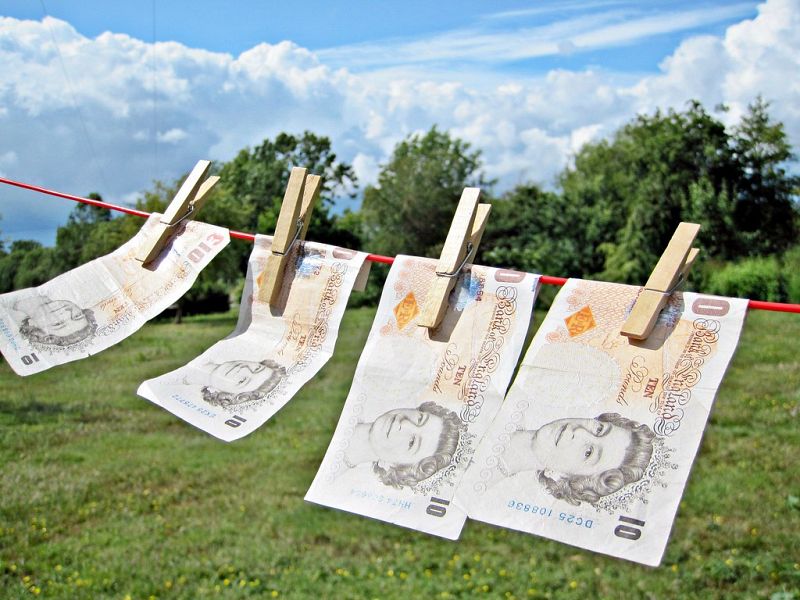
Money laundering is big business, but only because the banks are the partners in laundering.
The 1988 UN Vienna Convention defined money laundering as the transfer of stolen funds for the purpose of concealing the illicit origin of the funds and assisting those involved to evade legal consequences. Money laundering involves three stages; diverting funds away from the crime, layering a trail of concealment and integrating the money to make it look legal.
Money laundering represents an economy in itself, with estimates as high as 5% of global GDP. Almost certainly, it is much higher as 90% of laundering goes undetected and only 0.1 % of illicit funds are recovered. Money laundering is the crime of the digital age, the crime that relies on the anonymity of transactions and the gaps in bank systems.
One of the problems with money laundering is that it is a borderless crime. An estimated 70% percent of laundering crosses at least one border, rendering it difficult for sovereign nations to act. Australia is at the edge of a global hotspot. The Asia‑Pacific accounts for 40% of the world’s money laundering and we are a prime target because of regulatory failures.
The global response has been to fine banks that facilitate money laundering and to require banks to be more compliant with national anti-money laundering (AML) statutes. In 2024, there were US$4.6 billion fines issued globally across 52 enforcement actions and AML compliance cost banks a little more than US$60 billion. However, the fines and the costs of compliance represent less than 0.01% of the money laundered. The most damning statistic is that only 0.1% of suspicious activity is investigated. We are in a dark age of money laundering.
The fight against money laundering began a long time ago, featuring in the prohibition era and expanding in the digital age with the Group of Seven (G7) Financial Action Task Force, successive U.N. conventions and AML laws designed to enhance the monitoring of transactions. There is no universal standard for anti-money laundering (AML) laws. Australia's 2006 Anti-Money Laundering and Counter-Terrorism Financing Act differs from India’s 2002 Prevention of Money Laundering Act and from the US Corporate Transparency Act. Money laundering requires global standards, but there is no global standard.
Notwithstanding the limited response, there have been some notable investigations and prosecutions of money laundering. In December 2012, HSCBC paid a $1.9 billion fine for laundering, in July 2014, BNP Paribas was fined $8.9 billion; and in September 2020, the International Consortium of Investigative Journalists revealed that US$2trillion of transactions had been laundered by some of the world's largest banks.
Chinese organised criminal groups have been identified as the principal money launderers for drug cartels in Mexico, Italy and elsewhere. In the U.S., Chinese networks drove over US$312 billion in illicit money from 2021 to 2024. Money laundering is the crime no one sees until too late.
AUSTRAC (Australian Transaction Reports and Analysis Centre) is the agency charged with ensuring banks comply with the 2006 AML Act. AUSTRAC is very selective. In 2018, they fined Commonwealth Bank of Australia (CBA) $700 million for breaches of the AML Act and in 2020, they fined Westpac $1.3 billion for breaches of the AML Act. However, in 2022, after a five-year investigation into breaches of the AML Act, the National Australia Bank NAB was not fined. Instead, it entered into an enforceable agreement promising the regulator to do better. Why the selectivity?
Since 2020, there has been an explosion in scams, with Australians losing $7 billion. Most of the money was laundered, an explosion of money laundering without prosecution. In the scam to which we were subjected, hundreds of thousands of dollars were taken out within 24 hours, yet the bank algorithms of the banks did not detect anything anomalous. Why are the banks not prosecuted when there is real evidence of money laundering? This is a question all scam victims ask.

The Government and regulators appear to be soft on money laundering. There appears to have been a systematic strategy to deflect away from laundering.
The Scam Prevention Framework Act 2025 (SPF) does not mention money laundering and the Treasury position paper of November 2025 on scams appears to separate scams and money laundering, stating:
'The rules could be used to exclude the following activities, that in isolation, would not meet the definition of a scam: certain criminal conduct regulated under anti-money laundering and counter-terrorism financing (AML/CTF) legislation.'
A scam is the first stage in money laundering. If the money is not laundered, the victim could be able to recover the money. Scams and money laundering are inextricably linked together. They are not separable, but the Government evidently thinks so.
AUSTRAC, which monitors money laundering, is in the Department of Home Affairs, whose Minister is Tony Burke. The scam prevention response is coordinated by the Treasury, whose Minister is Daniel Mulino. Of course, scam victims have been unable to meet either Minister.
The separation of regulatory remit illustrates the fragmentation of Australian regulation that allowed scams to proliferate without accountability of banks that allowed them to proliferate. The UK is years ahead of Australia, with mandatory bank reimbursement for authorised push-payment scams, liability shared between sending and receiving banks, and liability implied by the failure to detect money laundering.
The UK reimburses scam victims 88% of losses in five days, while most scam victims in Australia are fighting for reimbursement after more than two years. Last year, the UK appointed its first Minister for Fraud to coordinate the fight against fraud — particularly cybercrime and money laundering. They established an integrated framework.
In 2020‑23, global crypto‑related money laundering grew by more than 80% and in the first quarter of 2025, there was a 230% rise in deep‑fake identity attacks. However, what is most troubling for Australia is the possibility of mortgage fraud. One-quarter of global money laundering is now related to real estate.
A recent Commonwealth Bank-commissioned report revealed the number of loans based on doctored documents could exceed $1 billion and that suspicious loans taken out with other banks amount to at least another $1 billion. Mortgage fraud is the new frontier of fraud.
Australia has been too soft on white-collar crime. Regulation has been fragmented and not pre-emptive and we suffer from the bystander problem that she’ll be right… until it's not. Financial crime has no borders; we cannot afford to be the bystanders that we have always been. We need a regulatory reboot. Will any party have the resolve to do it?
Dr Kim Sawyer is a senior fellow in the School of Historical and Philosophical Studies at the University of Melbourne.
 This work is licensed under a Creative Commons Attribution-NonCommercial-NoDerivs 3.0 Australia License
Support independent journalism Subscribe to IA.