As global tensions rise, Colm Tóibín’s portrait of Thomas Mann reminds us how easily war, censorship and nationalism can reshape culture, writes Dr Tony Smith.
AS THE WORLD again edges toward war and governments invoke patriotism to silence dissent, history offers reminders of how easily culture can become entangled with politics.
Irish novelist Colm Tóibín has a remarkable knack for choosing apposite subjects and themes for his writing. In his book about German writer Thomas Mann are many important revelations about fiction, biography and history.
In this age of censorship, ethical vacuity and disregard for international law, The Magician seems especially prescient.
While Mann’s “magic” tricks for his children are the source of his nickname, his accomplishments in and around a self-destructive and crumbling Germany were also unlikely. Mann (1875-1955) was a Nobel laureate in 1929. His best-known work is perhaps Death in Venice, inspired by time spent in Italy, which was experiencing a cholera epidemic.
Indeed, one reason that Mann’s writing attracted attention and controversy is that he used his own experiences as the basis for his work. Inevitably, this led critics to assume he was writing about his own family, his own class and his own country.
Tóibín makes numerous references to the demands of writing about living subjects. One of Mann’s most controversial works, Doctor Faustus, has a protagonist who trades his soul to the devil for brilliant musicianship. Mann drew on Arnold Schoenberg for the central character but only to the extent that he recognised the composer’s leadership in atonality, dissonance and the avant-garde. Some readers inevitably associated other undesirable features of his Faust with Schoenberg.
Although Tóibín sticks close to information in published biographies and Mann is not a living subject, he acknowledges Mann’s sensitivity and courage in tackling difficult projects. Mann came from a privileged background in Lubeck, then moved to Munich.
Eventually, arguments about German cultural superiority led to the silencing of criticism and a total war effort in 1914. This kind of patriotism is echoed today in spurious arguments about America being the epitome of freedom and democracy. Mann remained quiet during the 1914-18 war, was sceptical about the Weimar Republic and did not support the anarchist revolution. When Hitler first appeared on the scene, Mann dismissed him as irrelevant.
Mann was indeed surrounded by artists, writers and musicians. Elder brother Heinrich wrote satire, and children, Klaus and Erika, were polemicists, while son Michael was an accomplished viola player. These family members were perhaps more committed than Mann and found his positions frustrating. Generally, they were further left in their political views. And German emigre Bertolt Brecht also found Mann too ready to compromise.
Witnessing the violence of the Nazis, especially against Jewish people, Mann fled to Switzerland, then Princeton, where he was offered work and then to warmer California. Throughout these changes in his life, each of which brought fresh perspectives, Mann was preoccupied with obtaining safety for his family — his brother, his wife Katia and their six children.
Klaus and Erika were openly bisexual. Erika, rejected by novelist Christopher Isherwood, wed the poet WH Auden to acquire British citizenship. Her interviews with the FBI exposed the Americans as prudish, narrow-minded and obsessed with perceived communist sympathies. The infamous House Un-American Activities Committee of the 1950s provided a model for the scapegoating today of anyone who criticises Israel. Mann supported those, such as actors victimised in this era of McCarthyism.

Mann himself was attracted to young men, although there was never any scandal. In a post-war tour of Germany to lecture about Goethe, Mann was “advised” not to visit the Eastern bloc because he would be considered a fellow traveller.
Tóibín has Mann point out to his inquisitors that he had seen this not-so-subtle censorship before as the Nazis rose to power. Mann refused to be intimidated and gave his lecture in both East and West, arguing that his brief was for the German language, which was situated in both.
Tóibín’s Mann is a study in caution. While others around him were quick to understand the threats from ignorant people of power across the world, Mann seemed determined to give everyone the benefit of the doubt until forced to recognise the danger. In some respects, the tipping point was reached when Mann considered events through the lens of his writing.
Tóibín gives authenticity and authority to Mann in some compelling dialogue. There are discussions between Thomas and Heinrich, for example, that are very evocative. Mann resists calls to appeal directly to President Roosevelt and powerful media interests, but perhaps Mann’s most powerful statements arise when questioned – and threatened – by the Americans.
The current regime in America exhibits many of the features that forced Mann to return to Switzerland. A U.S. naval vessel named for a gay rights activist has been renamed. And if that seems merely symbolic, educational institutions and libraries have been vilified and denied funding for teaching courses and stocking books which are deemed unpatriotic and un-American.
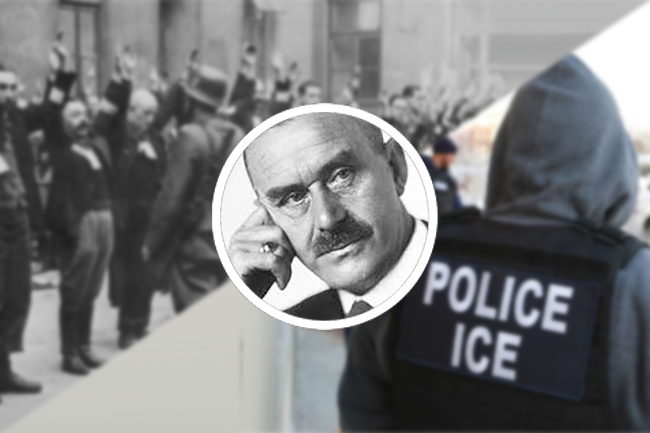
In the name of conservative family values, women’s access to some pregnancy services has been curtailed. Anti-immigration campaigns border on racism and are conducted by thugs who would not be out of place in Nazi Germany. The list of similarities goes on.
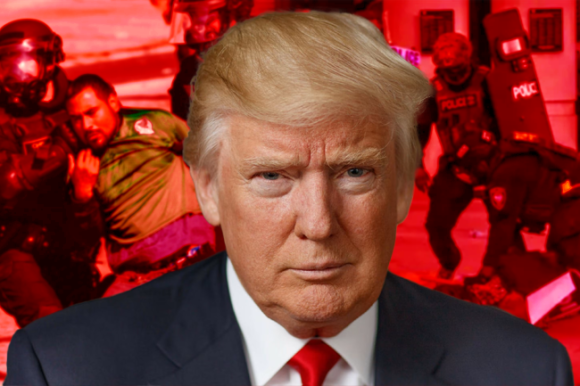
Thomas Mann was someone whose views were sought and whose support was valued. Anyone seeking the views of a Trump or a Netanyahu is crazy. Anyone wanting their support or afraid to criticise their warmongering is uncivilised.
Many writers are being forced to experience the censorship threatening our literature. It is inspiring to keep Mann’s story before us in this time when dialogue is monologue, when compassion lacks meaning and when the future seems so bleak. Mann spoke out eventually and so should we all.
Dr Tony Smith is a former political science academic with interests in parliament, elections and ethics.
 This work is licensed under a Creative Commons Attribution-NonCommercial-NoDerivs 3.0 Australia License
Support independent journalism Subscribe to IA.