

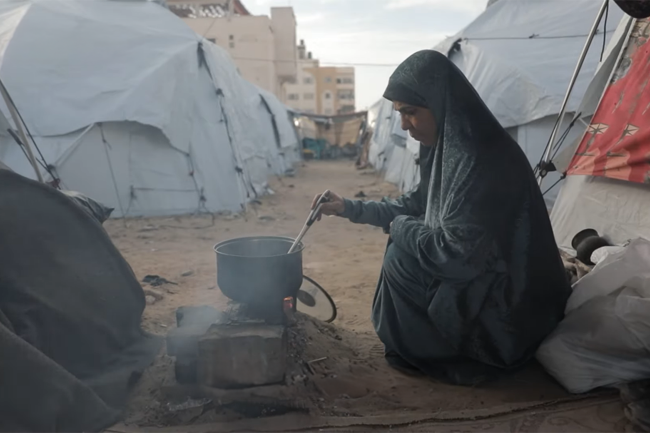
Women in Gaza are enduring displacement, loss and hunger, yet continue to lead resilience efforts through local organisations, writes Dr Ibrahim Natil.
PALESTINIAN WOMEN have been among the most affected and impacted groups, not only in terms of the loss of security and stability, but also in terms of the increasing psychological, social and economic burdens as a result of Israel’s war on Gaza.
Amid the harsh conditions endured by the people of the Gaza Strip for years and with the escalation of the ongoing war since October 2023, thousands of women have been forcibly displaced from their homes. They have been moving between shelters or temporary places that lack the most basic necessities of life.
These women are burdened with fear for their children, anxiety about an uncertain future, and the educational, health and social future of their families as a result of a systematic policy of starvation, as the Integrated Food Security Phase Classification (IPC), a United Nations-backed global hunger-monitoring system, declared last month.

Many of them lost their husbands or a member of their family or extended relatives. Some became the sole breadwinners for their families, amid the collapse of infrastructure and the paralysis of institutions since the outbreak of the war in the Gaza Strip in October 2023.
In response to the destruction of the entire civil society, however, local CSOs such as Palestinian Network Non-Governmental Organisations (PNGOs), including Society Voice Foundation (SVF, Gaza Strip-based), emerged to assist women in the current humanitarian crisis. These independent local CSOs worked diligently to provide comprehensive support to women and adolescent girls, creating a safe space for them amidst the rubble and fear.
SVF, for example, has been actively present in all displacement areas, particularly in the central and southern governorates. Since the early days of the war, local CSOs, such as PNGOs and SVF, have adopted a holistic approach, despite the cut in foreign aid, which aimed to support women and adolescent girls psychologically, socially, and morally. They believe that empowering women is a fundamental step toward rebuilding society.
SVF conducted a series of group and individual psychosocial support sessions, which played a significant role in alleviating anxiety and trauma among women, especially in shelters and overcrowded areas.
The sessions were not only aimed at emotional release, but also included awareness programs on how to deal with children in times of crisis, psychological resilience mechanisms and self-protection methods. This was in response to the ongoing 24-month war, which has created a catastrophic environment of destruction of entire civil society, never seen since the Second World War and Nakba for Palestinians.

Stories of women whose testimonies from the heart of displacement shared have reflected in-depth pain and experience, as Iman, 36 years old, said:
“Since the war began, I lost my sense of security, and I couldn’t sleep, but after participating in the psychological support and awareness sessions during 2024, I began to regain my balance and feel that I am not alone.”
Iman added that she developed her skills and now volunteers at the women’s centre. Her tasks include mobilising and organising women’s meetings, documenting stories and suffering inside the displaced people’s areas. This sense of resilience, however, could be broken various times as the war has been going on.
Focusing on empowerment through raising voices, the efforts of PNGO and SVF were not limited to the psychological aspect. It also sought to enhance women's skills and empower them economically and cognitively by organising short training workshops on life skills, crisis management and leading community initiatives despite losing hope.
Nada, 17, lost her home and school in the Zeitoun area and found herself living in a UNRWA shelter, saying:
“I felt like my life was over. But participating in local activities gave me back hope and I learned how to face my reality without breaking down.”
Many young women have begun organising initiatives within the displacement camps aimed at providing support for children, organising recreational and educational activities in an environment that lacks the essentials of childhood.

One of the most important outcomes of these programs is that the SVF has been able to restore confidence in many women's abilities and empower them to be partners in bringing about change within their communities, even in the midst of war.
Heba, 24, whose family home was destroyed in Al Zahraa City, south of Gaza, works with the SVF’s team in the field of media and awareness, and said:
“The war shattered my dreams and ambition to complete my master's degree, but despite all the challenges, I will continue to achieve my goals.”
The voices, once silenced by pain, have become audible through initiatives, dialogue meetings and stories shared by participating young women, documenting their experiences of resilience and determination despite adversity. The SVF has also placed special emphasis on women's participation in public discussions and organised educational meetings on community awareness in times of conflict and women's rights during displacement. These efforts aim to enhance women's role in community dialogue and highlight their issues in the face of mothers and newborns who are the most at risk from malnutrition.
Despite the enormous challenges, the local CSOs, SVF and activists have emphasised the importance of continuing to support displaced women, particularly through:
- continuing psychosocial support sessions in all shelters and host communities;
- expanding economic empowerment programs to create opportunities for women and adolescent girls to confront poverty and rising unemployment;
- enhancing women's participation in community decision-making, particularly with regard to reconstruction and post-conflict planning, if the war might stop one day; and
- providing programs specifically for adolescent girls who have dropped out of school, through informal learning or alternative education.
Palestinian women in Gaza, however, have proven during this war that they are not just victims, but rather agents of change, resilient despite the bombing, displacement and destruction. Through ongoing activities, many CSOs, including SVF, placed women at the centre of attention, opening windows for them to hope, recovery and continued struggle for a better future.
Dr Ibrahim Natil has published a number of works and books and is a civil society activist and human rights campaigner.
 This work is licensed under a Creative Commons Attribution-NonCommercial-NoDerivs 3.0 Australia License
Support independent journalism Subscribe to IA.


Related Articles
- UN intervention essential to stop Gaza genocide and establish peace
- Gaza's past preserved as present is destroyed
- The war on truth: How Israel is silencing Gaza’s journalists
- Gaza death toll far worse than reported in Western media
- Chris Minns and the Sydney Harbour 'Gaza Streisand effect'





