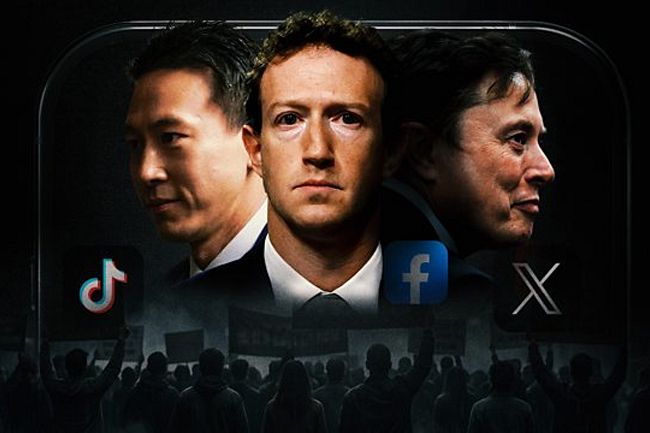
A chilling documentary exposes how social media giants profit from outrage, misinformation and political division while escaping meaningful accountability. Digital editor Dan Jensen takes a look Inside the Rage Machine.
INSIDE THE RAGE MACHINE is not comfortable viewing, but it is essential viewing. Presented by BBC social media investigations correspondent Marianna Spring and distributed domestically by Four Corners, the documentary examines how major social media platforms have helped create an online environment where outrage, misinformation and extremism are not just accidental byproducts, but profitable features of the system.
At around 45 minutes, it is a tight, accessible and sharply constructed piece of journalism. There is little fat on it. The documentary moves quickly, but not carelessly, building its case through whistleblower testimony, internal documents and examples of real-world harm linked to the content users are fed online.
The central point is not especially new, but it remains deeply alarming: social media platforms reward engagement, and few things drive engagement more effectively than anger. Content that shocks, divides or enrages people keeps them scrolling. More scrolling means more advertising revenue. More revenue means higher profits.

The problem, as Inside the Rage Machine makes painfully clear, is that the consequences do not remain trapped inside a phone screen. They spill into elections, riots, radicalisation, public discourse and the way millions of people understand the world around them.
Independent Australia has long been aware of the way social media is used to manipulate people into believing misinformation and shifting the political landscape. This documentary reinforces how urgent that problem has become. The world is now dealing with a communications system where lies can be amplified at an industrial scale, while the companies responsible continue to present themselves as neutral platforms rather than active participants in shaping public reality.
The most powerful material comes from former insiders at Meta and TikTok, who describe a corporate culture in which safety concerns were often forced to compete with growth, market share and stock price. Former Meta researcher Matt Motyl is especially compelling, explaining how algorithms can push users toward more extreme or harmful material because that is what keeps them engaged.
This is where the documentary is most effective. It does not simply claim that social media can be harmful. It shows how the machinery works. The algorithm does not need to “believe” in conspiracy theories, misogyny, racism or political extremism. It only needs to recognise that users are reacting. In that cold mechanical sense, outrage becomes indistinguishable from interest.
That should terrify anyone who still thinks the online world is merely a reflection of society. The platforms are not just mirrors. They are engines. They do not simply show people what is already there; they help decide what gets boosted, repeated, normalised and monetised.
The documentary also captures the grim absurdity of the current regulatory environment. These companies operate at a scale governments have struggled to comprehend, let alone control. Internal safety teams can raise concerns, whistleblowers can go public and journalists can expose harm, but the basic incentives remain intact. The platforms still make money from attention and outrage still captures attention.

Meta and TikTok, unsurprisingly, deny the central claims made by whistleblowers. They point to safety policies, investment in moderation and protections for younger users. But the documentary’s strength lies in the gap between corporate language and lived reality. The public-facing statements sound polished and responsible. The evidence presented suggests a far messier and more dangerous system underneath.
As a piece of television, Inside the Rage Machine is impressively put together. It does not rely on unnecessary theatrics, which is wise, because the material is disturbing enough without embellishment. The editing is clean, the pacing is strong and Spring proves an effective guide through a subject that could easily become dense or abstract.
The program is also careful not to get lost in technical detail. Viewers do not need to understand every aspect of machine-learning systems to grasp the moral issue at the centre of the film. When companies know harmful content drives engagement, yet continue to benefit from that engagement, the issue is not merely technological. It is political, economic and democratic.
That is what makes Inside the Rage Machine so important. It is not really a documentary about apps. It is a documentary about power.
The platforms examined here have become major forces in public life, influencing what people see, what they believe and who they fear. Yet the people running them remain largely insulated from the damage caused when misinformation and extremism are pushed into millions of feeds.
The documentary offers only limited solutions, mostly around transparency and governance. That may feel unsatisfying, but it is also honest. There is no quick fix for a system built around monetising attention at any cost.
Inside the Rage Machine is an easy watch in terms of length, but a difficult watch in terms of what it reveals. It is also a necessary one.
At a time when misinformation is reshaping politics around the world, tech giants can no longer be treated as passive hosts of online conversation. They are shaping the conversation, profiting from the conflict and avoiding anything close to adequate accountability.
Inside the Rage Machine is available to watch on ABC iView.
You can follow digital editor Dan Jensen on Bluesky @danjensen.bsky.social or check out his podcast, Dan and Frankie Go To Hollywood. Follow Independent Australia on Bluesky @independentaus.bsky.social and on Facebook HERE.
 This work is licensed under a Creative Commons Attribution-NonCommercial-NoDerivs 3.0 Australia License
Support independent journalism Subscribe to IA.


Related Articles
- 'Spinal Tap II' proves lightning can strike twice
- Terrifier 3 slashes its way into cinematic history
- Longlegs reinvents the crime genre with pure nightmare fuel
- Leave the World Behind warns of America's doomful destiny
- Dial of Destiny disappoints: Indiana Jones belongs in a museum