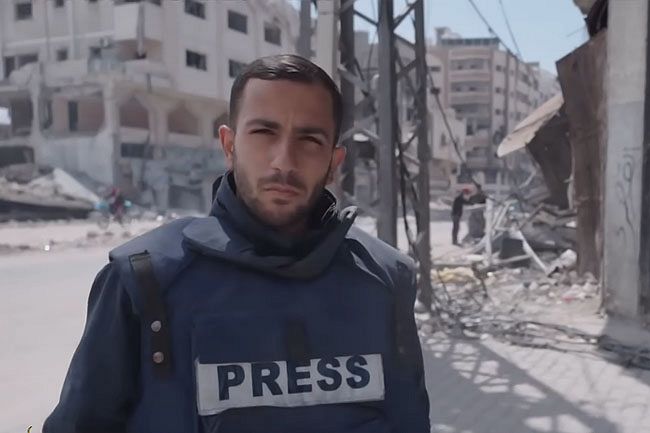
As Gaza becomes the deadliest conflict for journalists in modern history, Israel faces mounting accusations of targeting the press to suppress truth and evade accountability, writes Tatiana Svorou.
ON 10 AUGUST 2025, six journalists were killed when an Israeli airstrike hit a tent outside the main entrance to al-Shifa Hospital in Gaza. Among those killed were journalists Anas al-Sharif and Mohammed Qreiqeh, cameramen Ibrahim Zaher, Mohammad Noufal and Moamen Aliwa, as well as freelance journalist Mohammad al-Khalidi.
Following this attack, which in no way could be perceived as isolated, the Israeli military contended that Anas al-Sharif functioned as a Hamas operative and led a cell responsible for rocket attacks. However, these allegations remain unsubstantiated by independently verifiable evidence. Al Jazeera has strongly rejected this claim, denouncing it as part of a concerted effort to delegitimise its journalists and rationalise lethal action against media personnel.
Likewise, press-freedom organisations, including the Committee to Protect Journalists and Reporters Without Borders, have categorically dismissed the allegations as baseless, identifying them as attempts to undermine journalistic integrity under the guise of security.
At the same time, in light of the protection afforded to journalists as civilians under the Geneva Conventions and customary international law, as well as the systematic and harsh targeting of journalists currently operating in Gaza, significant questions arise concerning Israel’s adherence to international humanitarian and human rights law. No need to say at this stage, to support accountability, human rights monitoring and humanitarian efforts, journalists are vital in recording armed conflict.

According to the International Federation of Journalists, intentionally or carelessly targeting media professionals obstructs the free flow of information and hides the realities on the ground from the global community. Thereby, this incident fits into a larger context of information warfare, in which witnesses to purported widespread humanitarian and human rights violations are silenced by unfounded security accusations.
At the moment, more than 240 Palestinian journalists have been killed since October 2023, making it the deadliest time for media professionals in a modern armed conflict, which classifies as a genocide. This figure exceeds the number of people killed in several significant historical conflicts put together, suggesting a coordinated effort to target the media.
Furthermore, the Israeli Government's continued prohibition on foreign journalists entering Gaza exacerbates the danger by significantly limiting independent verification and raising the stakes for local Palestinian reporters who do not have the protection of international media. International legal protections for civilians and non-combatants are therefore violated when journalists and media facilities are targeted and access is restricted.
The murder of al-Sharif and his colleagues marks another turning point in Gaza's repression of press freedom and is part of the deliberate targeting of journalists, which is expressly forbidden by international law and is considered a war crime. The pattern points to a calculated tactic to prevent the recording of purported atrocities, impeding the processes of international accountability and a tool of political repression in addition to media freedom.
Such inertia is unsustainable from a legal, ethical and human standpoint. International law requires states that provide material support to Israel to cease any cooperation that could contribute to acts of genocide, apartheid or occupation. Consequently, this includes halting arms transfers that fuel ongoing violations, while actively supporting ICC investigations and imposing targeted sanctions on officials implicated in international crimes.
Without such measures, systematic violations of international humanitarian and human rights law will continue to go unpunished while human lives are daily lost, under the silent watch of the international community.
Tatiana Svorou is a human rights and humanitarian advocacy specialist.
 This work is licensed under a Creative Commons Attribution-NonCommercial-NoDerivs 3.0 Australia License
Support independent journalism Subscribe to IA.


Related Articles
- Gaza death toll far worse than reported in Western media
- Chris Minns and the Sydney Harbour 'Gaza Streisand effect'
- Chris Minns and the Sydney Harbour 'Gaza Streisand effect'
- Gaza march draws 100,000 despite state opposition
- Experts sound alarm on mass starvation in Gaza