Calls are mounting for the UN General Assembly to bypass Security Council vetoes and urgently deploy a protection force to halt the Gaza genocide and deliver peace, writes Bevan Ramsden.
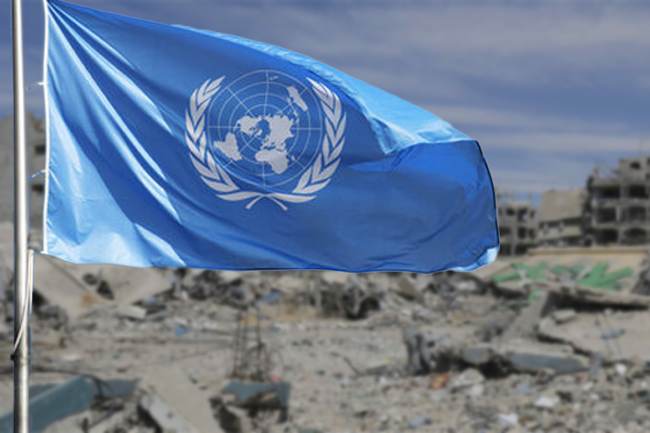
THE UNITED NATIONS General Assembly must activate its ‘Uniting for Peace’ mechanism to bypass the UN Security Council veto and establish an armed interventionary force to establish peace and end the genocide in Gaza.
Anyone who watches TV knows that genocide is happening in Gaza and millions of concerned people are marching in countries worldwide calling for an end to this abominable situation. The United Nations Human Rights Council has investigated the Gaza situation and confirmed, if there was any need to do so, that indeed Israel is committing genocide in its invasion of Gaza.
In its recently released report, the Council concludes that Israeli authorities ‘intended to kill as many Palestinians as possible’ and have committed the crime against humanity of extermination. The report cites direct targeting of civilians, including children and mass killings in ‘far larger numbers compared to previous conflicts’.
The report also found Israel deliberately inflicted life-threatening conditions by blocking food, water and medicine — actions "calculated" to bring about the ‘destruction of Palestinians’.

Attempts this month by the UN Security Council to demand an immediate and permanent ceasefire in Gaza and the release of hostages were blocked by the United States because they said the effort did not go far enough in condemning Hamas.
All 14 other members of the United Nations’ most powerful body voted in favour of the resolution, which described the humanitarian situation in Gaza as “catastrophic” and called on Israel to lift all restrictions on the delivery of aid to the 2.1 million Palestinians in the territory.
Unfortunately, the UN Security Council is structured in a totally undemocratic manner, which enables any one of the big five permanent members – the USA, Russia, China, France and the UK – to block a resolution passed by the other 14 members.
And this is just exactly what has happened this week. The USA has again vetoed action by the Security Council to address the disastrous humanitarian situation that has arisen in Gaza due to the Israeli military invasion.
There is, however, a solution. The UN General Assembly can act on its own when a resolution is blocked by the Security Council. And we are indebted to Craig Mokhiber, an international human rights lawyer and former senior United Nations official, for alerting us all to this mechanism.
Mokhiber explained recently:
Established by a Cold War-era resolution adopted in 1950, the Uniting for Peace mechanism authorises the UN General Assembly (UNGA) to act when the Security Council is blocked by the veto of one of its permanent members. Under this mechanism, the UNGA could mandate a UN protection force to deploy to Palestine, protect civilians, ensure humanitarian aid, preserve evidence of Israeli crimes, and assist in recovery and reconstruction.
Legally, there are no hurdles. The rules allow it, the UNGA’s Uniting for Peace power has been repeatedly affirmed, and there are precedents, most notably the UNGA’s mandating of the 1956 UN Emergency Force to the Sinai (UNEF) over the objections of the UK, France and Israel.
Once mandated, let the protection force be deployed by air, land and sea, accompanied by international media and supported by all diplomatic avenues to ensure its successful deployment and to press the regime and its Western backers to stand down. The world has a chance, belatedly, to stop a genocide and other crimes against humanity. All it needs is the will to do so.

In Australia, the Independent and Peaceful Australia (IPAN), in discussing this mechanism, has stated its support for an armed interventionist force for such a UNGA deployment, seeing armed as being essential, for their own defence.
IPAN has issued a media release headed ‘The Australian Government must act at United Nations meeting to support multinational intervention in Gaza’.
In it, IPAN’s spokesperson, Annette Brownlie, says:
It is clear that the Security Council is powerless to promote peace in Gaza and put an end to the genocide being carried out there.
The failure of this resolution should be the trigger for the United Nations General Assembly ‘Uniting For Peace’ mechanism to be activated as it bypasses a Security Council veto.
IPAN calls on the Australian Government to not only recognise the Palestinian state but to support such intervention and offer to supply ADF forces for this.
A Change.org petition to the United Nations is circulating internationally, calling for the UNGA to activate its Uniting for Peace mechanism to address the humanitarian distress in Gaza and establish peace.
It reads:
We demand the immediate deployment of a UN multinational armed protection force with the following mandate:
- to protect civilians from further violence and displacement;
- to ensure full, safe and sustained humanitarian access to food, water, shelter, energy and medical care;
- to assist in the initial stages of reconstruction to enable families to return to their homes and rebuild with dignity; and
- to preserve and secure evidence of potential war crimes, crimes against humanity and human rights violations to enable future accountability and justice mechanisms
You can sign this international petition HERE.
Bevan Ramsden is an ex-telecommunications engineer and a long-time peace activist who advocates for Australia’s independence. He was a member of the coordinating committee of the Independent and Peaceful Australia Network (IPAN) for a number of years and is the editor of its monthly publication, 'Voice'.
 This work is licensed under a Creative Commons Attribution-NonCommercial-NoDerivs 3.0 Australia License
Support independent journalism Subscribe to IA.


Related Articles
- Gaza's past preserved as present is destroyed
- The war on truth: How Israel is silencing Gaza’s journalists
- Gaza death toll far worse than reported in Western media
- Chris Minns and the Sydney Harbour 'Gaza Streisand effect'
- Chris Minns and the Sydney Harbour 'Gaza Streisand effect'