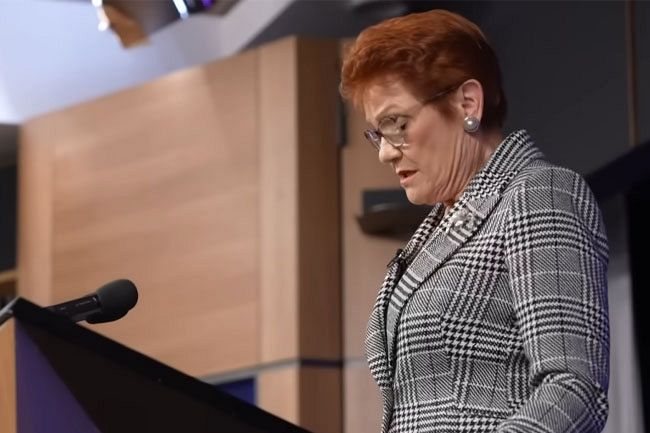
Pauline Hanson’s National Press Club speech raised real problems such as housing, energy costs and institutional distrust, but turned them into cultural blame, writes Rob Powell.
THE PROBLEM with Senator Pauline Hanson’s National Press Club speech, from a philosophical point of view, is not that it failed to raise real issues. It did. Housing is a significant problem for many people. Energy is getting too expensive and that is reality. Energy poverty is real. Distrust of institutions is real. Many Australians believe they have been ignored by politics.
The problem is that Hanson identifies real problems, then turns them into cultural blame.
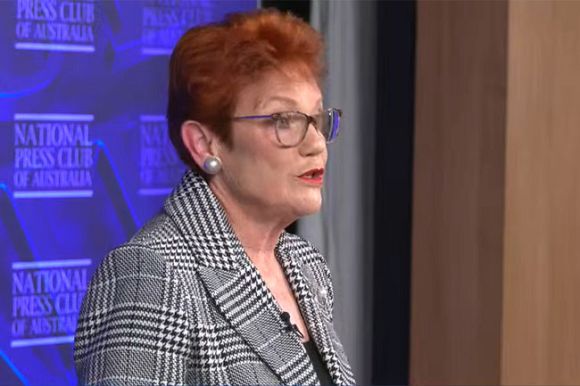
In her National Press Club speech, Hanson said Australia “must be monocultural”. The question, then, is where to place the philosophical criticism.
Hanson is not only proposing a migration policy. She is also making a statement about who belongs and who must conform. She seems to think Australia can be a multiracial country, but that one culture must dominate, with Australians living under “the one cultural umbrella”. This is not civic unity. It is cultural conformity.
A critique grounded in recognition theory, particularly the work of Axel Honneth and Charles Taylor, asks who is accepted as a full member of the political community and who is treated as the questioned other, the threat or the outsider.
Hanson’s words are not merely a description of the state of affairs in Australia. They imply a division among Australians. Some are treated as the natural owners of the country’s history, while others are depicted as conditional guests who may remain only if they comply.
Her words should therefore be interpreted as a politics of misrecognition. She gives one imagined version of true Australia a sense of worth, but at the same time denies equal worth to those who are culturally different in her eyes. Migrants, Muslims and transgender people are transformed into symptoms of the nation’s decline. They are not given the same status as existing real Australians, nor are their own voices, histories and experiences properly recognised.
This fails the standard of a decent society described by Israeli philosopher Avishai Margalit. For Margalit, a decent society is one whose institutions do not humiliate its members. Yet Hanson’s language politicises humiliation. When she makes multiculturalism central to Australia’s crisis, it is not merely a policy critique. It publicly identifies culturally different Australians as a problem to be solved.
A decent society ought to be able to discuss migration numbers, integration, housing and language without humiliating fellow citizens as threats to the nation.
Hanson also confuses unity with similarity. The philosophical alternative to monoculture is civic pluralism. Liberal pluralism, far from saying that anything goes or that a country does not need shared values, maintains that a shared civic life is possible without forcing everyone into the same culture.
A democratic society needs common laws, mutual obligation, freedom of conscience, equality before the state and basic respect. It does not need everyone to eat the same food, worship the same god, use only one language at home or perform the same version of Australianness handed down to them.
Here lies the distinction between civic nationalism and cultural nationalism. In civic nationalism, belonging is a matter of citizenship, participation, law and shared responsibility. In cultural nationalism, belonging is conditioned by conformity to a dominant cultural identity. Hanson’s language leads away from civic community and toward cultural purity. That is why her monocultural claim is so threatening. It presents itself as a defence of unity, but ends by excluding those it places under suspicion.
Her criticism of multiculturalism also operates by identifying a scapegoat. French academic René Girard’s scapegoat theory helps explain how socially pressured groups can blame an outsider to unite themselves.
Hanson links pressure on housing, rental scarcity and rising costs to immigration and multiculturalism, as if cultural difference itself caused the crisis. But migrants did not create negative gearing. Refugees did not underfund public housing. International students did not create decades of property speculation. These are political and economic failures. Turning structural failure into cultural accusation is what blaming multiculturalism comes down to.
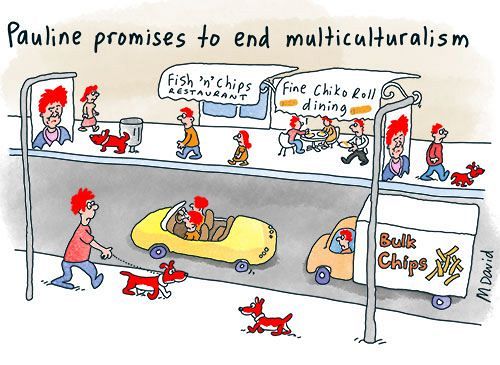
It is also a politics of ressentiment, in the Nietzschean and Schelerian sense. Ressentiment is not just ordinary anger. It is anger that cannot hit the real target of its hurt, so it creates a symbolic enemy. Hanson’s speech repeatedly addresses people who feel ignored, looked down upon and betrayed. That feeling is genuine. But the moral target is wrong.
Instead of asking who owns the assets, who benefits from scarcity, who designed the tax system, who profits from insecure work and who captured policy, Hanson’s discourse diverts pain onto migrants, Muslims, trans people, public broadcasters and bureaucrats. This does not amount to justice. It is displacement.
Hanson’s remarks on Islam are indicative of the same failure. A democratic society has the right to reject violent extremism, hate propaganda and anti-democratic politics. Yet in a liberal democracy, a clear line must be drawn between denouncing acts and making whole communities liable to a presumption of guilt.
When Hanson describes “radical Islam” as a menace to Australian values, the reasonable issue is extremism. But when that kind of language is surrounded by broader claims about immigration, culture and national identity, it risks putting Muslim citizens permanently on the defensive. That is not public safety. It is collective distrust.
Hanson’s term “transgender insurgency” is even more revealing. Regardless of what someone thinks about sport, schools, medical ethics or sex-based spaces, the term “insurgency” carries a strong implication. It militarises a minority. It portrays trans people and their allies as a hostile force operating inside the country.
That is not logical debate. It is moral panic. It inflates a small and vulnerable group into a threat to civilisation.
British philosopher Miranda Fricker’s concept of epistemic injustice is also relevant here. Hanson talks about trans people, migrants and Muslims as national concerns, but not as individuals with knowledge, citizenship or active roles in the dialogue. They are talked about as issues while their voices remain unheard.
Epistemic injustice happens when bias strips people of credibility or the authority to interpret their own lives. Hanson’s discourse carries out that act: it claims to be on the side of ordinary Australians while denying some Australians the very status of ordinary citizens.
French philosopher Michel Foucault’s notion of discourse and power is useful for revealing what is happening. Political speech is not just a mirror of reality. It creates categories of fear.
When Hanson uses terms such as “ideology”, “subversive”, “militant” and “insurgency”, she is doing more than putting forward policy options. She is laying the groundwork for a discourse in which certain people are imagined as poisons inside the national body. Her rhetoric fabricates enemies, then frames their removal as common sense.
Her anti-institutional stance is echoed in her climate and energy claims. To label climate policy the “hoax of global warming” goes beyond policy disagreement about energy. It rejects the idea that expert knowledge, scientific consensus and institutional evidence should help guide democratic decision-making.
German philosopher Jürgen Habermas’ concept of public reason is useful here. Democracy demands more than airing grievances. It demands arguments open to public scrutiny, testing, challenge and justification.
In Hanson’s speech, suspicion repeatedly takes the place of public reason. Experts are redefined as ideologues, public broadcasters as enemies, human rights institutions as captured and climate policy as a hoax. Such tactics weaken democracy by weakening shared reality.
Hanson’s plan for SBS and the ABC is no exception. Public media can and should be criticised. Yet to say “the SBS will be gone” is not simply a budget argument. It communicates whose stories warrant public space.
In a multicultural democracy, SBS stands for the idea that national life contains more than the majority voice. Getting rid of it under the guise of monoculture would not bring about unity. It would contract the democratic imagination.
Hanson’s artificial intelligence remarks, to her credit, were stronger. She acknowledges that “AI should not be left entirely to self-regulation”. She also recognises that AI could influence labour, privacy, safety, democratic participation and public trust.
But this only reveals the contradiction in the rest of the speech. If unchecked corporate and technological power can harm ordinary people, then why is the same critical eye not cast over housing markets, fossil fuel interests, political donations, media concentration and the tax privileges of the wealthy? Hanson can identify power when it is represented by AI, but she is often blind to it when power is represented by property, capital and class.
The final philosophical verdict is that Hanson’s speech is a politics of misrecognition, ressentiment and scapegoating dressed up as common sense. It starts with the genuine pain of people, but directs that pain at the wrong targets. It says it is standing up for the people, but defines the people too narrowly. It says it wants to bring the nation together, but ends up humiliating those labelled as culturally threatening.
Australia does not need monoculture. What it needs is civic pluralism. It needs a decent society where institutions do not degrade individuals. It needs public reason strong enough to distinguish evidence from fear. It needs recognition expansive enough to include working-class Australians, rural Australians, migrants, Muslims, trans people, Indigenous Australians and everyone else who is part of the country’s life.
Hanson is right that people are angry. She is wrong about where that anger should go. The real crisis is not multiculturalism. The real crisis is a political economy that leaves people insecure, then offers them scapegoats instead of justice.
Rob Powell is a retired mature-aged student currently studying politics and philosophy, focusing on how ethical frameworks shape public policy and political behaviour.
 This work is licensed under a Creative Commons Attribution-NonCommercial-NoDerivs 3.0 Australia License
Support independent journalism Subscribe to IA.


Related Articles
- No, Pauline, 63 per cent of Australians do not use candles
- CARTOONS: Pauline is playing up her populism
- Pauline Hanson, Joh Bjelke-Petersen and the IA story
- EDITORIAL: Pauline Hanson, Joh Bjelke-Petersen and the story of Independent Australia
- Hanson and the media: an unholy alliance of the ruling class