The March quarter national accounts confirm the Albanese Government is achieving its economic goals, as Alan Austin reports.
THERE WAS good news and bad news in last Wednesday’s quarterly report on the economy from the Bureau of Statistics (ABS). Positive news overwhelmingly outweighed the negative, despite newsrooms desperately trying to claim the opposite.
Growth in gross domestic product (GDP) for the quarter was 0.21%, which was below expectations and slightly below the average for the last five quarters of difficult adjustment after years of disastrous mismanagement by the Coalition.
Annual GDP growth was 1.34%, also below target, but the strongest since the December quarter in 2023.

Most of Australia’s growth was achieved in the private sector rather than via government spending, fulfilling one of Treasurer Jim Chalmers’ objectives.
The total income Australians have to spend, referred to as gross disposable income, hit a record high of $424.9 billion. That’s up 6.9% on last year’s March quarter and 13.2% higher than March 2023 and marks eight straight quarters of expansion.
Real net disposable income for each Australian resident increased this quarter to $18,423, confirming living standards have been restored for the majority.
That these outcomes were highly positive was confirmed when the ASX indices surged to all-time highs.
Australia leads the world
Significantly, Australia has recorded 14 consecutive quarters of positive quarterly growth and 17 straight quarters of annual growth — the only economy in the 38-member OECD to have achieved that status.
The dismal March quarter outcomes in most comparable countries underscore the global challenges, with war in Europe and international trade destabilised by the destructive stupidity of the Trump White House.
Countries with negative GDP growth were Sweden, Denmark, Norway, Japan, South Korea, Portugal, Luxembourg, Estonia, Latvia, Slovenia and, unsurprisingly, the USA.
Ten OECD members are now in negative annual GDP growth, including South Korea and Slovenia, which went backwards for the first time in more than four years.
After lagging badly through the Coalition years, Australia is now among the leaders on nearly all indicators of sound economic management.
Share of national income pie going to workers
As mentioned above, net national disposable income per person has increased slightly, but remains below levels recorded during and after the COVID conniptions from 2020 to 2022.
This does not mean all incomes are lower now than when this measure was higher. As explained here in April, the top deciles have taken a haircut while the vast majority of workers, retirees and pensioners are now much richer.
This is clear from data on the share of national income going to workers, contrasted with that going to company profits. This is found in table 7 of the national accounts, ABS file 5206. See chart below.
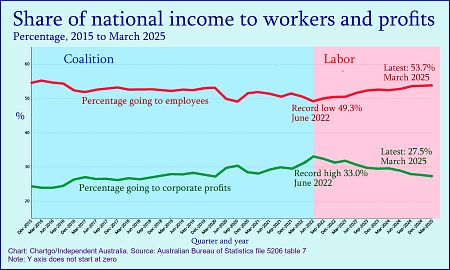
In the dying days of the failed Morrison Government, workers were allocated less than 50% of the nation’s total income. That was down from above 60% in earlier periods. That percentage has increased steadily since the 2022 change of government, reaching a nine-year high of 53.71% in the March quarter.
Conversely, the share going to company profits surged under the previous Coalition and is now being restored to fairer levels.
The significance of this chart is that it explains graphically how it is that the vast majority of Australians are now enjoying a remarkable consumer spending boom, while the national income per capita is not surging, but remains steady.
Productivity reassessed
All critics of the Albanese Government routinely lament productivity, which has stalled between 98 and 101 index points since 2016, except for a brief spurt during the COVID disruptions.
Treasurer Chalmers acknowledged this in his first interview after Labor’s extraordinary election victory last month:
“...first term was primarily inflation without forgetting productivity, the second term will be primarily productivity without forgetting inflation.”
Complicating the productivity debate is the reality that Australia has greatly expanded its provision of care for people with disabilities and illnesses, both at home by family members and in external facilities. Much of this is highly valuable work that greatly improves lives and extends life expectancy. But when no money changes hands, it is not measured by the national accounts.
The Bureau of Statistics has announced it will publish estimates of labour productivity for the total non-market sector, starting in September.

The ABS said:
‘For a variety of conceptual and practical reasons, this is a challenging part of the economy to measure.’
Indeed. We shall soon see if this shifts the discussion significantly.
Media continues to manipulate and mislead
The latest attempt by the Australian Financial Review (AFR) to attack the Government unfairly was in last Thursday’s essay by a senior writer titled, ‘We’re told Australia’s economy is world-beating. The data shows it’s not’.
It claims:
‘The Treasurer said no major advanced economy could boast unemployment in the low-4s, inflation below 2.5% and three years of continuous economic growth. Perhaps the Treasurer’s international counterparts were just being polite.’
In fact, Chalmers is entirely correct. The AFR failed to identify any country matching Australia’s outcomes.
The AFR focused primarily on real GDP per person, which it claimed is a proxy for living standards and which fell 0.5 per cent last year:
‘That was the fourth-worst outcome across advanced economies with available data.’
Two problems here. First, as explained above and elsewhere, although overall GDP per person declined slightly, the majority enjoyed higher living standards by virtue of the substantial shift in incomes from the very rich to the middle and the poor.
Second, that is only one of multiple key variables.
How much better-informed, happier and more confident would Australians be without the AFR? And how much more productive?
Alan Austin is an Independent Australia columnist and freelance journalist. You can follow him on Twitter @alanaustin001.
 This work is licensed under a Creative Commons Attribution-NonCommercial-NoDerivs 3.0 Australia License
Support independent journalism Subscribe to IA.


Related Articles
- Australia's failure to sanction Israel a diplomatic and moral abdication
- Republic should be top priority for Albanese re-election
- Economic growth slows, incomes surge and Coalition hypocrisy hits new high
- Australia sets impressive trade records which newsrooms refuse to report
- ‘Labor big spenders’ myth can finally be laid to rest