While the economy recorded its best year ever in 2025, life dissatisfaction hit a new low, as Alan Austin reports.
PERHAPS WE NEED a name for this syndrome. It is an intriguing phenomenon, but also deeply troubling, as it reveals declining mental health.
As Australians achieved their highest material living standards ever last year, their enjoyment of life and community engagement, as assessed by the Bureau of Statistics (ABS), plummeted.
As discussed early last year, Australians have the best life of anyone on the planet, based on objective criteria, but ranked a miserable tenth on Oxford’s Happiness Index. In this year’s rankings, Australians tumbled to 15th.

Highest living standards ever
We now know 2025 was the first time on record that Australians achieved these four excellent outcomes simultaneously over a full year:
- jobless below 4.5%;
- inflation below 4%;
- interest rates between 3% to 5%; and
- annual GDP growth above 2.5%.
Australia was the only country in 2025 to enjoy those four outcomes plus triple A ratings with all major credit agencies. Denmark, Norway, Saudi Arabia, Israel and Vietnam ticked four of those five boxes, but only Australia ticked all five — in the world!
Datasets confirming the best-ever quality of life include:
- record number of overseas flights: 12.55 million;
- median wealth second highest in the world: US$268,424 (AU$370,137);
- record percentage of students attending fee-paying private schools: 37.2%;
- record home loans: $383.5 billion;
- record consumer spending to GDP;
- record percentage of retail spending on dining out: 13.8%;
- record consumer spending on cosmetics, jewellery and other luxuries;
- record sales of electric cars;
- record single and twin-engined light aircraft registered;
- record high jobs to population: 64.6%;
- record minimum wage, pensions and benefits, all up more than inflation; and
- record families in social housing: 429,212.
Life satisfaction in severe decline
According to last Tuesday’s ABS general social survey results, life satisfaction in 2025 was well down on 2019, when Australia’s economy was close to the worst-performed among OECD members.
Overall life satisfaction in 2019 was rated high or very high by 77.6% of the population. That plummeted to 68.3% in 2025. Only 6.2% of citizens experienced low life satisfaction in 2019. That jumped to 9.7% in 2025.
Yet, as the International Monetary Fund (IMF) reported last month, on overall budget balance, Australia ranked last among developed nations in 2019. The economy trailed badly then also on economic growth, government debt, global innovation and the jobless rate.
Mainstream newsrooms continue to foment fear and anxiety
The problem, of course, is that most Aussies have no idea how well they are travelling relative to past periods and to the rest of the world.
The news media steadfastly refused to report last year’s impressive results, claiming instead that the Australian dream was ‘dead’, monetary policy was a ‘horror scenario’ and a ‘failed experiment’ haunting Australia, whose very ‘survival’ is at stake, and the economy was a ‘nightmare’, a ‘crisis’ and a ‘dire reality’.
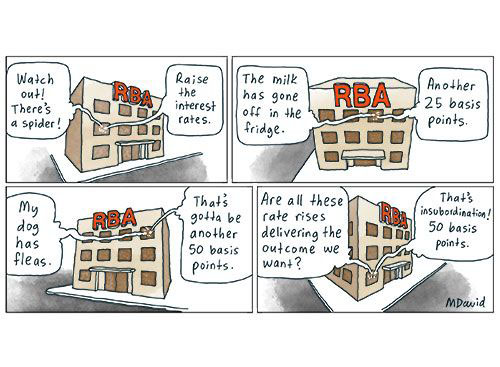
Last week’s jump in the interest rate provided another example.
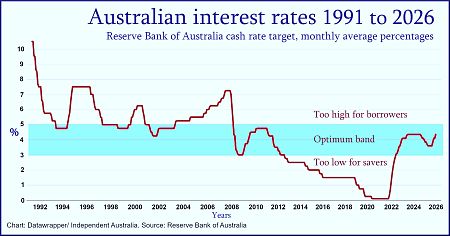
Interest rates are finally climbing towards 5%, offering relief to long-suffering savers who rely on interest to survive, but have been denied a fair go since 2013.
Interest rates are now smack in the middle of the optimum range, 3% to 5%, which balances the needs of both savers and home buyers. See chart below.
Newsrooms distort the reality
The RBA’s decision should have been welcomed as an inspired outcome. It dampens the risk of inflation accelerating while disadvantaging neither borrowers nor lenders. Win-win-win.
Instead, it was depicted as ‘brutal’, ‘disastrous’, ‘risking recession’, ‘another blow’ and ‘pouring petrol on the inflation fire’.
The Murdoch tabloids said: ‘We’re inching closer to the recession we didn’t need to have’. ABC News falsified the record with: ‘Opposition blames Labor for inflation, rate hike’. Sky News, fuelling Australia’s deteriorating mental health, declared: ‘People are giving up hope’. Absolute destructive nonsense!
Yes, mortgagees will now pay more. But they can negotiate the repayment schedule to avoid hardship and will eventually recover more than the extra outlays via the associated increase in property values.
Abundant evidence that all is well
The RBA’s report last Tuesday contained remarkably upbeat forecasts, given the global turmoil resulting from the madness of U.S. President Trump’s kleptocracy.
GDP growth is expected to be 1.9% this financial year and 1.3% in the next. Yes, that’s historically weak, but nowhere near a recession.
Inflation is forecast at 4.8% for June this year and just 2.4% at June next year. Given inflation varied between 7.5% and 18% for most of the period from June 1973 to June 1990, that is extremely benign.
Surprisingly, the jobless rate, which is now 4.26%, is expected to be 4.2% this June and 4.4% in June 2027.
All these compare favourably with the rest of the world.
In fact, Australia’s inflation rate since January has risen just 0.73%. The increments have been above 1% in Austria, Finland, Portugal, Poland, Turkey and Chile; higher than 1.8% in France, Italy, Luxembourg and the USA; and above 2.8% in Belgium and Greece.

Supportive behaviour impacted
Last week’s ABS social survey shows that Australians' engagement in the community has declined sharply as wealth has increased and misery has advanced.
Citizens who undertook unpaid voluntary work fell from 29.5% in 2019 to 22.6% in 2025. Those who provided unpaid support for non-household members dropped from 51.5% to 45.4%. Participants in community support groups slipped from 25.3% to just 20.7%.
Disturbingly, face-to-face contact with family or friends living outside the household tumbled from 67.8% to just 52.9%.
So Australians are not just more despondent but also less practically helpful.
Newsrooms telling the truth would fix this. Now, there’s a happy thought.
Alan Austin is an Independent Australia columnist and freelance journalist. You can follow him on Twitter @alanaustin001 and Bluesky @alanaustin.bsky.social.
 This work is licensed under a Creative Commons Attribution-NonCommercial-NoDerivs 3.0 Australia License
Support independent journalism Subscribe to IA.


Related Articles
- Farmers are anxious, but still in a pretty good paddock
- Global agencies give Australia’s economy thumbs up
- Boycott newsroom liars and restore Australia’s absent self-assurance
- Specialists refuse to correctly diagnose best economy ever
- No longer true that the rich keep getting richer as the poor get poorer