As job losses, inflation and weak growth impact many economies, Australia advances apace, as Alan Austin reports.
AMONG THE LATEST global institutions to commend prime manager Anthony Albanese and his chief accountant Jim Chalmers are the International Monetary Fund (IMF), Knight Frank and Standard & Poor’s (S&P).
International property consultants Knight Frank released its 20th annual wealth report last Thursday and singled out Australia for special mention. After years of sluggish growth in wealth and income, prosperity is now increasing steadily.
Surge in personal wealth
Australians with wealth above $30 million are forecast to increase by almost 60% over the next five years, to a total of 26,095 — nearly one in every 1,000 residents.
Australia’s booming affluence, according to Knight Frank:
‘...reflects more than just rising asset prices. It speaks to a broad -based, resilient economy anchored in agriculture and mining, and increasingly powered by finance, business services and a fast-maturing technology sector.’
Those engines have created a depth of wealth that now outstrips most comparable economies, with the billionaire population forecast to grow by a staggering 77% between 2026 and 2031. That increase in billionaires, if it eventuates, will be the world’s fourth-highest. The top three are Saudi Arabia, Poland and Sweden.
The report concludes:
‘In a world where wealth is becoming more mobile, Australia stands out for the diversity and durability of its wealth creation story.’
Also important in wealth creation, of course, is the distribution of that largesse across all percentiles. Knight Frank offers no data on this, but the annual UBS Global Wealth Report does. Due mid-year, we await that with interest.
City house price rises moderating
A valuable section in Knight Frank’s report is its annual PIRI 100 – the prime international residential index – which ranks the world's richest cities by rate of increase in property values.
Last week’s update showed Sydney has fallen from ranking 30th in the world in 2018 to 78th in 2026. This does not mean values have declined, just that the rate of increase has moderated. This is most encouraging.
Brisbane is down from 31st to 54th. Melbourne has tumbled from 41st to 84th, and the Gold Coast has slipped from equal 42nd to 48th. Perth, in contrast, has risen from equal 42nd to 37th.
IMF confirms Australia’s ascendancy
Treasurer Chalmers was keen to highlight the positive data in this month’s biennial Fiscal Monitor from the International Monetary Fund. Well, he might, given the refusal of most Australian newsrooms to report anything which might drag consumer and business confidence out of the cellar.
Headed ‘Australia now top three in G20 budget rankings’, the Treasurer’s media release claimed that the IMF shows Australia ‘has surged up global rankings for best budget management to have one of the three strongest budget balances in the G20, up from 14th under our predecessors’.

A note on country comparisons
Those observations are accurate and quite valid, given Australia is a member of the G20. That contrasts with the previous hapless Coalition governments, which made deceptive comparisons with the G7, of which Australia was not a member.
This column, however, prefers OECD members for comparisons, as these are 38 developed countries with mixed capitalist economies and mostly liberal democracies. The G20 is a smaller group which includes developing nations Indonesia, India and South Africa, and single-party states Russia, China and Saudi Arabia. We will also focus on past and present results rather than speculative forecasts.
With any grouping, however, results are far more positive today than at any time since the Rudd/Gillard years.
Key IMF findings for 2026
The Fiscal Monitor’s principal listing comprises 30 highly advanced OECD members with which comparisons are instructive. It excludes developing countries Costa Rica, Colombia and others, and the USA, for which reliable data has been unavailable since the Trump Administration replaced its professional statisticians with lackeys.
Growth in Australia’s GDP is projected to be 2% this year, ranking equal seventh among those 30 economies. That’s up from 21st in 2019 and 22nd in 2021.
On overall budget balance, Australia ranks 13th, up from 30th in 2019 — dead last!
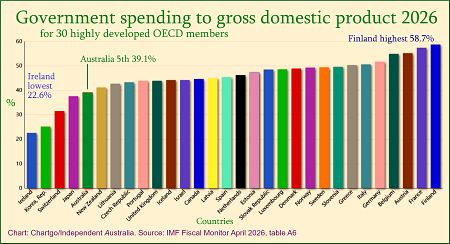
This has been achieved by stronger government revenue and controlled spending. Australia’s spending is 39.1% of GDP, well below the OECD average of 45.4%, thus undercutting mendacious newsroom claims that Labor is a spendthrift administration.
Ranking this year is fifth in this group of 30, up from ninth in 2019. See chart below.
Australia’s gross debt to GDP ranks 12th in this group, up from 14th from 2020 to 2022, having snuck ahead of New Zealand and South Korea.
Credit ratings news
In a positive signal from ratings agency S&P, Australia’s composite purchasing managers' index (PMI) jumped from 46.6 in March to 50.1 in April. The PMI measures the performance of the private sector each month by combining data from both manufacturing and service industries.
According to Trading Economics, export orders continued to grow, but only modestly, helped by sales to North America, Asia and New Zealand. Employment growth picked up, allowing companies to reduce backlogs.
Relentless negative press
Meanwhile, the mainstream newsrooms continue to ignore most positive outcomes. Recent alarmist headlines, most with highly misleading content, include:
- ‘Economic nightmare just weeks away’ (The West Australian, 20 April 2026);
- ‘Australia’s inflation time bomb: why the worst is yet to come’ (AFR, 23 April 2026);
- ‘Aussies face weeks of tough economic news’ (Herald Sun, 25 April 2026);
- ‘We won’t last six months’: Aussie trucking industry faces wipe out’ (Courier Mail, 15 April 2026); and
- 'Complacent market drifts lower as economic outlook sours’ (ABC News, 17 April 2026)
That’s Australia. Rich in talent, enterprise, capital, resources, property and overall wealth. Extremely poor in news and data analysis.
Alan Austin is an Independent Australia columnist and freelance journalist. You can follow him on Twitter @alanaustin001 and Bluesky @alanaustin.bsky.social.
 This work is licensed under a Creative Commons Attribution-NonCommercial-NoDerivs 3.0 Australia License
Support independent journalism Subscribe to IA.


Related Articles
- Boycott newsroom liars and restore Australia’s absent self-assurance
- Specialists refuse to correctly diagnose best economy ever
- No longer true that the rich keep getting richer as the poor get poorer
- Rejoice! Some fabulous surprises in the latest economic news
- Australia rejoins the global economic elite