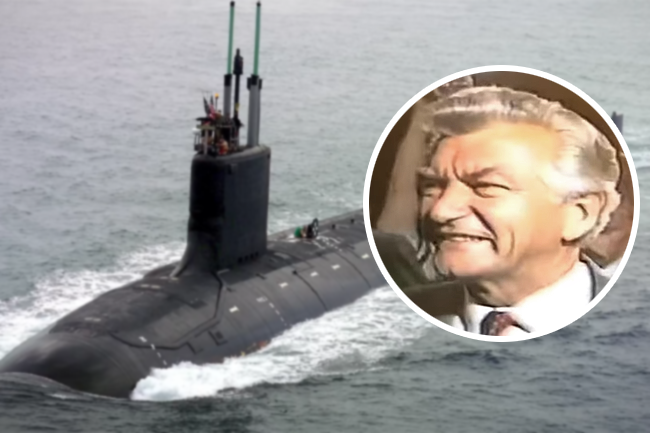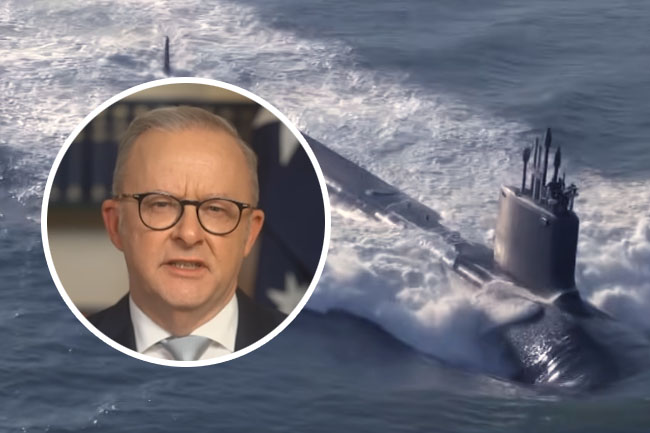
Our new series, WARFARE TO WEALTH, is a progressive critique of the Federal Government's defence and foreign policy trajectory. It provides in-depth analysis of Australia's $368 billion AUKUS commitment and the broader militarisation of our economy.
It is timed to precede the ALP national conference (23-25 July) – which will shape the Government's policy platform and strategic direction for at least the next two years – in the hope that, along with growing pressure from the broader community, the arguments against this militarisation may be compelling enough to make their mark.
This article is part seven of the series, From Warfare to Wealth: Redirecting Australia's Future. You can read the other chapters in this series HERE. The next chapter will be published soon.
Part 7: The 1984 warning: Why the AUKUS debate cannot be silenced
Looking back at Labor's 1984 U.S. alliance battles, it's more important than ever the party does not silence grassroots dissent on AUKUS as Australia confronts a far more uncertain strategic future, writes David Higginbottom.
IN THIS INSTALMENT of our Warfare to Wealth series, we examine a pivotal moment in Labor history when the party leadership shut down a grassroots revolt over the U.S. alliance.
Today, as the party enforces discipline around an AUKUS submarine program estimated to cost $368 billion, the strategic stakes are vastly higher.
The year was 1984. George Orwell’s Nineteen Eighty-Four had become shorthand for a society in which language was manipulated, dissent contained and official orthodoxies made to appear inevitable. In Australia, the reality was less dystopian, but the political echo was unmistakable.
At that time, Australia was witnessing a massive, organic uprising against the nuclear arms race and the deepening integration of the Australian continent into the United States’ nuclear war-fighting apparatus. The Palm Sunday peace rallies had grown to include hundreds of thousands of citizens. Yet the Hawke Government had steadily retreated from its earlier anti-uranium policies and remained firmly committed to the American alliance.
When the ALP National Conference met in July of 1984, the party leadership enforced alliance orthodoxy. Rank-and-file efforts to withdraw from ANZUS, close facilities like Pine Gap and ban nuclear-powered ship visits were defeated after bitter debate. The leadership stood firmly by the U.S. alliance, offering only a minor qualification to prevent the de facto home-porting of American naval vessels. It was a demonstration of executive control over a party desperate for a more independent foreign policy.
Clinging to the old playbook of unquestioning alliance loyalty is no longer just democratically risky; it is strategically reckless.
The lesson of 1984 is stark: when party leadership enforces rigid adherence to the U.S. alliance against mass grassroots opposition, the dissent fractures the progressive vote.
Today, the ALP faces a remarkably similar grassroots revolt over an AUKUS submarine program estimated to cost $368 billion, the expansion of facilities for rotational U.S. bomber deployments and the lack of parliamentary control over war powers. We are once again hearing the political language Orwell warned against — phrases like “strategic certainty” and “interoperability” used to disguise dependence, loss of sovereign choice and staggering opportunity costs.
However, the strategic reality of 2026 is fundamentally different from the Cold War certainty of 1984. Clinging to the old playbook of unquestioning alliance loyalty is no longer just democratically risky; it is strategically reckless.
The erosion of American primacy
In 1984, the United States was a confident superpower engaged in a binary struggle with the Soviet Union. Today, we are witnessing the undeniable erosion of uncontested U.S. primacy and the painful birth of a more multipolar global order.
The illusion of American predictability was shattered during Donald Trump’s first presidency and the intervening years have only deepened the structural unreliability of Washington.
The “America First” doctrine is not a temporary aberration; it is a permanent feature of the modern Republican Party. Figures like Vice President JD Vance have positioned themselves as the ideological heirs to this movement, championing a selective, transactional approach to foreign commitments that treats allies as liabilities rather than partners.
While the United States remains the world's predominant military power, assuming that Washington will seamlessly and selflessly underwrite Australian security in perpetuity is a dangerous fantasy. We are integrating our most sensitive military capabilities – at the cost of hundreds of billions of dollars – with an empire in relative decline, whose domestic politics are increasingly erratic and inward-looking.
We are pouring our national wealth into nuclear-powered submarines designed to project force against the very nation that underwrites our standard of living.
The China reality
The contrast between the Cold War threat of 1984 and the economic reality of today could not be sharper. The Soviet Union was a genuine ideological and military adversary with which Australia had negligible economic ties. Today, the primary target of the AUKUS pact is China.
Yet China is Australia’s indispensable trading partner. It accounts for one-quarter of our total goods and services trade, valued at a staggering $326 billion, and takes nearly 30 per cent of our global exports. Our national prosperity, the funding of our hospitals and the transition of our energy grid are all heavily dependent on this economic relationship.
We are pouring our national wealth into nuclear-powered submarines designed to project force against the very nation that underwrites our standard of living. It is a profound failure of statecraft, substituting military posturing for the hard, necessary work of regional diplomacy and conflict prevention.
A choice for the 2026 Conference
When delegates gather at the Adelaide Convention Centre from 23 to 25 July for the 2026 ALP National Conference, they must look back at the ghost of 1984.
They have the power to demand that the Government redirect our national wealth from warfare to human security. They can insist that the decision to go to war must rest with the Parliament, not the unchecked executive. They can refuse to rubber-stamp the militarisation of our economy and the surrender of our strategic independence.
It is time to choose genuine independence over the illusion of alliance security.
David Higginbottom is a member of the coordinating committee of the Independent and Peaceful Australia Network (IPAN) and coordinator of the Make Peace A Priority campaign (mpap.au).
This article is the seventh in a multi-part series, FROM WARFARE TO WEALTH, examining the real costs of our current defence trajectory and exploring the alternatives proposed by the Make Peace a Priority (MPAP) campaign.
Read the other chapters in this series:
 This work is licensed under a Creative Commons Attribution-NonCommercial-NoDerivs 3.0 Australia License
Support independent journalism Subscribe to IA.


Related Articles
- FROM WARFARE TO WEALTH — The path to peace requires investment in conflict prevention
- FROM WARFARE TO WEALTH — Why parliament must decide before Australia goes to war
- FROM WARFARE TO WEALTH — The AUKUS illusion and the death of statecraft
- FROM WARFARE TO WEALTH — The myth of American idealism
- FROM WARFARE TO WEALTH — Australia's struggle for strategic independence