This is the anonymous story of a survivor of domestic violence who sought help — and was met with disbelief, negligence, and institutional failure at nearly every turn.
* CONTENT WARNING: This article discusses domestic violence
IN NOVEMBER 2024, I fled my home in fear for my life. I was the victim of repeated physical and sexual abuse, coercive control and threats, including threats to fabricate domestic violence allegations against me, and threats that I would be assaulted or killed by members of an ethnic minority community.
These calculated acts of intimidation were used to instil terror, assert control and threaten my liberty.
Her motive, I later discovered, involved a calculated visa fraud scheme, coached by a so-called “immigration agent”. I now understand that some migrants are instructed to manipulate pathways to residency by fabricating domestic violence claims against Australian citizens.
When I turned to the police, I expected help. I received something else entirely.

Institutional neglect and gender bias
Police failed to properly investigate my report. The officers conducted only a cursory desk interview, denied me the opportunity to share evidence – including text messages, photos and CCTV footage – and formally closed the case within minutes of interviewing my ex-partner.
I was not interviewed by the officers responsible for my case and was not given the opportunity to make a formal written statement. They failed to allow witnesses to be presented. I was terrified for my physical safety and liberty, yet my pleas for protection were dismissed.
Attempts to retrieve crucial CCTV footage were delayed for months. By the time police attended the café where the assault occurred, the tape had been wiped. Despite this failure, they refused to reopen the investigation. When I raised these concerns with the Professional Standards Office, I received only “mail-merge” denials. There was no indication of any genuine review.
The Law Enforcement Conduct Commission (LECC) likewise failed to act. Though its mandate includes investigating systemic misconduct and bias, they declined to open an inquiry even when provided with extensive documentation.
Legal misrepresentation and systemic dismissal
Hiring a criminal lawyer offered no reprieve. Instead of recognising me as a victim of abuse and acting accordingly, my lawyer emphasised my “right to silence” and refused to allow me to provide a brief of the facts.
This conduct left me silenced and critically unrepresented. The failure to act on instructions, including securing exculpatory evidence, may amount to negligence. I await a review from the NSW Legal Services Commissioner (OLSC), who also rejected my initial pleas for assistance and has so far taken no disciplinary action against the lawyer in question.
This experience also exposed a deeper conflict of interest embedded within defence law practice. Lawyers often gain little from the early resolution of false allegations, especially when the facts clearly support a client’s innocence. Instead, there can be disproportionate financial and reputational rewards in pursuing a “Perry Mason moment” in court. Muddying the pool of cases keeps the courtroom guessing, which benefits those representing guilty clients.

As author Upton Sinclair famously observed:
“It is difficult to get [a person] to understand something when [their] salary depends upon [their] not understanding it.”
Psychological and physical toll of systemic neglect
This experience left me not only emotionally distressed but physically broken. Over a period of eight months, I was diagnosed with heart failure and admitted to hospital six times for stress-related conditions. The compounded trauma, from the abuse itself to the institutional invalidation, drove me to the edge of suicide.
What began as a plea for help became a fight for survival on every front. The system didn’t just fail me; it nearly cost me my life.
Policy reform and the way forward
Having previously worked in public policy, I offer several recommendations for reform:
- In cases of “crossing allegations”, police must investigate both parties’ claims independently and without bias. No party should be dismissed without thorough inquiry.
- All Professional Standards’ responses must transparently list the evidence reviewed. Mail-merge denials must be replaced with accountable documentation.
- LECC must clearly state which materials it relies on in its decisions and provide justifiable reasoning when declining to investigate.
- Defence lawyers must be legally required to hear a client’s version of the facts if requested. The right to silence must not be misused as a gag order.
- Clients must have the right to provide a factual brief to their lawyer after receiving any appropriate warnings from their lawyer. Legal advice should be informed by the facts, not by strategic ambiguity or the lawyer’s business considerations. Lawyers simply must find a way to have these difficult conversations with their clients.
- Gender bias training across all institutions involved in domestic violence and legal response must be strengthened and independently evaluated.
- The loophole in Australian immigration law that incentivises false domestic violence reports must be closed. This vulnerability not only undermines genuine survivor protections, it exposes the system to exploitation and erodes public trust.
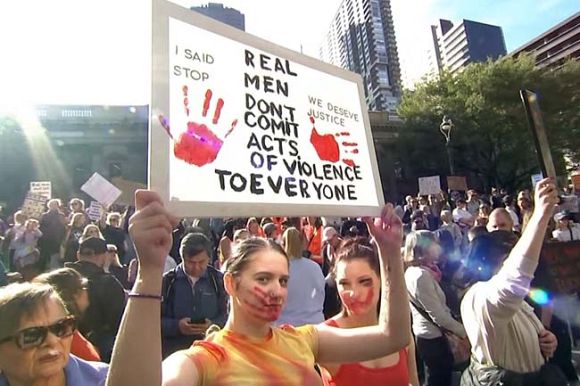
A call to conscience and a step toward reform
This account is not about undermining the importance of protecting female victims; the statistics show women are disproportionately impacted by domestic violence. But justice must serve all victims. Dismissing a male complainant without investigation is not just negligence — it is systemic abuse.
Anonymity is necessary to protect myself from further harm. But I share this story in hope: hope that someone will listen, that systems will change, and that survivors of all genders can find justice without being revictimised.
Only months later did I find a police officer willing to listen. For the first time, I was given the opportunity to present the full breadth of evidence supporting my account. But I fear what fate would have awaited me had I not been able to document my case so thoroughly.
If the institutions meant to protect victims continue to fail them, the consequences extend far beyond those individuals. Some, like myself, may be driven to the edge of suicide. Others may commit acts of desperation that hurt not only themselves, but those around them.
This is not to excuse such outcomes, but to recognise the role that systemic neglect plays in escalating harm. Prevention begins with accountability, empathy and reform.
If this article has raised any issues for you, contact Lifeline on 13 11 14 or 1800RESPECT on 1800 737 732 or online at 1800RESPECT.org.au
 This work is licensed under a Creative Commons Attribution-NonCommercial-NoDerivs 3.0 Australia License
Support independent journalism Subscribe to IA.


Related Articles
- Healthy masculinity key to solving DV
- Violence against women a global scourge
- Violence against women: The toxic culture of weaponised victimhood
- Calls to address domestic and family violence met with more words
- The bipartisan problem of women dying because 'good blokes' get angry