
You picked an HR system when the team was 200 people. Now you're heading toward 1,500 across three states, payroll runs span half a dozen Modern Awards, and the platform that once felt tidy can't keep up.
Inevitably, the project nobody wants lands on the desk: a full migration, fresh data mapping, retraining every manager, and a year of risk. That re-platforming tax is the quiet cost most growing Australian businesses pay. It's also the exact problem the best HRIS software in Australia for mid-size and large companies should remove rather than create.
The right platform carries you from a couple of hundred staff to several thousand on the same foundation. It keeps one source of people data, plugs into the tools you already run, and works on a phone in a warehouse as well as it does on a laptop in head office. This list ranks ten systems against that bar, with honest limitations and Australian compliance front of mind, so you can shortlist without guessing.
How we evaluated the best HRIS software for Australia
Each system here earned its place on five practical measures: whether one connected core scales from about 200 to 5,000-plus employees without a rebuild, the depth of the integration marketplace, mobile-first usability for everyday staff, how it handles Australian payroll obligations like Single Touch Payroll and superannuation, and documented user sentiment from G2 and Capterra. Pricing reflects what vendors publish or what users report, since several keep figures behind a demo request.
1. HiBob: Best for scaling on one connected core
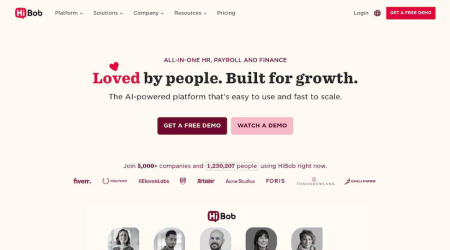
Bob is built for the awkward middle that catches most Australian companies off guard, the stretch where a few hundred employees become a few thousand and the old system starts to crack. Its answer is Bob Core, a single connected layer holding unified people data, role and skills context, and live dashboards that every other module reads from. Because the data sits in one place, you add headcount, sites, and entities without a second platform or a migration each time the org chart changes.
The integration marketplace is the second reason it sits at the top. Bob ships open APIs, single sign-on, and attribute-based sync that pushes a change in one record out to every connected tool. For Australian payroll, the Payroll Hub connects local providers through no-code setup wizards, so Single Touch Payroll reporting and superannuation run through systems that already understand ATO rules while Bob stays the system of record. Slack, LinkedIn, and Google Calendar connect in the same way.
Third is the interface itself. Bob is mobile-first, and managers approve leave or check a team snapshot from their phone while frontline staff update details and read payslips without raising a ticket. The daily adoption shows in a G2 score of 4.5 across more than 1,800 reviews.
Key features: Bob Core unified people data, marketplace integrations and open API, mobile-first self-service, attribute-based sync, real-time dashboards.
Pros: One core scales from mid-market to several thousand staff with no re-platforming; deep integration marketplace; high daily adoption from a modern interface.
Cons: Bob doesn't publish pricing, so buyers request a quote through sales, and the modular suite structure means advanced talent or planning capability sits in add-on suites beyond Core.
Pricing: Quote-based; Core is the required foundation, with Talent, Payroll, and HR Planning suites added as needed.
Rating: G2 4.5 / 5 (1,800-plus reviews).
2. ELMO: Best for a familiar all-in-one suite
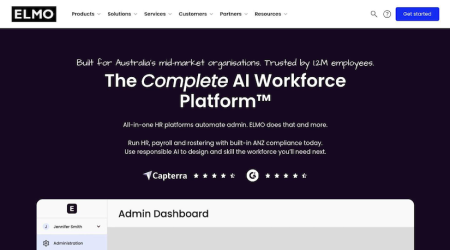
ELMO is an ANZ-built suite that bundles HR, payroll, recruitment, and learning under one contract, which makes it a default shortlist name for Australian buyers who want local payroll and compliance handled in-region. Its strength is breadth at a fair price for organisations that prefer one vendor over a stack of specialists.
The trade-off shows as you climb the size curve. ELMO leans toward SMB and lower mid-market expectations, and larger teams that want deep workflow configuration or richer analytics can find the modules more rigid than a modern core. Buyers report the suite feels traditional next to newer platforms, so test whether it stretches to where you're heading rather than only where you sit today.
Key features: Local ANZ payroll, recruitment, learning management, performance, onboarding.
Pros: Australian-built with local compliance baked in; single-vendor suite; competitive pricing for mid-market.
Cons: Skews toward smaller organisations and can feel SMB-oriented as headcount and complexity grow.
Pricing: Quote-based, scaled by employee count and modules.
Rating: Capterra 4.5 / 5.
3. Rippling: Best for unifying HR with IT
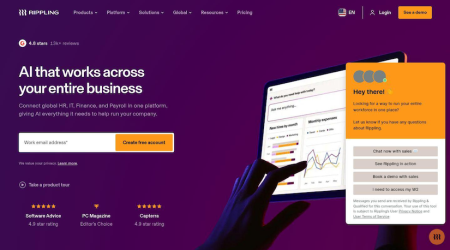
Rippling pulls HR, payroll, IT, and device management into one workforce platform, and its automation engine is the headline act: onboard a new hire and the system can trigger app access, hardware provisioning, and payroll setup in a single flow. For Australian companies running lean operations teams, that cross-departmental wiring saves real hours.
Two cautions matter here. The HR side can feel like a junior partner to the IT and device story, so teams focused on engagement and employee experience may find it thinner than they want. Reviewers also flag a steep learning curve, with one noting the platform "can sometimes feel overwhelming for new users" given how many modules and settings it carries. Smaller HR teams should budget for the ramp.
Key features: Unified HR and IT, automated onboarding workflows, device management, global payroll, app provisioning.
Pros: Powerful automation across departments; single source of truth for employee data; fast payroll processing.
Cons: HR feels secondary to IT, and the breadth of features makes it overwhelming for smaller teams during setup.
Pricing: Starts around AUD 12 per user per month; modular add-ons raise the total.
Rating: G2 4.8 / 5.
4. Employment Hero: Best for Australian small and growing teams
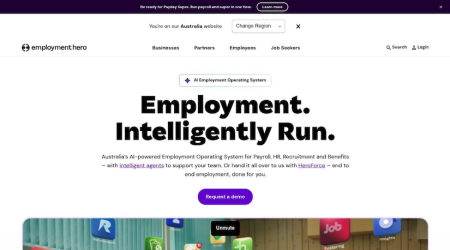
Employment Hero is one of the most recognised HR names in Australia, with payroll, HR, and benefits built around local rules and a generous free tier that gets small teams started fast. Award interpretation, Single Touch Payroll, and super are native rather than bolted on, which is why so many smaller Australian businesses begin here.
The fit loosens as you scale. The platform is tuned for small and lower mid-market organisations, and larger companies with complex structures, multi-entity reporting, or sophisticated talent needs can outgrow it. If you're already past a few hundred staff and accelerating, weigh whether it has the configuration depth for where you'll be in two years.
Key features: Native Australian payroll and award interpretation, employee benefits, onboarding, HR compliance.
Pros: Built for Australian compliance; strong free entry tier; wide local brand recognition.
Cons: SMB-oriented, so it can feel limiting for larger organisations with complex reporting and talent requirements.
Pricing: Free starter tier; paid plans quote-based by module.
Rating: G2 4.5 / 5.
5. BambooHR: Best for a clean core HR experience
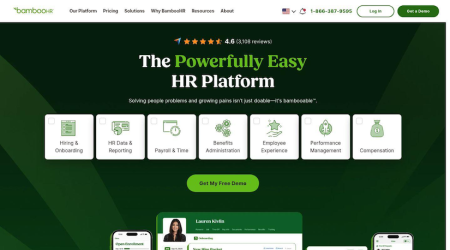
BambooHR earned its reputation on a clean interface and painless onboarding, and that holds up: employees navigate it with almost no training, and the self-service app handles leave, directory lookups, and PTO from a phone. For mid-market teams that want core HR and onboarding done well, it's a comfortable pick.
Limits surface in three places that matter at scale. Reviewers describe customisation and reporting as rigid, with one calling it harder than expected to pull "highly customised reports or more complex data analytics." To run payroll, you pay extra for a bolt-on module shaped around US employees, which leaves a real gap for an Australian pay run. Users return again and again to one phrase: the platform can "start to feel limited as a company grows." Global and STP-heavy operations should test it hard.
Key features: Core HR records, onboarding workflows, employee self-service app, reporting, 150-plus integrations.
Pros: Clean, intuitive interface; strong onboarding; high employee adoption.
Cons: Limited customisation and scalability, weaker global coverage, and a US-shaped payroll module that costs extra.
Pricing: Quote-based; payroll and advanced features cost extra.
Rating: G2 4.4 / 5 (5,000-plus reviews).
6. Deel: Best for global contractors and EOR
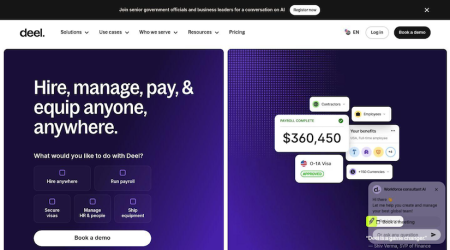
Deel made its name on global hiring, paying contractors and employees across borders through an employer-of-record model that removes the need to open a local entity. For an Australian company hiring talent in markets where it has no presence, that reach has real value.
The core HR story is lighter, though. Deel leads with payroll and EOR, so its everyday HR depth trails the full platforms on this list. Reviewers also flag cost: one contractor reported withdrawal commissions of "about 16%," and others describe pricing as high with unclear fees. Treat Deel as a global payroll and contractor layer rather than the connected HRIS a mid-size or large Australian company runs day to day.
Key features: Employer of record, global contractor payments, multi-country payroll, compliance, contract management.
Pros: Strong global hiring and EOR coverage; fast cross-border payments; clean payment tracking.
Cons: EOR-first design means lighter core HR, and users report high or unclear fees on withdrawals and plans.
Pricing: EOR from around AUD 900 per worker per month; contractor plans lower.
Rating: G2 4.7 / 5.
7. Workday: Best for very large, complex enterprises
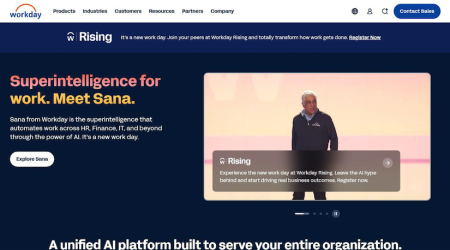
Workday is the heavyweight, built for global enterprises that need deep analytics, a unified data model, and the resources to run it. Its Power of One architecture means every module reads from one dataset, and for organisations at the top of the size range with dedicated HRIS teams, that consistency is a real draw.
The cost and complexity follow in step. Implementations run long and demand specialist partners, and the platform is overkill for companies that haven't yet crossed into large-enterprise scale. Even reviewers who rate it well note the rollout effort. A mid-size Australian business eyeing growth should ask whether it needs this much system today, or whether a core that scales into enterprise gets there with less pain.
Key features: Unified data model, advanced analytics, workforce planning, global compliance, talent management.
Pros: Enterprise-grade analytics and scale; single data model across modules; strong global coverage.
Cons: High cost and complexity with long implementation timelines that overwhelm mid-market teams.
Pricing: Quote-based; enterprise pricing with significant implementation investment.
Rating: G2 4.1 / 5.
8. Happy HR: Best for compliance-focused Australian SMBs
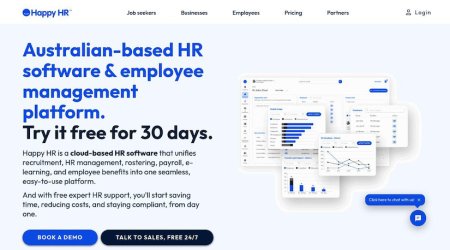
Happy HR is an Australian platform that pairs HR management with strong compliance tooling, contracts, performance, and policy support tuned to local employment law. Smaller Australian businesses that want guidance baked into the software, rather than a bare database, find it reassuring.
Its ceiling is the catch for this audience. Happy HR is built for the SMB end of the market, and its advanced feature set is thinner than the platforms designed to scale into the thousands. Larger or fast-growing companies tend to run into limits on configuration, analytics, and integration breadth. It's a fit for the lower end of this list's range rather than the upper.
Key features: Australian HR compliance, contract and policy management, performance reviews, onboarding.
Pros: Built for Australian employment law; compliance guidance built in; approachable for smaller teams.
Cons: SMB-oriented with limited advanced features, so it strains to fit large or complex organisations.
Pricing: Subscription tiers scaled by employee count.
Rating: Capterra 4.6 / 5.
9. Personio: Best for European-style process standardisation
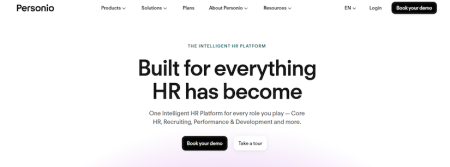
Personio is a polished all-in-one HR platform with a loyal European base, known for clean self-service, structured workflows, and an open API that links it into existing tooling. Companies that want standardised, template-driven HR processes get a tidy, well-supported system.
For an Australian mid-size or large company, two issues weigh in. Personio is strongest inside Europe and thinner elsewhere, so local payroll and ANZ-specific compliance lean on integrations rather than native depth. Reviewers also point to limited customisation, with one noting many features "can feel rigid and not fully customizable to specific company needs," and others flagging steady price increases. Workforce planning is light compared with the leaders here.
Key features: Core HR, structured workflows, self-service, open API, performance and development modules.
Pros: Clean interface and high usability; strong process standardisation; solid integration options.
Cons: Weak outside Europe with limited workforce planning, plus rigid customisation and rising pricing.
Pricing: Quote-based; add-ons increase cost.
Rating: G2 4.4 / 5.
10. Dayforce: Best for unified pay and time at scale
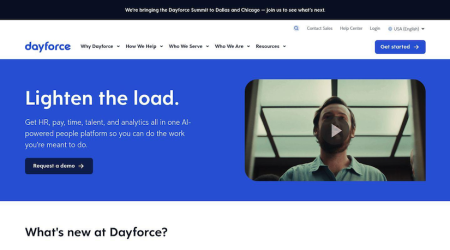
Dayforce brings HR, payroll, benefits, and workforce management onto one platform, with continuous payroll calculation that appeals to organisations running complex pay and time rules, including shift-heavy workforces. For larger Australian companies with intricate award and rostering needs, that single-engine approach has pull.
The reservations mirror the enterprise tier. Dayforce carries enterprise-level complexity and cost, implementation takes time and planning, and smaller mid-market teams can find the depth more than they need. Configuration and reporting reward organisations with the internal expertise to drive them. Confirm the implementation timeline and total cost map to your team's capacity before committing.
Key features: Continuous payroll, workforce management, time and attendance, benefits, talent.
Pros: Single engine for pay and time; strong for complex award and shift rules; scales to enterprise.
Cons: Enterprise-level complexity and cost with implementation effort that exceeds smaller mid-market needs.
Pricing: Quote-based; enterprise pricing.
Rating: G2 4.0 / 5.
How to choose the right HRIS for a growing Australian company
The decision comes down to where you're going rather than where you sit today. Australian-built suites like Employment Hero, ELMO, and Happy HR handle local compliance well but tend to top out at the SMB and lower mid-market end. Enterprise systems like Workday and Dayforce scale almost without limit, though they ask for budget, time, and a specialist team to run them. The harder question for a company moving from 200 toward 5,000 staff is what sits between those poles.
That's where Bob earns the top spot. One connected core that grows with you, a deep integration marketplace that keeps Single Touch Payroll and superannuation flowing through systems built for ATO rules, and an interface people open every day. You scale without the re-platforming tax, and the system you choose at 300 employees is still the system you run at 3,000. For most mid-size and large Australian companies in 2026, that continuity is the difference between a tool you'll replace and a foundation you'll keep.
Frequently asked questions
Can one HRIS still fit when a 200-person company grows past 5,000 employees?
It can, provided the platform runs on one connected core rather than a patchwork of modules. Bob is designed for this exact path: you add headcount, sites, and entities on the same foundation instead of re-platforming each time you grow. Systems aimed at the SMB end often force a migration once complexity rises, so confirm the architecture scales before you commit, not after you've outgrown it.
Why does unified people data matter for a larger company?
When every module reads from one dataset, a change to a record updates everywhere at once, which kills the duplicate entry and reconciliation work that drains larger HR teams. Bob Core keeps people's data, roles, and skills context in one place so dashboards and reports stay accurate across thousands of staff. Fragmented systems force constant manual syncing, and the errors compound as you scale.
Will employees and managers really use a mobile HRIS?
Adoption tracks usability. Bob is mobile-first, so managers can approve leave requests or review a team snapshot from a phone and staff can update details and read payslips without a ticket, which is why its daily engagement runs high. Several platforms here offer apps, but interfaces tuned for HR admins rather than everyday users tend to see adoption drop once the rollout novelty fades.
How does an HRIS handle Australian Modern Awards and STP?
Award interpretation, Single Touch Payroll, and superannuation carry strict ATO rules, and getting them wrong is costly. Local platforms build these in as native features, while global systems vary. Bob's Payroll Hub connects local Australian payroll providers through a no-code setup, so STP reporting and super run through systems built for the rules, while Bob stays the single source of people data. Verify award coverage against your specific industry before you sign.
How much does HRIS software for mid-size and large companies cost in Australia?
Pricing runs per employee per month in most cases, and the enterprise-grade vendors here, Bob included, quote after a demo rather than publish rates, since cost depends on headcount and which modules you enable. Per-user figures on this list range from about AUD 12 upward, with EOR services like Deel priced far higher per worker. Factor in implementation, payroll add-ons, and integration work, since the sticker price seldom reflects the full first-year total.