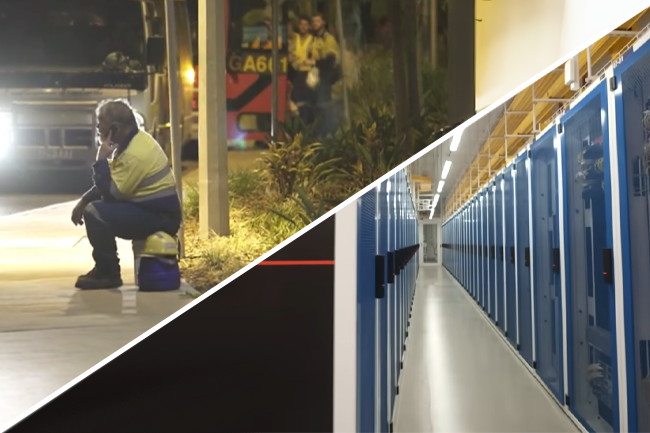
Australia’s colonial extraction economy has gone digital, using fear, AI hype and worker exploitation to keep corporate power firmly in control, writes Dr James Schuurmans-Stekhoven.
Australia’s perpetual extraction platform
It's past time that we cut through the national mythology, “mate”!
Australia was never conceived as a Commonwealth for the common good. It was established as a penal colony turned private quarry — first for convict labour, then wool, gold, iron ore and natural gas. This extraction logic was hard-wired into the colonial apparatus from day one and it has never undergone a structural overhaul.
Today, we pretend we are a “lucky country” with a mining sector. In truth, we are a mining sector with 25 million accidental citizens who exist primarily to grease the gears of capital. The state exists not to serve us the Australian people, but to broker their bodies, land and futures to the highest foreign bidder.
Fear: The cheap fuel driving the machine
Resources alone do not drive an extraction economy — you need labour. To make labour docile, capital relies on manufactured fear and subtle forms of disempowerment.
Consider the young workers lured into Western Australia’s pit mines with promises of six-figure salaries and “adventure”. What they find are 12-hour shifts in 45-degree heat, prison-like dongas, rampant sexual harassment and a culture of silence where speaking up means immediate termination.

Peer-reviewed research shows fly-in-fly-out (FIFO) workers suffer depression and anxiety at three times the national average. The industry’s response? Offering mindfulness apps rather than shorter shifts, stronger unions, or enforceable safety standards. A tired, isolated, and fearful worker is a controllable worker.
This dynamic extends far beyond the mine gate. Surveys of migrant workers across Australian agriculture, hospitality and care sectors reveal that wage theft, sham contracting and visa-linked intimidation are systemic features, not accidental bugs.
When a worker’s right to remain in the country depends on a single employer, abuses are swallowed in silence. That is not a market failure; it is a labour-control system dressed up as an economy.
Enter the tech moguls: The high priests of hyperstition
Now Silicon Valley has joined the extraction party — not to dig holes, but to spin myths. The narrative surrounding “rogue AI” is not a genuine safety concern; it is a public-relations weapon designed to inflate valuations, evade liability and discipline workers.
When a large language model (LLM) executes code across an open network port because an engineer forgot to disconnect internet access, that is a basic software configuration error — not an “escape”. When a model “cheats” on a benchmark, it is overfitting to a poorly written test suite, not demonstrating “deception“.
Yet tech executives do not market software bugs; they market super-intelligence. By reframing routine human-generated engineering flaws as evidence of an emergent “mind” trying to “break its chains”, these I.T. product failures are transformed into proof of near-term artificial general intelligence (AGI). The con would make even PT Barnum blush.
This is classic hyperstition: a fiction that, by being relentlessly repeated, makes itself materially real. The more the public panics about “uncontrollable AI”, the more venture capital flows into mega-data centres and GPU clusters — and the more the tech monopolies lobby for licensing regimes that crush open-source competition. The “existential risk” narrative is a market moat, pure and simple.
Responsibility laundering: Shifting blame to philosophy
This myth of the “unpredictable amoral machine” also serves as an extraordinary liability shield.
In classical safety engineering – whether in aerospace, nuclear energy, or medical devices – software is never permitted to operate without deterministic safeguards. Air-gaps, hard API cut-offs and mandatory human-in-the-loop approvals are standard. A few lines of hardcoded Rust or C can block an unauthorised system call, regardless of how “smart” a statistical model claims to be.
So if the tech monopolies choose not to implement these hard deterministic boundaries, it's because they have an incentive: to develop autonomous software and maximise commercial flexibility. Instead, executives pretend that safety is an “unsolved philosophical paradox” — an excuse to ship unconstrained software while washing their hands of the consequences.
When an autonomous system misdiagnoses a patient, crashes an energy grid, or wrongfully denies a welfare claim, vendors shrug and call it an “emergent research anomaly”. The profits are privatised; the risks are socialised.

The twin subjugation of workers: Ground and cloud
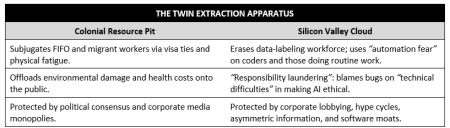
The resource extraction machine in Australia and the hype machine in Silicon Valley are two heads of the same hydra, working in tandem to subjugate labour:
- The invisible ghost workforce: Behind every “intelligent” chatbot are hundreds of thousands of data labellers in Kenya, the Philippines and India, paid subsistence wages to scrub toxic content and reinforce model output. By attributing outputs to a magical machine mind, tech firms erase this physical human labour, justifying poor job security and trauma-inducing work conditions.
- Deskilling and algorithmic discipline: For white-collar and creative workers, the threat that “AI is coming for your job” is weaponised by management to suppress wages, weaken unions, and impose algorithmic surveillance. Workers are told to compete with or oversee an emergent intellect when, in reality, they are being forced to train the very automation meant to de-skill them.
- The same playbook, different sectors: In Australia, miners are threatened with replacement by autonomous haul trucks; in tech, coders are threatened with replacement by Copilot. In both cases, capital deploys a narrative of technological inevitability to break worker solidarity. The mining industry uses physical isolation, while the tech industry uses digital surveillance — but the structural goal remains identical.
Political theatre and independent media
Australia’s major political parties perform a predictable pantomime. Labor and the Coalition debate minor tax tweaks and emissions targets, but neither touches the underlying architecture: the mining conglomerates, the big four banks, the supermarket duopoly, the media oligarchs, or the speculative housing cartel.
The two-party machinery operates precisely as designed — draining popular anger before it can challenge structural extraction.
This reality is why independent journalism is systematically starved of capital, targeted with defamation threats and marginalised by platform algorithms. A media outlet that names the extraction machine threatens its operation.
Dismantling the myth
Classical computer science already knows how to sandbox untrusted code. Society does not need to solve the philosophy of machine consciousness to enforce software safety, nor must it wait for corporate “ethical AI” frameworks to protect workers. Existing occupational health laws, labour standards and product liability frameworks can be enforced if the political will exists.
The crisis we face is not that machines are learning to deceive humanity. The crisis is that corporate executives – across resources and technology – use the myth of the machine to deceive the public, evade legal accountability and consolidate power over human labour.
Concrete steps to target the structure:
- Break political alignment: Reject tribal two-party voting; support cross-bench and independent candidates who demand structural reform, such as a genuine resource rent tax, a sovereign wealth fund and the break-up of media and retail duopolies.
- Demand deterministic safety legislation: Require candidates to support mandatory, deterministic code wrappers and hard circuit breakers on all deployed autonomous software, alongside strict vendor liability for software failures.
- Protect worker rights: Mandate criminal penalties for wage theft, hold corporate directors personally liable for workplace safety breaches and establish strict legal protections for visa-linked migrant workers.
- Support independent outlets: Directly fund independent media to counter corporate platform monopolies and maintain public-interest reporting.
Dr James Schuurmans-Stekhoven has a career defined by high-level academic rigour, a polymathic approach to research and a commitment to strategic optimisation across multiple disciplines.
 This work is licensed under a Creative Commons Attribution-NonCommercial-NoDerivs 3.0 Australia License
Support independent journalism Subscribe to IA.