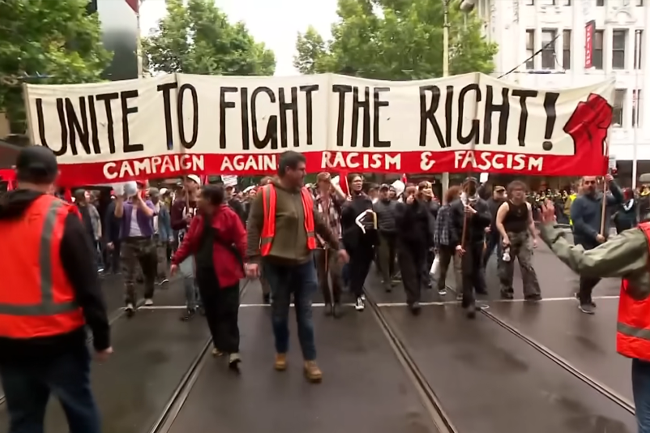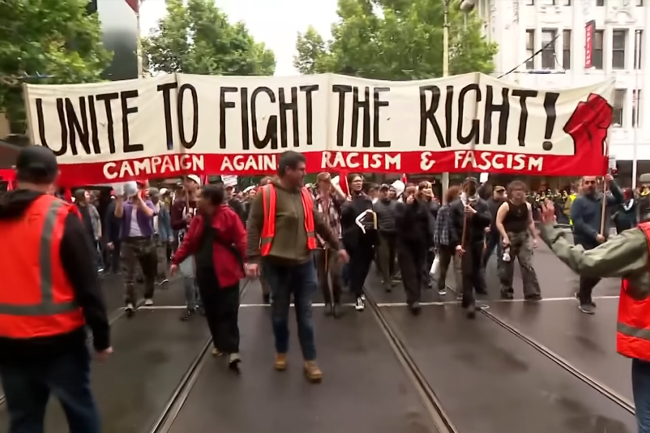
Multicultural liberalism has failed to address the violence of capitalism on the lives of the working poor and has left the door wide open for Far-Right, billionaire-backed grifters to take control of the narrative, writes Yuki Lindley.
AUSTRALIA IS ONE of the most successful multicultural societies in the world, and our diversity is our strength. Successive politicians across the political spectrum have echoed these sentiments ever since former Prime Minister Paul Keating challenged the nation to embrace multiculturalism as a path towards economic success.
Liberal progressives across the world like to imagine they are post-racial, that their embrace of multiculturalism makes them an ally to those who have been historically marginalised and that those draping themselves in the Australian flag and demanding an end to "mass immigration" are the last vestiges of white nationalism in a country on a steady path of progress.
However, what progressive liberals actually want from multiculturalism is a wider selection of cuisines, cultural events and shows; a multiculturalism that is safe, contained and exists for their benefit. In this sense, they echo the sentiments of Pauline Hanson, when she demands Australia maintain a monoculture, where we can accept people who look different from us, so long as they accept our "way of life".
The "way of life" that multicultural liberals most want to maintain is one of relative privilege within a system built on capitalist exploitation. Liberals talk endlessly about the need for tolerance and respect. However, racism and xenophobia will only be addressed when the inequalities brought about by racial capitalism and neoliberalism are confronted.
We need to recognise the violence of capitalism; who it protects and serves, and who is rendered disposable in its calculations.

The rise of the Right is correctly associated with increasing worker precarity, brought about by neoliberal austerity measures that have eroded social safety nets and destroyed communal spaces and political life in favour of a culture of individualism built around consumption.
Yes, the cost of living crisis fuels Far-Right ideologies and the rise of One Nation; however, it is only because of the ideology that progressive liberalism has produced that these grievances are so easily funnelled into attacks on immigrants.
By treating race, gender and other forms of oppression as matters of identity that can be addressed by increasing diversity within positions of power, progressive liberalism has ushered in an era of ecological collapse, obscene levels of inequality, and the emergence of a global military industrial complex driving conflict, incarceration and mass surveillance.
All of this at a time when we are seeing increasing diversity within the boardrooms and halls of power. This emerging class of women and people of colour who have gained access to privilege and power has certainly shifted what power "looks like". However, it has done little to address the exploitation of the working poor and those in the global majority.
As Slavoj Žižek argues, capitalistic exploitation supersedes other forms of oppression, such as racial patriarchy.
This is not to deny the impact of racism, patriarchy and all other forms of oppression, but rather to highlight that capitalistic modes of production pervade all these oppressions. We cannot address racism without also addressing capitalist exploitation, which is why progressive liberalism’s focus on identity, diversity, and recognition serves as a distraction from the exploitation at the heart of capitalism.

The everyday violence of capitalism on the working poor is often ignored by progressive liberals, who only recognise the more visceral forms of violence that emerge from the Far-Right. The slow squeezing of the working-class in the form of precarious employment, a lack of affordable housing, and the increasing costs of living are often overlooked by progressive liberals.
Liberals have a fascination with Trump and the rise of Fascism because they exist at a safe enough distance to not feel the violence of capitalism in their everyday lives; they consider racism to be a problem affecting individuals, ignoring the connection between racism and class oppression. Consequently, they produce a multicultural free-market ideology that is tolerant of different cultures, whilst ignoring capitalist relations of power and domination which emerged along racial lines.
In Black Marxism, Cedric J. Robinson’s analysis of racial capitalism reveals how, because capitalism emerged in step with European colonisation, the exploitation of workers was never universal, but always divided along colour lines. In fact, the emergence of better worker conditions in the West was paid for by the increasing exploitation of workers in the global majority.
Multicultural liberalism, which tries to resist the emergence of the Far-Right by supporting diversity, inclusion and cultural understanding, finds itself insufficient to the task because it incorrectly identifies the working-class white Christian male as the enemy, rather than the capitalist class, which often holds liberal ideals itself.
The antidote to the rise of the Far-Right has always been working-class movements of solidarity. Fascism emerges during times of economic stress to protect the interests of the capitalist class, and what they fear most has always been the collective anger of the workers. The division and fear peddled by corporate media, and the erosion of unions under neoliberalism, speak to their fear of the power of a united, worker alliance that can span national borders and racial divides.
The Lancashire Cotton Famine is a powerful reminder of international worker solidarity; textile workers in northern England supported the abolition of slavery in the United States even though it caused severe hardship for their own communities. These workers had likely never met a black person, yet they took a principled stance even at the expense of their own economic interests, out of a sense of Christian brotherhood.
Another memorable example is the solidarity between the LGBTQ+ community and striking coal miners in Britain. The group Lesbians and Gays Support the Miners raised money and support for mining communities during their strike against Prime Minister Margaret Thatcher’s neoliberal policies.
Although the two groups came from very different backgrounds, they developed strong mutual respect and solidarity through shared political struggle. In return, many mining unions later supported LGBTQ+ rights campaigns, including backing gay rights motions at the Labour Party conference.
In Australia, the Wave Hill Walk-Off, led by Vincent Lingiari, provides a powerful example of trade unions, students and non-Indigenous activists working in solidarity with Aboriginal pastoral workers demanding fair wages – a movement which quickly evolved into a powerful claim for land rights.
These are the stories we desperately need to remember and retell, because multicultural liberalism, having failed to address the violence of capitalism on the lives of the working poor, has left the door wide open for billionaire-backed grifters on the right to take control of the narrative.
Yuki Lindley is a student of philosophy of race, colonisation and Indigenous sovereignty.
 This work is licensed under a Creative Commons Attribution-NonCommercial-NoDerivs 3.0 Australia License
Support independent journalism Subscribe to IA.


Related Articles
- How the Right radicalised its own voters
- Support growing for LGBTQI+ community against hate groups
- Far-Right fails to shut down Rainbow Storytime event
- Far-Right grifter found guilty of running fake charity
- Killing LGBTQ+ events to counter Far-Right rabble won't work