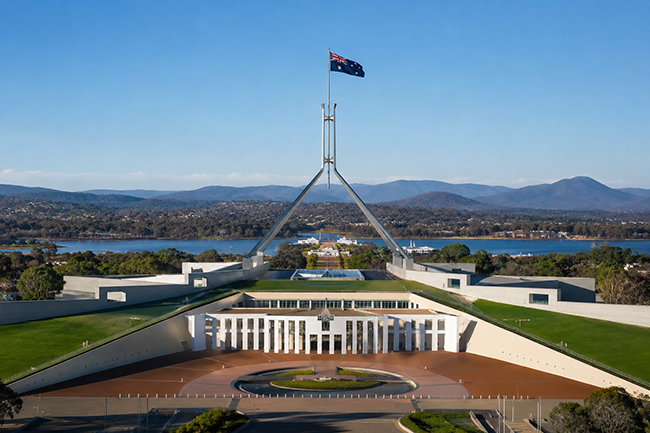
As governments become increasingly disconnected from public needs, people-led inquiries and democratic forums offer a way to reclaim influence over policy and spending decisions, writes Dr Bronwyn Kelly.
WITH THE ANNOUNCEMENT in the recent Federal Budget of an intention to cut $37.8 billion over four years from the National Disability Insurance Scheme (NDIS), it is apparent that something awful has happened to the Labor Party and its commitment to Australians.
This is the party of government that, when it established the NDIS, was proud to have secured the participation of millions of disabled Australians in the economy and society. It had secured their prospects for a decent life. So what is it that, not 15 years later, has made Labor so severely cut those aspects of the NDIS that support social connection and economic participation by the disabled?
As an outsider to politics, it is impossible to divine the cause of this regrettable policy reversal. But no doubt the standard explanation will be about a purported lack of money.
Those who understand the way money really works in an economy like Australia’s, where all currency is issued by government fiat, will see straight through this. They will point out that the Government, as the creator of money, cannot run out of it. As John Maynard Keynes correctly observed, “Anything we can actually do, we can afford”. Money is not our problem.
But the Government is obviously inclined to fall back onto hollow and hopelessly unconvincing themes of needing to make sure the NDIS is “financially sustainable”, because this plays to its donors and to their neoliberal preferences for low public spending, low taxation (or none for some businesses), low public debt (rather than low private debt) and a balanced federal budget.
Under Labor of old, all human lives were valued; but with Labor now, a balanced federal budget apparently trumps human lives.
So it is that the current Labor Government has decided it is preferable to sacrifice the lives and life quality of millions of disabled Australians and their families rather than risk offending its major corporate donors and those in the media who hanker after neoliberal austerity.
This is all the more appalling given that, even though a fiat currency issuing government never needs to balance its budget, it could have done so this time around by covering the expected future costs of the NDIS with a tax that would not fall on Australian consumers — namely, a 25% tax on gas exports.
This and many other choices were available to satisfy the Government’s entirely unnecessary obsession with balancing its budget. And yet the Government chose to hurt Australians twice over by attacking the disabled and permitting unseemly private profits to be made from environmentally destructive mining and exports of gas.
Notwithstanding its recent changes to capital gains tax and negative gearing, the Labor Government has a deeply ingrained fear of tax reform that, unless it is overcome, will consign Australians to ever-growing austerity in provisions for services that are essential not just to our survival but to the private sector’s chances of sustainable profits. And so it is that The Australia Institute has called for a national plebiscite on a 25% tax on gas exports.
A plebiscite is an excellent idea. Like the recent launch of a people’s inquiry into AUKUS, people-led inquiries and policy reform programs are a long-overdue democratic response to bad government. They can open up access to decision processes that will allow ordinary Australians opportunities to influence good policy design.
Over the 21st Century, a series of anti-democratic policies, especially in rules about lobbying and political donations, have dramatically reduced the influence of ordinary Australians compared to large corporate donors and their lobbyists. Australia’s electoral system is so distorted by the donations that are now permissible that we no longer have the system of one vote equals one value, as we might have expected is our due in a democracy. We have a system that is closer to one-vote equals zero value.
Of course, the reform that would restore the political equality of individual Australians more surely than any other would be to ban political donations entirely and to fund elections properly through the Electoral Commission, so that political communication is preserved fairly for all. But since we might not reasonably expect any Labor or conservative government to be able to wean itself off donations and campaign instead on the strength of good policy, there is not much point in waiting around for a fair reform of electoral distortions.
Better to opt in straight away to whatever forums can be organised by ordinary people to design policies that will minimise the irrational impulses of governments towards denial of a decent life for vulnerable sections of the community, such as the disabled. The sooner we organise these sorts of people-driven democratic forums, the sooner we will prevent governments from taking even more unnecessary risks with our lives.
Today it is the disabled who have been singled out, but tomorrow it might be any other group — maybe women, Indigenous Australians, students, migrants, gender diverse people, the aged, or children.
That said, people’s inquiries and other forms of organised people-led policy analysis and development will have limits to their effectiveness if they are not organised in such a way as to help the Government out of its binds.
For instance, based on polls already conducted, Australians may well vote overwhelmingly in a plebiscite in favour of a 25% tax on gas exports. But in the unlikely event that the Government consents to hold such a plebiscite, and in the even more unlikely event that they will agree to impose the tax, we can expect no guarantee that the tax will result in the restoration of the NDIS or in increased expenditure on any service essential for our health, safety and wellbeing.
Labor and Liberal/One Nation governments would be far more likely to insist that the Federal Budget be adjusted instead to pay down government debt. Unnecessary fiscal rectitude and austerity will persist at our expense and to our peril.
The smarter way, then, to organise people-led reforms, especially tax reform, is to angle them towards a redesign and expansion of the Federal Government’s spending programs. It is to strike a deal with the Government not just on how tax must be reformed to make it fair, but also on how much the Government must spend and where it should spend to safeguard the health and well-being of the public. After all, what else do we elect them for?
This is not to say that plebiscites on tax and public inquiries into obviously bad policies like AUKUS should be abandoned. On the contrary, they should be encouraged. But if every time the Government defaults to austerity, we opt to respond by raising another people-led inquiry or plebiscite, we will run ourselves ragged, achieving far less than we need.
The more efficient option for time-poor Australians is to begin designing these people-led forays into democratic decision-making so that we have a better chance of securing everyone’s health, safety and wellbeing.
A model for that sort of more enabling people-led reform process has recently been proposed by Australian Community Futures Planning (ACFP). Called the Australian Public Interest Collaboration, the proposal allows everyday Australians to collaborate as equals to design a social new deal with the Government — one in which we can agree to fair tax reforms of our choosing in exchange for specific guarantees on what public funds must be spent on.
This kind of forum gives people an entryway into the federal budgeting process that will prevent the sort of unnecessary austerity most recently exhibited in those awful cuts to the NDIS.
Dr Bronwyn Kelly is the Founder of Australian Community Futures Planning (ACFP). She specialises in long-term integrated planning for Australia’s society, environment, economy and democracy, and in systems of governance for nation-states.
 This work is licensed under a Creative Commons Attribution-NonCommercial-NoDerivs 3.0 Australia License
Support independent journalism Subscribe to IA.