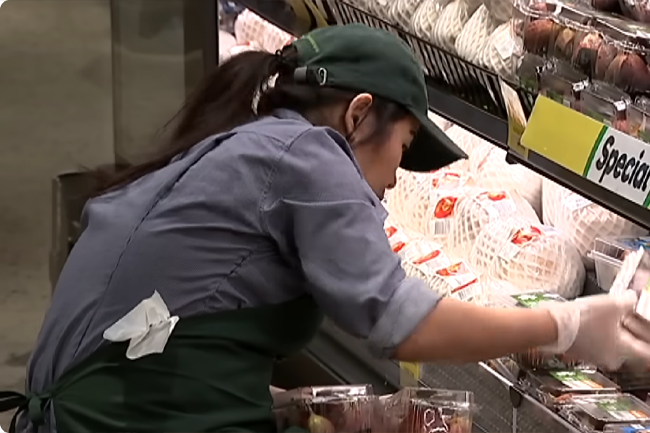
Retail workers offer valuable insights into household financial pressures that Australia's economic data alone cannot reveal, writes Samiul Mashooq Antony.
AN ECONOMY can look surprisingly healthy from the wrong end of a receipt.
A customer buys a new refrigerator. The sale is counted. Money has moved, a business has earned revenue and a household has acquired something useful.
What the receipt cannot explain is whether the old fridge failed, whether the purchase emptied a savings account, or whether the buyer spent the previous evening working out which other payment could wait.
The transaction is real. So is the strain behind it. Only one fits neatly into a spending total.
This is where retail workers have something to contribute to Australia's economic conversation. They stand near the awkward moment when a desire meets a budget. They hear the question after the advertised price has been explained. They also encounter the people who leave without buying anything, a group whose absence from the sales report can conceal quite a lot.

That does not make every shop assistant an economist. It makes the shop floor a place worth listening to.
The Australian Bureau of Statistics ended its Retail Trade publication in July 2025 after expanding the Monthly Household Spending Indicator. The newer measure covers more of household consumption. Improving the evidence is useful; national policy cannot sensibly depend on whoever had the most memorable conversation beside a washing machine.
But better measurement does not make interpretation automatic. A total tells us what was spent. It cannot, by itself, tell us how comfortable people felt spending it, or what they surrendered elsewhere.
Consider a hypothetical household replacing damaged flooring. The family asks for prices for the whole home, then decides to do only the bedrooms. A smaller sale still appears in the figures. The abandoned rooms do not appear as abandoned rooms. Someone who discussed both quotes knows something about the decision that the final invoice cannot preserve.
That knowledge is partial. Perhaps the family simply changed its taste. Perhaps the rest of the house can wait for reasons unrelated to money. A worker should not turn a hesitation into a diagnosis of national decline. Still, repeated questions can identify matters worth investigating with proper research.
Our public debate is less careful about the opposite mistake. It can treat continuing expenditure as evidence that households are coping. People do not cease to need school shoes, working appliances or somewhere safe to live because their finances have become uncomfortable. Spending may show resilience. It may also show that the alternatives are worse.
There is a class question here. We readily recognise expertise when it arrives with a title, a presentation and a city office. Someone paid to serve customers is more likely to be asked about sales targets than about what customers are telling them. Their proximity to the public becomes commercially valuable and intellectually invisible.
I would like economic commentary to make more room for that knowledge without romanticising it. Retail workers have biases. Sales incentives can shape what they notice. One expensive showroom cannot represent Australia any more than one supermarket queue can. The answer is to collect observations across different locations and types of business, then test them against broader evidence.
Employers could start by asking staff what customers find confusing, what they repeatedly postpone and what concerns keep returning. Researchers could use those patterns to design better questions. Neither exercise requires recording identifiable customer stories or turning private embarrassment into public entertainment.
Listening must also include the worker's own circumstances. The person explaining a payment option has bills, too. It would be an odd consultation that welcomed their insights into somebody else's budget while ignoring their wages, hours and job security.
No serious account of Australia should choose between statistics and the people living inside them. We need the figures precisely because personal impressions can mislead us. We need people because figures can be made to carry conclusions they never established.
The next time a spending result is described as encouraging, it might be worth asking a second question: encouraging for whom?
Somewhere, a customer is putting a product back. The worker beside them may know why.
Samiul Mashooq Antony is a Melbourne-based writer and business professional with more than 20 years of experience in sales, marketing and retail. He writes about business, society, consumer behaviour and workplace culture.
 This work is licensed under a Creative Commons Attribution-NonCommercial-NoDerivs 3.0 Australia License
Support independent journalism Subscribe to IA.


Related Articles
- Newsrooms sook at substantial national reform and global successes
- Latest jobs dataset confirms Australia leads the world again
- Falsehoods about Australia’s productivity: Malicious intent or stupidity?
- Top 40 datasets showing quality of life in Australia steadily rising
- Australia’s incompetent newsrooms fail to report best financial year ever