By recognising Moroccan sovereignty over Western Sahara, Trump revealed how conditional international law had become, writes Mohamed Elbaikam.
FOR DECADES, international relations were governed not only by written rules but by a shared pretence.
The United Nations Charter, international courts and diplomatic language provided a normative framework that masked the raw exercise of power behind legal and moral vocabulary. Much of what great powers did was negotiated quietly, behind closed doors, under the table.
U.S. President Donald Trump did not invent this reality. But he did something unprecedented: he exposed it.
The Trump Administration’s 2020 recognition of Moroccan sovereignty over Western Sahara was not merely a controversial foreign policy decision. It was a moment of radical disclosure. What had long been practised discreetly – transactional diplomacy overriding international law – was suddenly declared openly, unapologetically and in plain language.
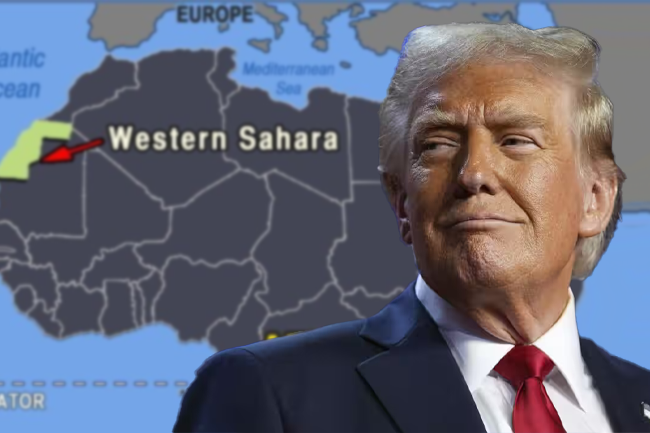
Western Sahara is not an obscure territorial dispute. It is one of the last unresolved decolonisation cases recognised by the United Nations. In 1975, the International Court of Justice concluded that no territorial sovereignty links existed that could negate the Sahrawi people’s right to self-determination. That right was later embedded in a UN peace process promising a referendum — a promise never fulfilled.
For years, the international community maintained a careful balance: formally affirming UN principles while informally tolerating their suspension. Trump shattered that balance. By tying Western Sahara’s legal status to an unrelated geopolitical deal, his administration treated international law not as a constraint, but as a bargaining chip.
This was shocking not because it was entirely new, but because it was no longer hidden.
In this sense, Trump functioned less as the architect of international law’s erosion than as its unfiltered mirror. His style – direct, transactional, dismissive of multilateral norms – stripped away the diplomatic theatre that had sustained the illusion of a rules-based order. What had once been done discreetly by major powers was now performed in public.
This exposure carries a dual significance. Negatively, it accelerates the collapse of legal norms. If sovereignty, self-determination and decolonisation can be traded openly, then international law loses its binding character and becomes optional. The Western Sahara precedent signals to the world that legal principles survive only when they align with power.
But there is also a paradoxical positive dimension. Trump’s approach forced a moment of clarity. It revealed that the international order was already fragile, already compromised, already selective. The problem did not begin in 2020; it merely became undeniable.

Western Sahara illustrates this truth with exceptional clarity. For nearly 50 years, the Sahrawi people have lived the consequences of an international system unable – or unwilling – to enforce its own rules. Refugee camps, political repression and prolonged legal limbo are not accidents; they are the structural outcomes of a system that privileges stability over justice and power over principle.
The danger today is not Trump alone, nor any single administration. It is that what was exposed remains unrepaired. When the pretence collapses, but nothing replaces it, cynicism fills the void. Other conflicts – Ukraine, Palestine, Taiwan, Kashmir – are now interpreted through the same lens: not “What does international law require?” but “Who has leverage?”
The United States, as a founding architect of the post–World War II order, faces a choice. It can continue down a path where law is openly subordinated to deals, or it can recognise that exposure creates responsibility. Once the curtain has been pulled back, returning to comfortable ambiguity is no longer an option.
Western Sahara is not peripheral to this reckoning. It is central to it. The territory stands as a living record of what happens when international law is indefinitely postponed. If the rules-based order is to mean anything in the 21st Century, it cannot survive as performance alone. It must apply even when inconvenient — especially then.
Trump revealed the truth of the system. The question now is whether that truth will lead to renewal or to irreversible collapse.
Mohamed Elbaikam is an independent activist from Western Sahara.
 This work is licensed under a Creative Commons Attribution-NonCommercial-NoDerivs 3.0 Australia License
Support independent journalism Subscribe to IA.


Related Articles
- The end of sovereign immunity: America’s new doctrine of capture
- Pole-to-Pole with Donald Trump: An Australian guide to the new flat Earth
- Trump’s Venezuela abduction shatters claims of Western moral authority
- Australia’s ‘national interest’ falters in the face of Trump’s lawlessness
- From rules-based order to rule by fear: America’s democratic unravelling