A striking Banksy, a recycled war lie and a drift toward exceptionalism reveal how easily truth is buried — and how urgently Australia must choose to see before stepping over the edge, writes Wayne Hawkins.
The statue and the lie
On 30 April 2026, a new Banksy appeared overnight in Waterloo Place, London: a life-sized bronze figure in a suit, mid-stride, stepping off the edge of a plinth. The figure's face is entirely draped by a billowing flag, rendering him sightless as he falls.
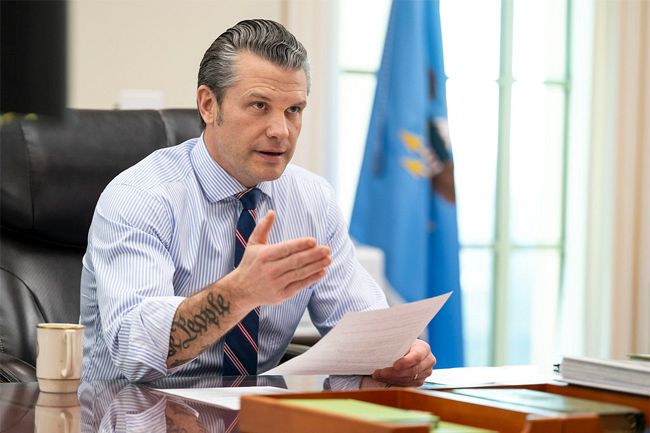
On that same day, U.S. Defence Secretary Pete Hegseth concluded testimony regarding the Iran war launched on 28 February 2026 — a conflict initiated without congressional authorisation or an honest public accounting.
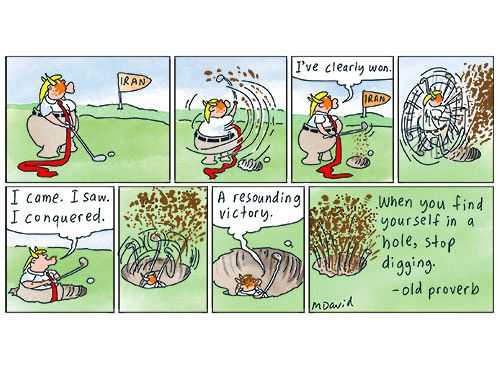
The stated justification was that Iran was on the verge of developing a nuclear weapon. However, the U.S. intelligence community’s 2025 assessment explicitly stated Iran was not building such a weapon. This was further confirmed on 4 March 2026 by International Atomic Energy Agency (IAEA) Director General Rafael Grossi, who noted the agency had no information indicating a structured Iranian nuclear bomb program. Despite these facts, the administration publicly claimed the opposite.
How lies persist
This phenomenon relies on the “illusory truth effect”, identified by psychologists in 1977, where repetition increases the subjective sense of truth regardless of evidence. The nuclear threat was repeated across government and media channels until familiarity was perceived as fact.
Identity-protective cognition also plays a role. When beliefs act as identity markers, factual corrections often trigger entrenchment. For instance, Pew Research found 79 per cent of Republicans approved the Iran policy even as the administration's own intelligence community contradicted the war's justification.
The Iraq parallel — and Australia’s role
The architecture of this conflict is forensically identical to Iraq in 2003: capability was presented as imminence and intelligence was subordinated to political messaging. Australia joined the Iraq coalition based on weapons of mass destruction that never existed.
Twenty-three years later, history repeats. Prime Minister Anthony Albanese endorsed the Iran strikes before the IAEA had even commented or a parliamentary debate occurred. When asked if the strikes complied with international law, Foreign Minister Penny Wong declined to answer.
Former Labor foreign minister Bob Carr described this lack of adherence to international law as “frightening”, noting that the lie on which the war is based was already being exposed. The structural failure to scrutinise threat claims suggests the lessons of 2003 were ignored by those in power.

The Darwin warning
When Charles Darwin visited Van Diemen's Land in 1836, he observed a system where prosperity was built on dispossession and the elimination of the original inhabitants. He noted that the British flag seemed to draw ‘wealth, prosperity and civilisation’ as a certain consequence, while the costs were borne by those without a voice.
Today, a quieter version of exceptionalism is being imported into Australia. Critics are framed as un-Australian and public broadcasting is systematically delegitimised. Nationalistic rhetoric, such as the use of the term “mass” regarding immigration policy, converts policy questions into perceived threats. This incremental shift in the Overton window has seen core arguments from Senator Pauline Hanson’s 1996 maiden speech become mainstream positions within the Coalition.
The choice
The Banksy statue serves as a portrait of nations where nationalism is used to prevent citizens from seeing the consequences of actions taken in their name. The flag covers the face as the figure strides off the plinth.
With a 10.1 per cent youth unemployment rate and a widening gap between the cost of living and stagnant wages, the current direction is unsustainable. The edge of the plinth is visible. The question is whether enough people will choose to look before we take the final step.
Wayne Hawkins is a small business owner in Hobart, Tasmania, and an independent candidate for the federal seat of Clark at the 2028 Election.
 This work is licensed under a Creative Commons Attribution-NonCommercial-NoDerivs 3.0 Australia License
Support independent journalism Subscribe to IA.


Related Articles
- America’s Iran war for oil signals environmental disaster
- Late 2026 — far from now
- Oil, war and ecocide: The destruction of the Middle East
- Who's making money? The arsenal trade after Ukraine and Iran
- Waning world order: Ethics in the age of great power politics