Muslim men who stopped to pray five times a day in the red dust of the Australian interior, doing the work that made modern Australia possible, their names are largely lost to us, but their legacy remains, writes Wayne Hawkins.
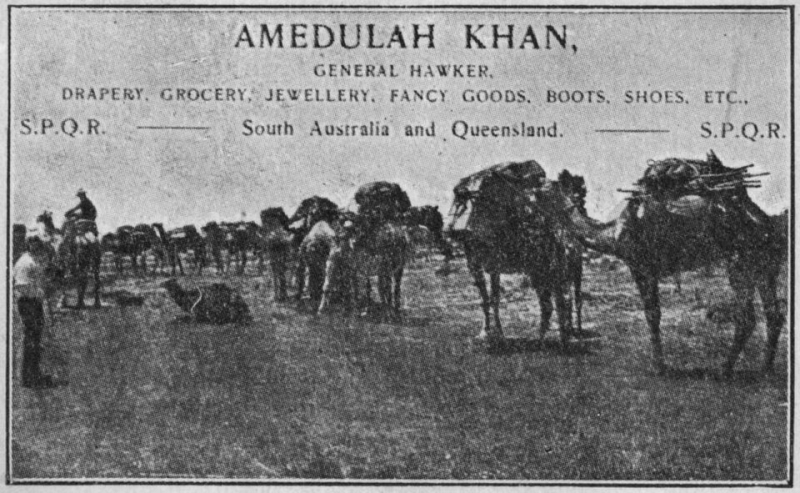
PICTURE A DESERT TRACK in central Australia, 1872. The Overland Telegraph line – the wire that would connect a continent to the world – is being threaded through country that has broken European expeditions and killed European men. The heat is biblical. The supply chains have collapsed. The project is on the verge of failure.
And then the camels arrive.
With them come the men who know how to read that country. Men from Balochistan, from the Punjab, from Afghanistan.
Men who stop to pray five times a day in the red dust of the Australian interior. Muslim men, doing the work that made modern Australia possible. Their names are largely lost to us. But the telegraph line stood. And Australia was connected to the world because of them.
I have been watching the footage from nationalist marches across Australia and Europe. The iconography is familiar by now. The flags, the slogans, the same recurring claim delivered with the confidence of someone stating an obvious fact: Islam does not belong here. It never has.
It is incompatible with our way of life — a foreign intrusion into a civilisation built on Judeo-Christian foundations, threatening something ancient and coherent that existed peacefully before it arrived.
It is a compelling story. It is also almost entirely false.

Not false in the way that political claims are often false — exaggerated, selective, misleading at the edges. False at the foundation. The coexistence of Muslim and non-Muslim communities is not a modern progressive experiment. It is one of the oldest and most documented features of the civilisational record.
Go back eight centuries. The Iberian Peninsula was home to one of history's most remarkable experiments in human coexistence. Al-Andalus. The Arabic word for it was "convivencia". Living together.
In Córdoba in the 10th Century, Muslim mosques, Christian churches and Jewish synagogues stood within walking distance of each other. Scholars of all three traditions shared libraries and translated ancient texts side by side.
The intellectual inheritance of that civilisation – the mathematics, the medicine, the philosophy – flowed into European universities and formed a substantial part of the foundation on which the Renaissance was built.
The nationalist who declares Islam incompatible with Western civilisation is, without knowing it, standing on intellectual ground partly built in that Córdoba library.
A note on nuance: convivencia was not a golden age of perfect equality — tensions existed, particularly under later Almohad rule.
But sustained, documented coexistence between the three communities during the Umayyad Caliphate period is a historical fact. What does not survive scrutiny is the nationalist claim of inherent, ancient incompatibility.

The Reconquista ended it. Christian kingdoms expelled the Muslims and Jews who had built that civilisation. What destroyed convivencia was not Islam. It was the insistence on homogeneity — the idea that a civilisation could only survive if everyone in it believed the same thing.
As one scholar of medieval Spain has written, the result was a society that became:
'... a closed, suspicious place that repressed and eliminated difference.'
That idea has a long and catastrophic record.
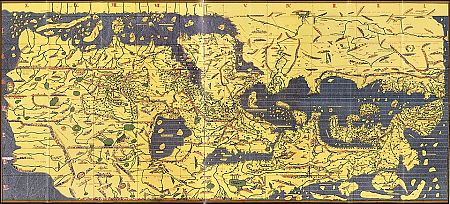
Come forward to Norman Sicily in the 12th Century. A Christian king spoke Arabic, employed Muslim administrators and produced the most sophisticated map of the medieval world in collaboration with the Muslim geographer Muhammad al-Idrisi.
Roger II's Court at Palermo is described as:
"The most intellectual court of Europe", where, through his [Roger II's] personal enthusiasm, "Sicily became a cultural clearinghouse where, for the first time, Christian and Islamic scholars could meet on an equal footing."
Al-Idrisi's Tabula Rogeriana, completed in 1154, remained the most accurate world map for three centuries. It was made by a Muslim scholar for a Christian king in a multicultural court that the nationalist imagination cannot accommodate.
And then come home.
The Afghan cameleers did not just build the telegraph line. They supplied the construction of the transcontinental railway. They kept remote communities alive across the interior for decades.
They built mosques – some still standing today – in outback towns from Broken Hill to Bourke to Marree. The oldest standing mosque in Australia, built in Broken Hill in 1887, was founded by these men.
They married into Aboriginal communities, producing descendants who are simultaneously Indigenous Australian and Muslim by heritage — a fact that makes a complete ruin of the incompatibility argument.
The Burke and Wills expedition of 1860 carried Afghan cameleers into the interior. Dost Mahomed, a Muslim from Ghazni in Afghanistan, was selected by Burke himself to accompany the advance party to Cooper Creek — a testament to how indispensable these men were considered.
The sole European survivor of that expedition, John King, was ultimately kept alive not by any European rescue party but by the Yandruwandha Aboriginal people at Cooper Creek, who provided food and shelter until a relief party arrived in September 1861.
Two forms of knowledge the nationalist narrative erases – Muslim and Indigenous – are woven into the founding mythology of the country it claims to defend.

Before any of the cameleers arrived, Muslim traders from Macassar in what is now Sulawesi had been making seasonal voyages to the northern Australian coast – from at least the 17th Century – with oral histories and genetic evidence suggesting contact possibly centuries earlier.
Their presence is recorded in Aboriginal rock art in Arnhem Land, in Aboriginal languages that carry Macassan loanwords, and in oral histories that remember their coming and mourn the day the trade was ended. The South Australian Government banned Macassan trepanging in 1906 — it terminated a trade relationship that predated British settlement entirely.
Islam does not have a short history in Australia. The ignorance of that history is short.
The men marching with anti-Islamic iconography believe they are defending something ancient and coherent. They are defending a myth — one constructed by erasing the actual record.
The call to prayer and the church bell have shared the same sky for longer than the nation-states these marchers claim to protect have existed. That is not an argument for any particular immigration policy or political position. It is simply what happened.
History does not care about the march. It already knows what the marchers do not.
Wayne Hawkins is a small business owner in Hobart, Tasmania, and an independent candidate for the federal seat of Clark at the 2028 Election.
 This work is licensed under a Creative Commons Attribution-NonCommercial-NoDerivs 3.0 Australia License
Support independent journalism Subscribe to IA.