A Ukrainian refugee fled one war zone for another — and her death exposes the violent, dehumanising culture Trump helped create, writes Dan Jensen.
IRYNA ZARUTSKA was 23 years old. A refugee from war-torn Ukraine, she had fled to the United States in search of peace, safety and a chance to build a future. She found work at a local pizzeria, was a talented artist and aspired to work in the animal welfare industry. She made friends. She was building a life.
On the night of 22 August 2025, she boarded a light rail train in Charlotte, North Carolina. Moments later, she was dead.
Zarutska was stabbed in what police have described as an entirely unprovoked attack aboard the Lynx Blue Line train. Emergency responders arrived within minutes, but her wounds were too severe. She died at the scene. A 34-year-old man, who fled after the stabbing, was arrested shortly afterwards and charged with her murder.
For those who knew her, the grief has been unimaginable. For those watching from afar, the horror of such a random act of violence has been compounded by its growing familiarity.
Because this was not an isolated event, but part of a disturbing pattern playing out across the United States — one that has flourished in the shadow of Trumpism, where cruelty, hatred and fear have become features of the political landscape, not bugs.

A culture steeped in violence
America is a country awash in violence. While partisan arguments over statistics continue, what cannot be denied is the sheer volume of assaults, stabbings, shootings and random attacks that occur daily — in schools, on buses, in shopping centres and on public transport. The randomness is the point. The fear it creates is the effect.
And yet, in case after case, little is done to address the climate that makes such violence not only possible, but predictable.
The attacker in Zarutska’s case has not, at this stage, been linked to a clear ideological motive. But even without slogans or manifestos, the context remains inescapable. The U.S. has spent the better part of a decade normalising the idea that certain people – immigrants, refugees, women – are worth less. That they are a problem to be solved rather than lives to be protected.
Zarutska was a young woman riding a train home. That alone was enough to make her a target.
A justice system that let her down
Adding to the tragedy is the fact that Iryna’s death was preventable — not just in a cultural sense, but in a legal one.
Her accused killer, Decarlos Brown Jr, should not have been on the streets. He had reportedly been arrested 14 times before the attack, with charges ranging from larceny to assault and resisting arrest. And yet, time after time, he was released.
Most recently, Brown had been in court just weeks earlier. But instead of being held in custody or sentenced to prison, he was released under the watch of Mecklenburg County District Judge Teresa Stokes. The decision – like so many made in an overburdened, underfunded and often indifferent judicial system – had deadly consequences.
No amount of spin can reframe this as anything other than a systemic failure. A vulnerable young woman is dead and the man accused of her murder was known to authorities. He was a repeat offender. He had a documented history of violence and instability. And yet, the legal system allowed him to walk free.
There will be questions. There must be accountability. But for Iryna, it’s already far too late.

When safety is a myth
Much of the American self-image is built on the idea that it is a safe haven — a place where people can flee conflict and find peace. That ideal has never matched reality, but for many immigrants, the hope remains.
Iryna Zarutska believed in that promise. She escaped the bombs and terror of Ukraine, only to be killed in what should have been one of the safest places in the world: a commuter train in a major American city.
Her death is a stark reminder that in a society where violence is both common and largely unchallenged, no one is truly safe — especially not those already marginalised.
The normalisation of cruelty
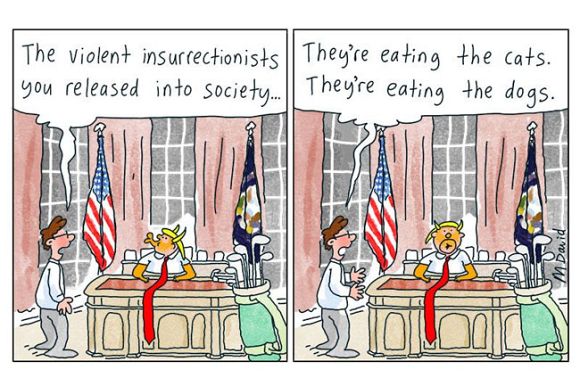
What has changed most dramatically in recent years is not the existence of violence, but the erosion of social resistance to it. Under President Donald Trump, cruelty became currency. Refugees were mocked. Women were derided. Minorities were scapegoated. And every insult, every lie, every racist dog-whistle reinforced the idea that empathy was weakness and violence was strength.
The results have been chilling. Hate crimes surged. Extremist groups were emboldened. The “mainstreaming” of once-fringe ideologies created a climate where acting on rage – against women, migrants, the vulnerable – no longer felt taboo. It felt validated.
Zarutska’s killer may not have acted in the name of any movement. But he acted within a culture that has made violence banal. That culture was not born in a vacuum.
A broken system, over and over again
Public transport systems, like the one on which Zarutska was killed, are supposed to be safe. They are the backbone of city life — the places where people commute, socialise and exist. But in many parts of America, they’ve become increasingly dangerous, with transit workers and riders alike reporting sharp rises in harassment, assault and violence.
The problem is systemic. Law enforcement is often reactive, not preventative. Mental health services are chronically underfunded. And political leadership – especially on the Right – prefers to deflect blame onto victims or vaguely defined “urban decay” than to confront the cultural sickness at play.
The end result is what happened in Charlotte. A young woman who had already endured one war was killed without warning, on a public train, in a country that sold her a lie about safety.
Strangely, Zarutska’s murder went unreported in national headlines for almost two weeks — a silence that says as much about media priorities as it does about the crime itself. But now, the world is finally saying her name with a heavy social media presence and even Elon Musk pledging US$1 million (AU$1.5 million) for murals to be commissioned in major U.S. cities to honour Iryna’s name.
Remember her name
Iryna Zarutska was more than a victim. She was a daughter. A friend. A worker. A refugee who refused to be defined by the violence she fled. She deserved to be seen for her strength, her ambition and her humanity.
Her death must not be dismissed as random. It must be recognised as a symptom — of a society drowning in unchecked aggression and of a political culture that rewards cruelty over care.
The train she boarded that night was meant to carry her home. Instead, it became the site of her final moments. That should haunt a nation that still dares to call itself free.
You can follow digital editor Dan Jensen on Twitter @DanJensenIA.
 This work is licensed under a Creative Commons Attribution-NonCommercial-NoDerivs 3.0 Australia License
Support independent journalism Subscribe to IA.