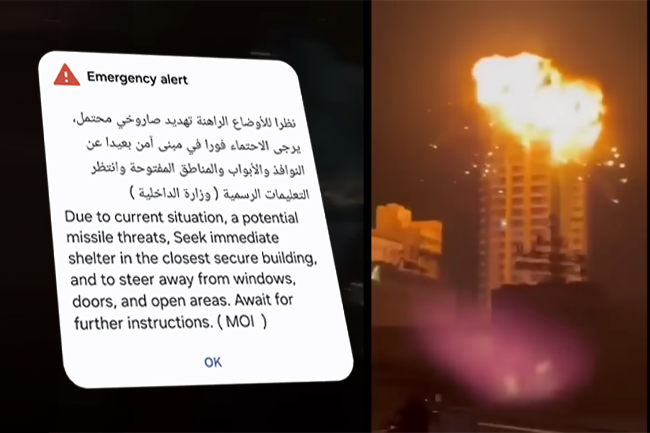
An Australian family holidaying in Dubai recounts the surreal experience of missile alerts, flight cancellations and limited government assistance as they scrambled to find a way home, writes Annalinde Nickisch.
OUR TRIP TO THE UAE began with a 14-hour flight from Melbourne to Abu Dhabi with two tired children, aged three and eight.
We landed in Abu Dhabi at around 1 A.M. on 28 February, collected a rental car at the airport and drove straight to Dubai. Our Airbnb wasn’t ready yet, so we stopped for breakfast and spent the morning wandering along JBR with the kids until it was time to check in. Once we got into the apartment, we slept briefly and then headed to the supermarket to buy a few basics for the house.
While standing in the aisle, I texted a friend to ask if she wanted to have dinner with us while we were in town. My husband and I had lived in Dubai before, and the trip was meant to be part holiday and part chance to see friends we hadn’t seen in years.

Her reply came quickly:
‘Have you seen the news?’
We hadn’t. Our phones weren’t connected to local data yet, so we had no idea what she meant. She forwarded a statement from the UAE Ministry of Defence saying several Iranian missiles targeting the country had been intercepted.
It was the first moment we realised something serious had happened. But standing in the supermarket, everything around us still felt completely normal.
People were calmly doing their shopping.
We drove back to the apartment, settled the children and went to bed.
At around two or three in the morning, our phones suddenly began making a loud alarm sound — the kind usually associated with a fire alert. A government emergency notification had been pushed to every phone in the country.
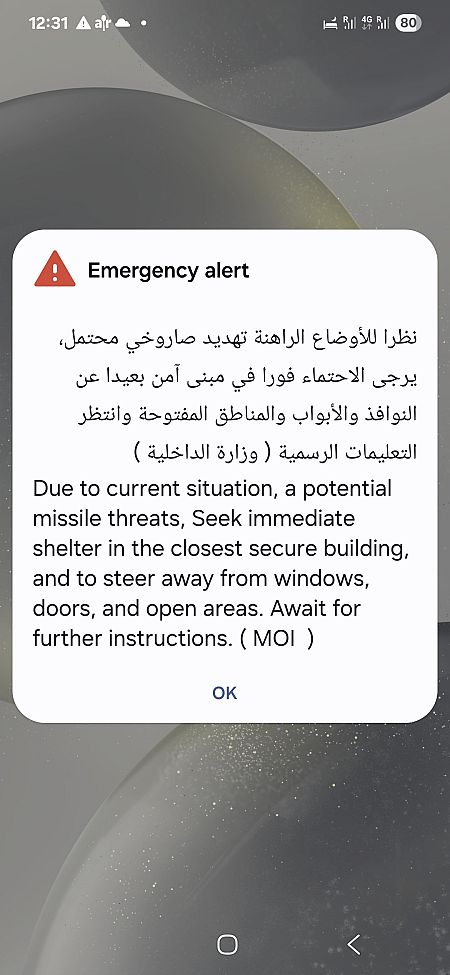
The message instructed people to stay indoors, keep away from windows and take shelter because of a missile threat.
A minute later, my husband’s phone started blaring the same alert.
We grabbed the kids and put them in our bed. We closed the blinds in case glass shattered.
Not long after the alert, we could hear explosions outside.
The alarms and the noise outside woke the children. In that moment, we didn’t know how to explain what was happening, so we simply told them it was construction noise and kept them in bed with us while we waited.
Until that night, the idea of hearing explosions from inside your home belonged to news footage or distant conflicts. It was not something I had ever imagined experiencing firsthand.
Lying there, we had no sense of how serious the situation could become. We did not know whether more missiles would follow, whether anything nearby would be hit, or what the next few hours would bring. There was nothing to do except wait.
My husband quietly packed a small bag with passports and documents in case we needed to leave quickly. At the same time, I couldn’t stop thinking that we were on the 29th floor. If something struck nearby, getting out could be impossible.
The next morning, the feeling was immediate: we had to leave the country as quickly as possible.
But when we checked the news, the airspace over the UAE had been temporarily closed. Several neighbouring countries had also shut their airspace. For the moment, leaving wasn’t possible.

We went back to the supermarket to stock up on some extra food. Having lived through the early days of COVID in Australia – when supermarket shelves emptied overnight – we assumed people might begin panic buying.
But the atmosphere was the opposite.
Shelves were full. People were calm. Life appeared to continue as normal.
Over the following days, we followed the situation closely, particularly local coverage from Gulf News, which provided far more detailed updates about missile interceptions and airport operations than most international outlets.
At the same time, we tried to maintain some sense of normal routine for the children. After the first night, staying inside the apartment and constantly checking the news quickly became tense and restless for everyone.
So we decided that if we were going to be indoors anyway, we might as well try to create some kind of routine. We chose indoor activities and took the kids to Ski Dubai to see the penguins.
We were already seated inside the enclosed penguin viewing area when suddenly every phone in the room began going off with the same emergency alert. Within seconds, the entire space was filled with the sound of alarms.
Because we were already indoors, there was nowhere else to go. People stayed seated. Families continued watching the penguins. Outside the viewing area, the mall carried on as normal.
A few minutes later, the all-clear notification appeared.
The contrast between the urgency of the alerts and the calmness of everything around us felt surreal.
Very early on, we were advised to register with the Australian Government through the Department of Foreign Affairs and Trade (DFAT) so they would know which Australians were in the country. We registered immediately.
At that point, we were following the news closely and could see that some governments were already organising departures for their citizens. Germany and Belgium, for example, arranged government-supported flights to help their nationals leave the region.

Because we had been asked to register, we assumed that something similar might be organised for Australians as well.
Over the following days, the emails from DFAT began arriving.
In total, we received around ten of them. Each time one appeared, there was a brief moment of hope that there might be some practical assistance for Australians trying to leave.
But the messages largely repeated the same advice: follow local government instructions and attempt to book commercial flights out of the country.
Travellers were also advised not to cancel their existing airline bookings.
In practice, this meant trying to secure additional flights while still holding onto the original ones — even as cancellations across the region continued.
Our return tickets to Australia with Etihad were booked for 14 March.
By this point, we had heard numerous stories of travellers booking additional flights only to have both their new and original bookings cancelled.
Rather than booking new flights immediately, we tried contacting Etihad in the hope that we could move our flights to an earlier date.
Because our Australian SIM cards didn’t work for local calls, we bought a prepaid local SIM and began calling the airline.
The problem with prepaid credit is that hold music still counts as call time.
After sitting on hold for two or three hours without speaking to anyone, the credit would simply run out and the call would drop. We topped it up, called again, waited again — and ran out again.
After two days of trying, we finally got through.
The best the airline could offer was to move our flight forward by one day, from 14 to 13 March.
Then the building next to ours was struck by debris from a missile interception.

No one in our building was injured, but it was enough to make us reconsider waiting another week.
Instead, we decided to leave as soon as possible.
We booked completely new tickets through Emirates for the earliest flight we could find.
Even on the drive to the airport, we weren’t sure the flight would actually depart. Too many people had already seen their flights cancelled at the last minute.
At the airport, our flight still appeared on the departure board. We checked in and felt cautiously optimistic.
But even then, the uncertainty wasn’t over.
As we sat at the gate, security staff suddenly asked passengers to move away from the windows. Within seconds, another emergency alert appeared on our phones and we were directed deeper into the terminal.
At that point, we had already checked out of our Airbnb. Our luggage was already loaded somewhere on the aircraft.
If the flight was cancelled, we had no accommodation and no clear plan.
For a while, it genuinely seemed possible that we wouldn’t leave the country that day.
Two hours later, another alert arrived: all clear.
Boarding resumed.
Eventually, the aircraft pushed back from the gate and took off.
Our Emirates flight finally departed Dubai on 10 March at 10 A.M., straight to Melbourne.
The entire experience felt surreal from beginning to end.
But one moment stayed with me.
The plane wasn’t full.
There were empty seats — quite a few of them.
Looking around the cabin, it was hard not to think that those seats could easily have been secured by the Australian Government for travellers who may not have had the financial means to buy entirely new tickets, or who simply couldn’t risk thousands of dollars on flights that might never depart.
In a situation where many Australians were trying to find a way home from an uncertain security situation, those empty seats felt like a missed opportunity.
For our family, the flight did eventually leave.
But until the moment the wheels lifted off the runway, we weren’t sure it would.
Annalinde Nickisch is a business-savvy senior HR management professional with extensive experience and knowledge in Government and Industrial Relations, stakeholder management as well as managing HR operational risks throughout exponential organisational growth.
 This work is licensed under a Creative Commons Attribution-NonCommercial-NoDerivs 3.0 Australia License
Support independent journalism Subscribe to IA.