Australia's latest skilled visa invitations reveal which occupations the Government considers most critical to the nation's workforce needs. Dr Abul Rizvi writes.
THE DEPARTMENT of Home Affairs (DHA) has released its latest round of invitations under the Skilled Independent visa.
This is a points-tested visa where the occupations invited and the pass mark used for invited occupations tell us most about what occupations the Government is prioritising. Occupations on the skills list that are not invited also represent a significant signal.
The Government has increased the number of places under the Skilled Independent visa from 16,900 in each of the last two program years to 21,090 in 2026-27 (including secondary visa applicants). Skilled independent migrants have no sponsoring employer or nominating state/territory government or regional authority. They are essentially on their own and must find a job quickly as they have no access to social support for four years.
According to the Continuous Survey of Australia’s Migrants (CSAM), they are remarkably successful in finding a well-paying skilled job, especially in the relatively strong labour market of recent years, although that may change as the labour market weakens.
The previous invitation round was in November 2025 for 10,000 primary applicants and prior to that for 6,887 primary applicants in August 2025. The June 2026 round is also for 10,000 primary applicants.
Note that not all invitations are successful, as claims made in an Expression of Interest (EOI) may not be found to be accurate when tested for evidence. To submit a successful EOI, the applicant must have a minimum (notional) points score of 65 and meet threshold criteria for English language skills (at least functional English or higher, depending on the requirements of the occupation), age (under 45) and recognised qualifications for the nominated occupation.
Also important is the length of relevant skilled work experience and where the applicant was educated (for example, Australia and especially regional Australia is favoured).
This invitation round is for 10,000 primary applicants. There is to be a further invitation round on 30 September 2026. The number of occupations invited in the June 2026 round fell to 145 compared with 149 in the November 2025 round.
The newly excluded occupations were:
- artistic director;
- biochemist;
- botanist;
- chemical engineer;
- civil engineering draftsperson;
- civil engineering technician;
- early childhood pre-school teacher;
- materials engineer;
- medical oncologist;
- motorcycle mechanic;
- neurologist;
- painting trades worker;
- pathologist;
- radiation oncologist;
- telecommunications field engineer;
- telecommunications network planner;
- telecommunications technical officer;
- vascular surgeon; and
- zoologist.
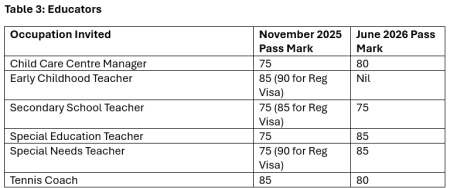
The removal of early childhood teachers is particularly notable given the recent debate on the salaries of this occupation.

The newly added occupations were:
- air conditioning and refrigeration mechanics;
- endocrinologist;
- fitter and turner;
- footballer;
- gastroenterologist;
- lift mechanic;
- meteorologist;
- music director;
- orthotist or prosthetist;
- panel beater;
- sheet metal trades worker; and
- shipwright.
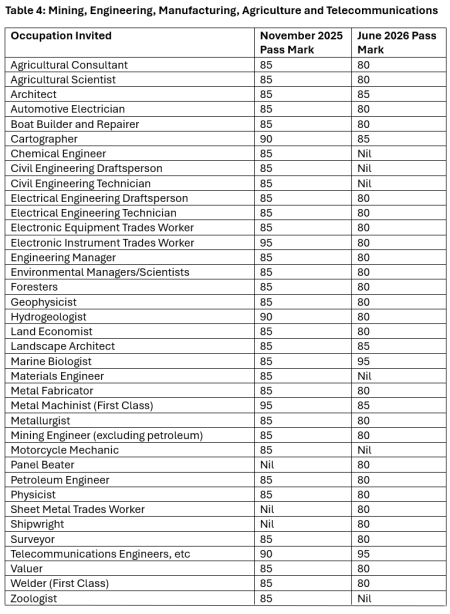
The focus of both the November 2025 round and the June 2026 round has remained construction trades (highest priority), health professionals, mining, engineering and manufacturing professionals, particularly in electrical engineering, teachers and environmental scientists.
On the other hand, there is a large number of occupations on the skills occupation list that received no invitations in either round, including the much politically and media celebrated yoga teachers and goat farmers.
There were also no invitations for finance professionals (such as accountants, auditors, stockbrokers, financial advisers), but actuaries and statisticians were invited. No chefs or cooks were invited despite these occupations being a favourite for employer sponsorship. No hairdressers were invited. Barristers and solicitors were invited at a high pass mark (in other words, not high-priority occupations).
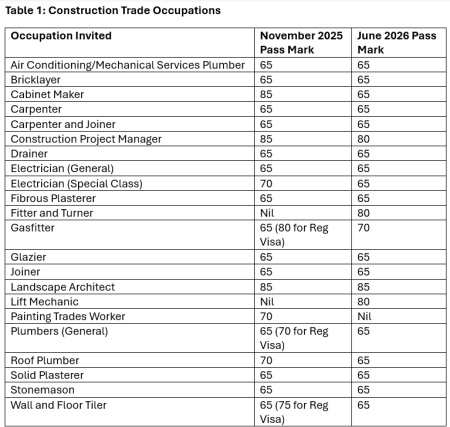
The priority for construction tradies is highlighted by the fact that most of these are accepted at the minimum pass park of 65 points (see Table 1). In other words, just about any EOI from a successfully skills-assessed tradie who can prove their English and age claims is accepted.
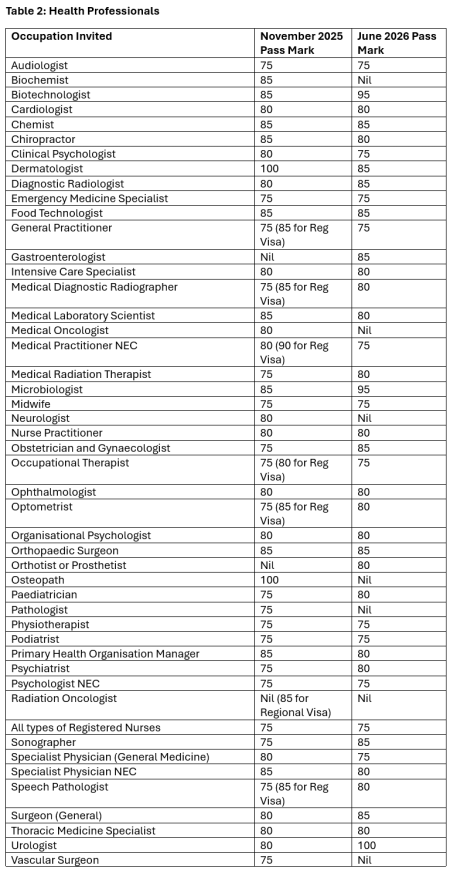
Health professions also remain a high priority, but not as high as tradies. The pass mark for most nurse occupations is around 75, which means that most qualified nurses continue to be accepted, as nurses must score very highly in English. Most other types of health professionals were invited, but at varying pass marks ranging from 75 for general practitioners to 100 for dermatologists.
Teaching professionals are also a high priority with most requiring a pass mark of 75. This would be achieved by almost all teaching applicants as the skills assessing body for teachers requires a particularly high English language requirement.
While not as high priority in terms of pass marks, numerous occupations in the mining, engineering, manufacturing, agriculture and telecommunications industries were also issued invitations.
Dr Abul Rizvi is an Independent Australia columnist and former Deputy Secretary of the Department of Immigration. You can follow Abul on Twitter @RizviAbul or Bluesky @abulrizvi.bsky.social.
 This work is licensed under a Creative Commons Attribution-NonCommercial-NoDerivs 3.0 Australia License
Support independent journalism Subscribe to IA.


Related Articles
- Why political diversity lags as ethnic diversity rises in Australia
- Labor Government playing dicey politics with immigration management
- Tony Burke signals an immigration shift as Labor confronts migration reality
- Liberal Party migration scare campaign built on the wrong data
- Suggested Cabinet submission for 2026-27 migration and humanitarian program