The Albanese Government has reduced net migration sharply, but further reforms will be needed if it is to meet its promised target by 2027-28. Dr Abul Rizvi reports.
THE LIBERAL PARTY says migration to Australia is “exploding”.
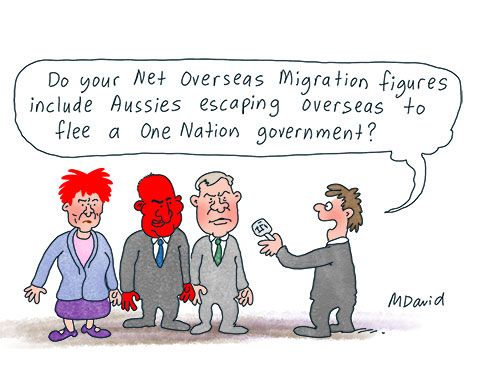
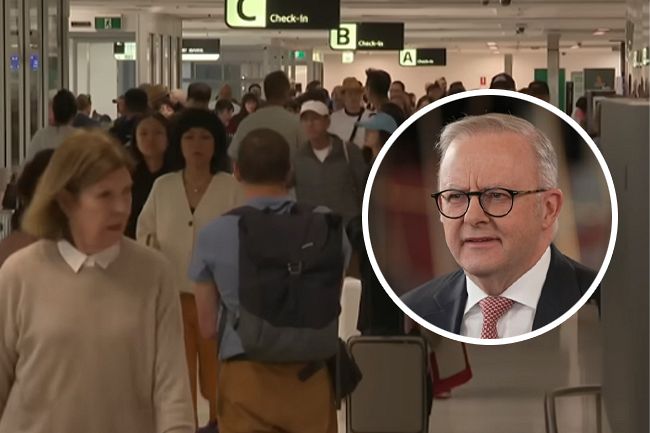
Senator Pauline Hanson has followed suit and promises to get net migration down to negative 100,000. The Prime Minister says net migration has fallen by 45% since its peak in 2022-23 of over 500,000 and that he intends to bring net migration down to 225,000 by 2027-28. Who should Australians believe?
The Liberal Party’s assertion that migration is “exploding” is based on misuse of data by the Institute of Public Affairs — misuse that has been called out by the Bureau of Statistics (ABS). And while net migration has indeed fallen significantly since the 2022-23 peak (mainly due to tightening of policy on overseas students), it remains at historically high levels of around 300,000.
The Labor Government has taken additional measures in the past six months to bring net migration down further. But has it done enough to get to the PM’s promise of net migration in 2026-27 at 245,000 and in 2027-28 at 225,000?
I doubt it.
We now have some additional data to help with that, but we won’t get the preliminary estimate of net migration in 2025-26 until December 2026 and we won’t have the preliminary estimate of net migration for 2026-27 until December 2027 (possibly months before the next election).
We now have data on the stock of temporary entrants in Australia at end June 2026. Changes in the stock of temporary entrants are an indicator of what is happening with net migration.
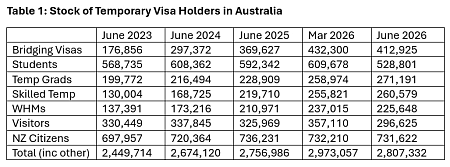
The total stock of temporary entrants at end June 2022 was 1,919,774 and at end June 2021 it was 1,681,585. The momentum for rapid growth was sown in policy measures put in place towards the end of COVID, together with the lack of any plan to manage net migration (from either the Coalition or Labor).
In 2022-23, the stock of temporary entrants in Australia grew by an astonishing 27.6% after having grown by 14.2% the year before.
Consistent with the fall in net migration, the growth rate in the stock of temporary entrants in 2025-26 fell to 50,346 or 1.8%. But this doesn’t tell the full story.
The stock of temporary entrants changes not just by a change in arrivals but also by (1) changes in departures; (2) temporary entrants securing a permanent visa; and (3) New Zealand citizens becoming Australian citizens.
We don’t have recent publicly available data on NZ citizens acquiring Australian citizenship. The latest public data shows that in 2024-25, 165,193 people were granted citizenship by conferral, of whom 33,103 (or 20% and well ahead of Indians on 13.9%) were formerly NZ citizens.
In 2024-25 and most likely also in 2025-26, around 65% of the permanent migration program were temporary entrants already in Australia.
It’s important to look at the composition of temporary entrants to understand what might be happening.
The decline in the stock of student visa holders in Australia reflects the policy tightening in 2023-25 as well as the marked increase in offshore student refusals since around October/November 2025. That higher refusal rate, plus the increase in student visa application fees, eventually led to a fall in offshore student visa applications from March 2026.
The high refusal rate based on subjective criteria is not sustainable. A more objective set of criteria will be needed, ideally a test of academic ability.
The stock of student visa holders in Australia at end June 2026 was 528,801. Lower than the stock at end June 2019 of 553,139 but higher than the stock at end June 2018 of 486,934. The contribution of students to net migration likely fell again in 2025-26 and will likely fall further in 2026-27. Abolishing the International Education industry, as implied by One Nation policy, would be foolish.
Stocks of working holidaymakers continue to rise from June to June and are well above anything pre-COVID. That likely reflects a lack of policy tightening since the COVID-era changes and Australia’s strong labour market. If the Government wants to reduce net migration to 225,000 in 2027-28, it will need to tighten working holidaymaker policy, possibly by abolishing the option of a third working holidaymaker visa introduced during COVID. It is no longer needed.
Temporary graduate stocks continue to increase June to June and were at an astonishing 271,191 at end June 2026. The pre-COVID June record was in June 2019 at 91,776. The Government has failed to adequately tighten policy on temporary graduate visas and will have to act.
The most obvious and most targeted option would be to confine temporary graduate visas to students who have completed high-quality courses in areas of long-term skill shortage (such as health care, construction trades and perhaps a few other niche occupations). That would increase departures of temporary graduates but retain a pathway to permanent residence for people with the skills we need long-term.
The stock of skilled temporary visa holders at end June 2026 was 260,579. Once again, an all-time June record and much higher than any pre-COVID level, partly due to the strong labour market. While the Government has tightened policy in this space by increasing the minimum salary to almost $80,000 after it had been frozen for almost a decade at $53,000, it needs to go further and increase the minimum salary to perhaps around $100,000 (other than in respect of nurses due to the low starting salary of nurses).
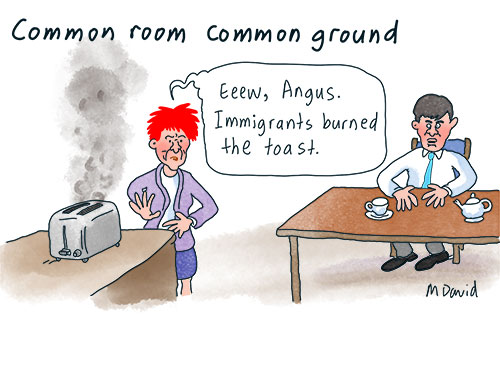
The record number of NZ citizens in Australia is partly due to Australia’s strong labour market relative to that of NZ and also policy changes made in mid-2023 to make it easier for NZ citizens to acquire Australian citizenship. The Government should reverse that policy change even if it is politically difficult. One Nation’s suggested policy change for NZ citizens would be poor policy from a number of perspectives.
The Government should also consider returning the humanitarian program of 20,000 back to the long-term average of around 14,000. The larger humanitarian program requires a much larger investment in settlement services. Unless the Government is prepared to do that, it cannot sustain a humanitarian program of 20,000.
Finally, the Government must act on the extraordinary backlog of people on bridging visas. That simply reflects a visa system in trouble. But putting more resources into visa processing will not be enough. Some targeted policy changes will be needed, including in terms of onshore student visa policy, partner visas and removal of unsuccessful asylum seekers.
The policy changes listed above would ensure the Prime Minister’s commitment to get net migration down to 225,000 is met. Not doing so would be both bad policy and bad politics.
Dr Abul Rizvi is an Independent Australia columnist and former Deputy Secretary of the Department of Immigration. You can follow Abul on Twitter @RizviAbul or Bluesky @abulrizvi.bsky.social.
 This work is licensed under a Creative Commons Attribution-NonCommercial-NoDerivs 3.0 Australia License
Support independent journalism Subscribe to IA.


Related Articles
- Government twists student visa policy to chase migration targets
- Visa fee increases reflect lazy government
- Skilled visa invites reveal Australia's workforce priorities
- Why political diversity lags as ethnic diversity rises in Australia
- Labor Government playing dicey politics with immigration management