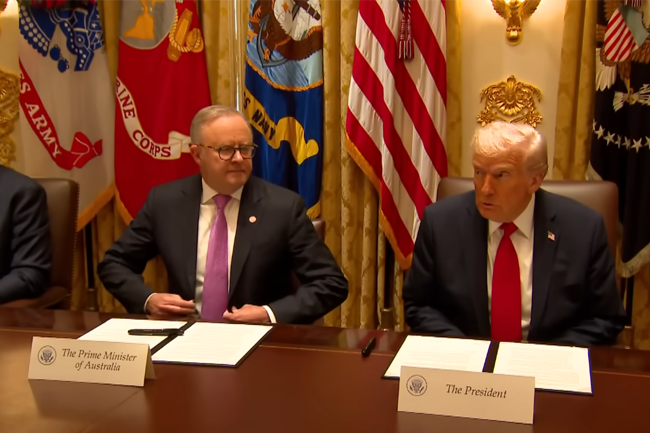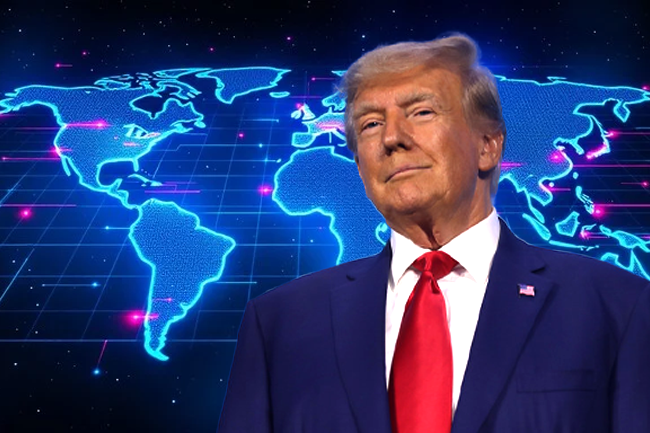
As Donald Trump redraws the world from ice cap to ice cap, Australia risks discovering that being strategically central in someone else’s map means being politically expendable on your own, writes Vince Hooper.
BY THE TIME Americans finished arguing about walls, tariffs and indictments, President Donald Trump apparently looked at a globe and decided it was inefficient. Why stop at borders when you can collect axes?
Thus emerges the latest cartographic innovation of Trump 2.0: a world reordered not left to right, but top to bottom – from the Arctic to the Antarctic – like a kebab skewer of influence, rotating slowly over a charcoal grill of international law.
For Australians, this should feel familiar. We live on the underside of the planet, perpetually upside-down in American political metaphors, and usually remembered only when Washington needs a loyal friend with submarines, sand, and a Constitution that doesn’t get in the way.
Now, however, we find ourselves staring at a grand new vision: Pole-to-Pole, a vertical empire stretching from polar ice cap to polar ice cap, with the rest of the world reduced to inconvenient continents floating off to the side.
Trump, it seems, has finally found a map he likes.

The great vertical turn
The genius of the Pole-to-Pole doctrine is its simplicity. Horizontal geopolitics – alliances, multilateralism, diplomacy – are messy. Vertical geopolitics is clean. You pick the top. You pick the bottom. You draw a straight line through whatever happens to be in between and call it destiny.
Greenland? Obviously, the hat. Antarctica? The boots. Everything else is merely torso.
Trump’s renewed interest in Greenland was once dismissed as a real estate joke that went too far. But jokes, like tariffs, have a way of becoming policy if you repeat them loudly enough.
Control the Arctic, dominate shipping lanes, access minerals and, most importantly, stick it to China. Control Antarctica and you future-proof yourself against climate change, science, and penguins with suspicious accents.
This is geopolitics for the age of the Sharpie.
Australia: The belt buckle of empire
Where does that leave Australia? Squarely in the middle — the belt buckle of the vertical world order. Not powerful enough to be a pole, not insignificant enough to be ignored. Strategically indispensable, politically disposable.
In Washington’s new imagination, Australia is no longer a country but a convenient stopping point: a refuelling station between ice caps, a friendly place to park submarines, drones and the occasional visiting senator who can’t find Darwin on a map but is absolutely certain it’s vital.
AUKUS, once sold to Australians as sober deterrence, now looks suspiciously like a loyalty program. Collect enough points and you might receive nuclear submarines by the 2040s — assuming the empire still runs on water and not vibes.
Our leaders nod enthusiastically. After all, it’s hard to say no when the person asking has the nuclear codes and a background in reality television.

The Pacific slips sideways
While Canberra gazes reverently south toward Antarctica and dutifully north toward Washington, something awkward is happening to Australia’s east: the Pacific is drifting away.
Island by island, Australia’s traditional backyard is being courted, financed and occasionally defended by powers that do not require submarines or polar metaphors. Pacific leaders talk climate survival; Australia turns up with strategic frameworks and photo opportunities.
The irony is brutal. While Trump redraws the world vertically, Australia is losing it horizontally — too busy positioning itself between poles to notice the neighbourhood changing around it.
We guard Antarctica with one hand while the Solomons quietly slip from our grasp with the other.
Climate change: Melting the prize
There is, of course, a small practical problem with polar obsession: the poles are melting.
The race to dominate ice caps unfolds just as the ice politely retreats. Trump, a man historically sceptical of climate change, now finds himself oddly invested in frozen real estate. Australia, meanwhile, funds Antarctic science with one hand while exporting the coal that melts Antarctica with the other.
It is a remarkable diplomatic trick — claiming stewardship over the ice while accelerating its disappearance.
This is less a strategy than a liquidation sale.
Sovereignty, but make it vertical
The Pole-to-Pole worldview has little patience for sovereignty, international law, or the Antarctic Treaty. Those belong to the old, flat world — fussy, multilateral, consensus-driven.
The new world is cylindrical.
Treaties are no longer binding agreements; they are decorative PDFs. Alliances are not based on shared values, but rather on subscriptions, which are renewable annually depending on tone, gratitude and applause volume.
Australia, a nation built on legalism and process, now finds itself enforcing a rules-based order on behalf of a patron who has quietly shredded the rulebook. We remain the deputy sheriff — long after the sheriff has decided law enforcement is bad for ratings.

Trump the brand, not the strategist
This is not grand strategy so much as branding.
Pole-to-Pole fits neatly on a rally banner. One can easily imagine Trump gesturing at a map and declaring: “We own the top. We own the bottom. Nobody’s ever owned the bottom like this.”
Australian diplomats are then tasked with deciphering whether this is metaphor, impulse or policy — while treating all three as actionable intelligence.
We applaud politely, scribble notes and hope the map doesn’t change again before the next press conference.
Antarctica: Peaceful, until it isn’t
Australians like to imagine Antarctica as a triumph of peaceful cooperation — science over sovereignty, penguins over power. That fiction survives only so long as great powers find it convenient.
Once Antarctica becomes strategic rather than symbolic, research stations begin to resemble forward operating bases with better branding. Cooperation becomes competition. Science acquires flags.
Australia, legally committed to keeping Antarctica peaceful, will soon face a question it has avoided for years: how peaceful are we prepared to be when our allies stop pretending?
Silence at home
Perhaps the most striking feature of this entire shift is not Trump’s ambition, but Australia’s quietness.
There is no serious national debate. No public reckoning. Just bipartisan nodding and a studied refusal to ask what alignment now costs.
Australia sleepwalks into entanglement while arguing about supermarket prices, discovering it has chosen sides only when the invoice arrives.
From falling off the map to being pinned to it
Australians have always joked about falling off the edge of the world. Under Trump’s new geometry, the danger is not falling — but being pinned in place, fixed between poles not of our choosing, spun by forces that do not consult us.
Pole-to-Pole may sound bold, decisive, even amusing. But empires drawn with rulers – and egos – rarely end well for those caught beneath the line.
And if history teaches us anything, it is this: when great powers start redrawing maps for entertainment, it is usually the middle that gets crushed — while the penguins quietly take notes.
An independent Australia does not need to choose a pole. It needs to remember where it stands.
Vince Hooper is a proud Australian/British citizen and professor of finance and discipline head at SP Jain School of Global Management with campuses in London, Dubai, Mumbai, Singapore and Sydney.
 This work is licensed under a Creative Commons Attribution-NonCommercial-NoDerivs 3.0 Australia License
Support independent journalism Subscribe to IA.


Related Articles
- Trump’s Venezuela abduction shatters claims of Western moral authority
- Australia’s ‘national interest’ falters in the face of Trump’s lawlessness
- From rules-based order to rule by fear: America’s democratic unravelling
- CARTOONS: Donald Trump is not 'falling asleep' in the White House
- Trump’s decline into open corruption signals the end of America’s authority