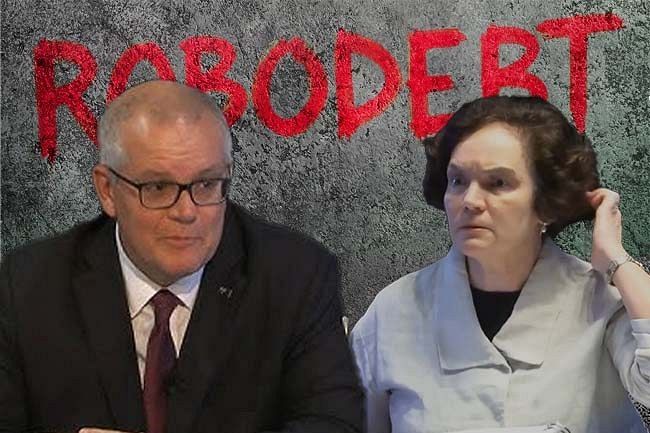
Reporting on the Robodebt reinvestigation released last week by the National Anti-Corruption Commission described scenarios which all but exonerated Scott Morrison and Kathryn Campbell.
Independent media commentators such as Rick Morton have noted the level of ineptitude which saw well-remunerated lawyers putting scepticism to rest while accepting self-serving accounts of problematic conduct and a want of ambition from a relatively low-level Social Services Minister whose brownie points earned following the $1 billion Robodebt "saving" saw him expeditiously replace the ailing Joe Hockey as Australia’s Treasurer in 2015.
At the same time, his equally unambitious public service associate witnessed herself being vaulted into the top job at the prestigious Department of Foreign Affairs and Trade in 2021.
While a degree of unprofessional gullibility might account for the acceptance of witness narratives that defied credibility, on the vexed question of conducting NACC hearings in secret, the overriding impressions left from Deputy Commissioner Kylie Kilgour’s reinvestigation of the "Robodebt Six" were confusion and bewilderment.

Deputy Commissioner Kilgour noted in her 445-page report that the presumption in the NACC Act is that hearings are held in private unless "exceptional circumstances" allow for public hearings.
She moved from that observation to make three assertions:
- the Act does not define "exceptional circumstances";
- the notion of exceptional circumstances is a high threshold to meet; and
- the Robodebt Royal Commission referrals did not meet the threshold.
The relevant part of the NACC Act on public hearings is division 3, subdivision B, section 73 (subsection 3). That subsection sets out five matters to which a NACC Commissioner may have regard when deciding whether to hold public hearings. They include ‘any unfair prejudice to a person's reputation, privacy, safety or wellbeing’ and the ‘benefits of exposing corrupt conduct to the public’.
To those matters listed in the Act, Ms Kilgour added the risk of ‘prejudicing any criminal prosecutions that might arise if serious corrupt conduct could be established’.
While that risk is real, it is also present in the deliberations of other anti-corruption bodies from which the NACC might learn, such as the NSW Independent Commission Against Corruption (ICAC). ICAC’s history of accomplishments has revealed it not to be a risk of such magnitude that it prevented the conviction and imprisonment of high-profile public figures such as Eddie Obeid, Ian Macdonald and Daryl Maguire — each of whom had given evidence to the ICAC in public hearings prior to their convictions in court.
Had she wished, Ms Kilgour could have given equal weight to section 73, subsection (4) of the Act, which simply states that ‘Subsection (3) does not limit the matters to which the Commissioner may have regard’ in deciding whether to hold public hearings.
That subsection appears to suggest that the "exceptional circumstances" threshold contains a degree of latitude available to a commissioner. For reasons best known to herself, the Deputy Commissioner made no use of the discretion available to her to set the bar; it might have been set as high or low as she decided to set it, but she appeared determined to fix it high. It seemed to be a bar that held more weight in her mind than, for example, the benefits of exposing corrupt conduct to the public.
On the question of public hearings conferring unfair prejudice to a person's reputation, it is worth noting that the Kilgour reinvestigation heard in private from 39 witnesses. They consisted of 28 public servants, four PwC employees, an ombudsman and the six people named under seal in the Robodebt Royal Commissioner’s referral. Her published report names each person and the office they held during the course of the Robodebt scandal, from its inception to its conclusion, following a Federal Court ruling that the scheme was unlawful.
Naming witnesses is therefore not in itself a slight on their reputation and commissioners have at their disposal ways of indicating that witnesses are to be seen merely as people called to provide evidence — including whether they are doing so in a voluntary or involuntary capacity.
In testing the public hearing threshold in her own mind, the Deputy Commissioner might well have used her discretion on the matter to consider the deluge of public complaints made to the NACC Inspector following the original decision of June 2024 not to investigate the sealed Royal Commission referrals at all — a decision which the Inspector found to have involved "agency maladministration" and "officer misconduct" centered on the person of NACC Commissioner Paul Brereton.

That finding involved conflicts of interest and a failure of transparency that have severely tainted the future work of the NACC. Since then, the wounded NACC has been in dire need of help on both fronts, with its reputation in tatters. Curiously, Deputy Commissioner Kilgour’s investigation steadfastly declined to avail itself of the opportunity to assist in its rehabilitation.
While declaring that the issue of public hearings was under "constant review" during the investigation, Ms Kilgour might have used her discretion to give some weight to the scandalous failings of Australia’s public service culture that had enabled – through Robodebt – a 'costly failure of public administration' within which 'extensive, devastating and continuing' wrongdoing was perpetrated on around 470,000 Australian citizens, a fact widely reported in Australia and overseas.
The Deputy Commissioner insisted that throughout the course of the investigation she ‘continued to review whether exceptional circumstances had arisen and whether it would be in the public interest to hold hearings in public,’ but gave no account of developments that might have affected her thinking on the matter during the course of those reviews.
In the event, she finalised her report with a sentence notable for its movement into the passive voice:
‘At no point during the investigation were both those statutory requirements satisfied.’
That sentence simply reminds a reader that statutory requirements for public hearings were not satisfied, but does so without informing the reader on what substantive basis the decisions were made, or who actually made the decisions if Deputy Commissioner Kilgour didn’t.
Paul Begley is a Melbourne writer who worked for many years in public affairs roles, most recently as general manager of government and media relations with the Australian HR Institute.
 This work is licensed under a Creative Commons Attribution-NonCommercial-NoDerivs 3.0 Australia License
Support independent journalism Subscribe to IA.


Related Articles
- Justice for some: NDIS fraud punished, Robodebt crimes rewarded
- Robodebt RC reforms needed ‘pronto’
- EDITORIAL: Robodebt RC reforms needed ‘pronto’
- 'Mean Streak' relives Robodebt horrors
- Robodebt response stirs Saturday Paper stoush