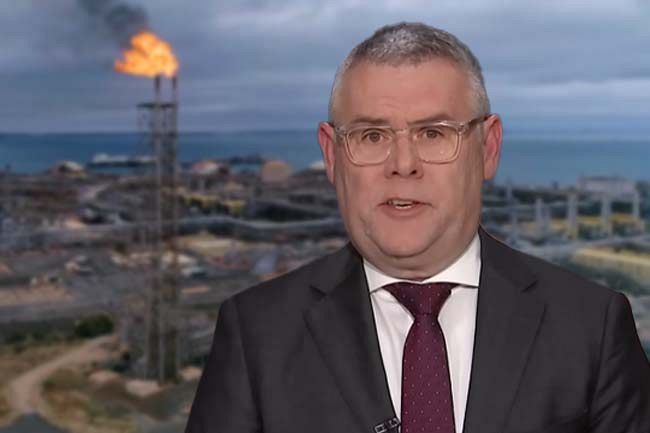
Environment Minister Murray Watt has been accused of sidelining UNESCO safeguards to smooth the path for gas giant Woodside, raising fresh concerns over the integrity of Murujuga’s World Heritage listing, writes David Paull.
SENATOR Murray Watt, the new Australian Environment Minister, was very happy with the outcomes at his recent Paris UNESCO meeting regarding the listing of the Murujuga Cultural Landscape site as World Heritage. Particularly, the decision by the body to disregard the conditions proposed by the International Council on Monuments and Sites (ICOMOS) committee regarding protection of the site from acidic rain after lobbying by the Australian contingent, including their indigenous allies, the Murujuga Aboriginal Corporation.
Perhaps the happiest, however, was the gas giant Woodside, the proponent of the North West Shelf Project, who are currently in backroom dealings with the Minister regarding as yet undisclosed development conditions.
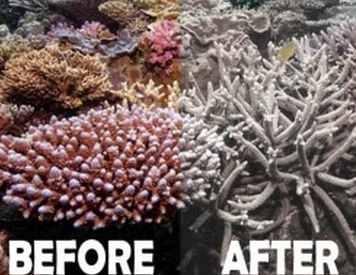
Indeed, the actions by Murray “Muzza” Watts follow a proud history of Australian Government deception at the UN, notably the brilliant work done by Opposition Leader Sussan Ley while Minister to stop the categorisation of the Great Barrier Reef as being “endangered”. Possibly the first World Heritage site to go from “healthy” to beyond help in one step, if current scientific information on bleaching levels throughout the Reef is to be accepted. It seems the ALP have followed the L-NP tradition that science is to be manipulated, not followed.
How did Watt obtain such a result? By using tactics that would make Sussan Ley and the Liberal Party proud. Woodside has a long history of engaging with the Australian Government in deception on the international stage, as history shows in relation to spying allegations over the Greater Sunrise Gas Field in the Timor Sea.

The gas giant certainly would have been onboard with the strategy to obtain a listing of the site by UNESCO without the troubling conditions, which would have inhibited the rollout of its acid-emitting gas and ammonium plants as proposed under the 45-year extension of Woodside’s operations. Operations that Watt had just given preliminary approval.
The tactics used by the Australian Government were primarily a PR offensive. UN organisations have a long history of giving Australia the benefit of the doubt over environmental issues and the veracity of their information and seem to be susceptible to Australia’s charm offensives.
The Australian Government and Woodside are well aware of this and, in this case, Watt used a combination of the “traditional owners” of Murujuga and the representatives of non-European nations sitting at the UNESCO table to support the unconditional listing. Backing this up, Watt presented to UNESCO scientific monitoring data giving the project the green light, but which could easily be called into question and which contradicted the findings of UNESCO’s own investigation.
The joint managers of the Murujuga Cultural Landscape are the Murujuga Land and Sea Unit, managed by Murujuga Aboriginal Corporation, and the Western Australian Department of Biodiversity, Conservation and Attractions. But Woodside has had a long relationship with the local Indigenous community while undertaking its commercial and export gas operations in the locality of the Burrup Peninsula. A relationship with a strong commercial component.
Traditional Custodians were not involved with the heritage assessments of the Karratha Gas Plant, the first of Woodside’s onshore gas infrastructure in the area in the 1980s, but since 2002 have been involved in cultural heritage management via Woodside’s Cultural Heritage Management Plans for their onshore facilities with audits as well as other investigations and monitoring activities.
As a sign of cooperation, in 2014, Woodside collaborated with Traditional Custodians to relocate more than 1,700 pieces of rock art from a holding compound used since the construction of the Karatha Plant to ‘appropriate positions within the local landscape’. Woodside stated this project ‘marked an important step forward on our reconciliation journey’.
Ten years later, this relationship has grown with the Traditional Custodians represented by the Murujuga Aboriginal Corporation now as the lead organisation dealing with Woodside. In 2024, in conjunction with the Western Australian Department of Water and Environmental Regulation, Yara and Rio Tinto, Woodside helped fund a five-year, $7 million State Monitoring Program, touted as a ‘comprehensive, independent program to monitor, evaluate and report on factors that could affect the condition of the rock art’. This amount has increased to $27 million following support for the program by the WA Government.
The representatives of the Murujuga Aboriginal Corporation who attended the UNESCO meeting in Paris expressed a strong desire to have the Australian Government’s amendments to the conditions on the proposed World Heritage listing passed, conditions which went too far for Woodside. Whether they believed the Australian and WA Governments’ interpretation of all the data on acidic rain impacts on the rock art (petroglyphs) or any other reason is open to speculation.
But to spearhead the Australian position and their amendments, Watt galvanised the support of several of the UNESCO seat holders with the Kenyan representative presenting the Australian amendments at the meeting. No doubt a PR coup, but what made the Kenyans accept this role?
Here, the hand of Woodside shows itself again. In 2006, Woodside started drilling for oil off the Kenyan coast, part of a consortium with a 50 per cent holding. While not yet a base, Woodside still retains interest in the Kenyan oil field.
Another UNESCO seat and supporter of the Australian amendments was South Korea, which signed a long-term supply agreement with Woodside just last year. No doubt the North West Shelf field would be a major contributor to this gas and cash pipeline. The independence of other countries at the table was similarly compromised.
But what of the position presented by Watt to the UNESCO meeting that the best evidence we have suggests that there is no impact from acidic rain on the 50,000-year-old petroglyphs at the Murujuga site?
This was a position also taken by the Murujuga Aboriginal Corporation and the Western Australian Government, who, after an 18-month study published last year, found that:
‘The acid rain/deposition theory proposed by earlier researchers is not supported by data from this program.’
It seems it depends on who you ask, as this latest conclusion lies in contrast to assertions made elsewhere. Woodside itself, on its website, has suggested contradictory data and, in ‘the absence of conclusive scientific research on the level of emissions which theoretically may affect rock art’, Woodside advocated for a precautionary approach across its operations and growth projects to minimise emissions.
The Government has long been aware of the potential issues with industrial emissions and the integrity of the Murujuga petroglyphs. In 2002, the Western Australian Government first established the Burrup Rock Art Monitoring Management Committee to assess the potential impacts of industrial emissions on the petroglyphs. While earlier reports suggested no discernible impacts, in 2010, the newly formed Burrup Rock Art Technical Working Group was established with contributions by the CSIRO.

The final CSIRO report notes that ‘the results are not fully conclusive’, a view echoed in a 2023 monitoring report, which Woodside stated was ‘not possible to draw meaningful conclusions based on the data collected to date, but some of the methods are considered promising in being able to inform standards for industrial emissions’.
No doubt, in order to provide some clarity to the preliminary listing of the site as World Heritage, UNESCO tasked its own investigative body, the ICOMOS group, to conduct an investigation into the impacts of predicted levels of emissions on a rock site such as Murujuga. It concluded that impacts could be significant and recommended Australia end acidic pollution on Western Australia’s Burrup Peninsula.
As Raelene Cooper, traditional owner and former chair of the Murujuga Aboriginal Corporation, stated, the report dispelled ‘the myth that the gas industry and the ancient Murujuga rock art can co-exist’. Cooper was part of a contingent of traditional owners who travelled to Paris to voice their concerns over the Australian Government amendments and the impacts of the proposed new gas facilities on the ancient and highly significant cultural site. Cooper has since accused the UNESCO group of silencing her delegation.
Then in 2025, no doubt to support the World Heritage listing but to squash the ICOMOS findings, the WA Government released its own monitoring report, supported by work conducted by Curtin University. In May, the WA Government released a summary report, but it was quickly questioned by one of the report’s lead authors, Professor Adrian Baddeley, who is a member of the Australian Academy of Science. He complained that a graph had been altered without his permission, which had shown a lower threshold level for acceptable levels of pollution, but it had been removed.
Baddeley stated:
‘If the green-aqua dashed line were reinstated, it would show that five of the monitoring sites were experiencing pollutant levels above the interim guideline, and again these are the five sites closest to industry.’
The report also found that the upper layer of the most common rock in the area had experienced elevated porosity – in other words, historic degradation – in samples taken from areas closer to Dampier, home to industrial operations since the 1960s.
While current monitoring shows low levels of atmospheric pollutants, such as nitric acids (though atmospheric ammonium is ‘above expected levels’), this is most likely because levels of current emissions are low, compared to historic and future emissions if the North West Shelf Extension goes ahead. It seems the WA report has not taken these considerations properly into account.
But the WA Premier, Roger Cook, stated emphatically:
“The science has said that modern industrial developments do not have a long-term impact in terms of the quality of the rock art.”
This was disputed by the Curtin University scientists, but as WA Environment Minister Matthew Swinbourn clarified, the government summary document was drafted by his department with input from Curtin University and the Murujuga Aboriginal Corporation.
And so, the decision to allow the World Heritage listing for the Murujuga Cultural Landscape was given and the annoying ICOMOS recommendations were removed, allowing Woodside to proceed with its gas operations.
However final conditions for the North West Shelf expansion are still to be worked out, no doubt, Minister Watt and Woodside will be giving these their fullest consideration, particularly as some traditional owners, the Save Our Songlines group, have committed to a Section 10 stop work order on cultural grounds. If the best information is provided, this could cause some concern for Watt and his corporate friends, given that he is the Minister who will give his consent or otherwise on the matter.
Perhaps like the Great Barrier Reef, Murujuga will be moved into the endangered category soon. But there are two issues which will not be looked at — interference in Indigenous decision-making through the use of financial reward and the undue influence of corporate interests at UNESCO and the Australian Government. Both remain central to the current state of play with regard to Murujuga.
David Paull is an Australian ecologist and blogger on politics and the environment.
 This work is licensed under a Creative Commons Attribution-NonCommercial-NoDerivs 3.0 Australia License
Support independent journalism Subscribe to IA.