Fixated on arbitrary defence spending targets, politicians are chasing percentages over practicality — even if it means redefining what 'defence' actually means, writes Stephen Koukoulas.
A LOT IS BEING MADE of the Australian Government’s spending on defence, mainly from the perspective of it being “just” 2% of annual GDP.
There are calls for this to be increased to 2.5%, 3% and even 3.5% of GDP. Even at the lower end, these targets would be a huge, tens of billions of dollars per year impost on the budget, tax and government debt for many decades to come.
And why?
These calls for extra defence spending are framed partly from the perspective of what procurement and personnel levels will be needed to make our defence force as effective and efficient as possible, relative to the threats and requirements from global geopolitical pressures. This is in the context of the perception that those threats to Australia are increasing.
There is a lot more to the issue of a numerical target for defence spending than the soldiers, sailors, missiles, computer technology and submarines needed to defend Australia from an as-yet unnamed aggressor. (Let’s put aside the notion that Australia does not need to ramp up its defence spending to invade another country.)

A tongue-in-cheek boost to defence spending as a percentage of GDP
Let’s have a think about how “defence spending” could be defined.
What if the transport-related infrastructure – roads, for example – that lead to defence establishments are included in the definition of defence spending? They are only there because of the defence facility. This modified definition could add a couple of hundred million dollars to defence spending with no impact on the budget.
What if an even greater share of foreign aid to Pacific Islands and some Southeast Asian nations for their defence and infrastructure requirements is classified as Australian defence spending? A form of this does exist under current definitions, but the Government could include more current spending in this category without impacting the budget.
Some people might actually consider a broader definition of these expenses to be a reasonable addition. It means that with no change in policy but with a change in labels, the defence to GDP spending ratio increases.
Then there are a range of other issues — ramping up housing subsidies for defence employees, more spending on the office fit out at the Defence Department in Russell Hill or giving defence personnel pay rises above the rate of nominal GDP growth that would help in increasing the numerical spending target.
These tongue-in-cheek examples would all see a defence to GDP spending increase, without any rise in defence capacity or, indeed, changes to the budget bottom line. They are meant to show how silly the spending-to-GDP target is.
But there is more.
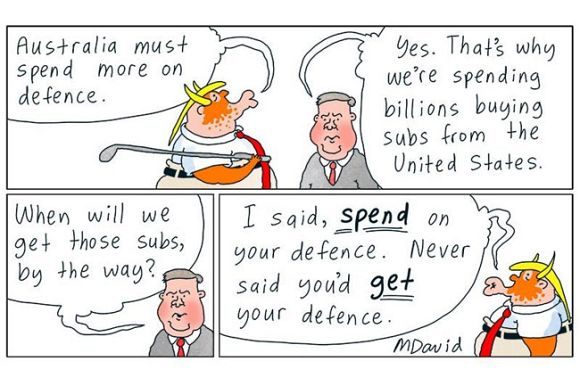
Let’s have a recession!
There are other ways defence spending can increase as a percentage of GDP.
At a macroeconomic level, a terms of trade slump in Australia, which lowers export prices, or if there is a deep and nasty recession, nominal GDP (the denominator of the defence to GDP ratio is measured) falls.
This means that even with flat defence spending in dollar terms and no extra defence capacity, spending as a share of GDP will increase.
Here is a simple example of that:
- Year 1: GDP is $3,000 billion. Defence spending is $60 billion. This is 2% of GDP.
- Year 2: Australia, hit with a nasty recession and a slump in the terms of trade, sees GDP fall, say, 10% to $2,700 billion. If defence spending is unchanged at $60 billion, it nonetheless rises to 2.22% of GDP.
A higher ratio of spending without any expansion in defence capacity, simply by having a recession!
Brilliant.
Or there could be the opposite problem — an inflationary surge that sees a sharp 10%-plus jump in nominal GDP (as happened in the period 2022 to 2024). The ratio could fall.
Even if defence spending growth is ramped up by 5%, with nominal GDP growth of 10%, the ratio to GDP falls.
What is needed for defence
Like all areas of government spending, defence should be accountable to the lowest-cost, efficient and necessary spending measures. Spending at a particular share of GDP, regardless of the need, is foolhardy.
It is hard to imagine a similar formula applying to spending on aged care, health or public debt interest. It will never happen in these areas because such spending, like defence, is based on need.
In the case of defence, it should be evident that spending should be associated with requirements — no more, no less. And this, regardless of what proportion of GDP.
Drones, cyber, missiles, planes or bayonets — whatever it takes to deal with the actual threat and risks for Australia should be on the Defence Department’s requirements and agenda.
An arbitrary figure, plucked from the air with no relevance to need, is not only ridiculous but can lead to a waste of huge sums of scarce government money at a time when education and skills, an ageing population, massive advances in health and enhanced infrastructure are all going to be requirements of government spending in the decades ahead.
Either that, or just redefine current spending to boost the defence-to-GDP ratio.
Stephen Koukoulas is one of Australia’s most respected economists, a past chief economist of Citibank and senior economic advisor to an Australian Prime Minister. You can follow Stephen on Twitter/X @TheKouk.
 This work is licensed under a Creative Commons Attribution-NonCommercial-NoDerivs 3.0 Australia License
Support independent journalism Subscribe to IA.