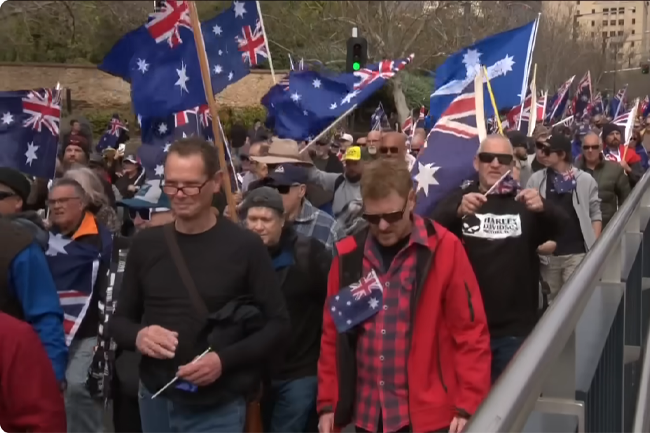
The March for Australia crowd says this country was built by European convicts and should stay that way. They might want to meet Australia's first bushranger, writes Wayne Hawkins.
A five-gallon bounty
On 15 February 1796, a former highwayman named John Wimbow tracked a runaway convict through the scrub at Liberty Plains, near today's Strathfield. He shot him. The wounded man was carried to Thomas Rose's hut, where he died.
Wimbow was after a reward. A fortnight earlier, Governor John Hunter had offered five gallons of spirits for the capture of the man the colony called Black Caesar.
John Caesar came out on the First Fleet, aboard the Alexander. He was a Black man, a servant in Deptford before Maidstone Assizes sent him to Botany Bay for seven years for stealing money. By most accounts, he was born in Madagascar or the West Indies.
He was also, by the reckoning of the Australian Dictionary of Biography, this country's first bushranger. That was decades before Jack Donohoe and the better part of a century before Ned Kelly.
So here's a question for the people waving flags and chanting about taking their country back. If Australia was built on the backs of convicts, which convicts did they have in mind?
The eleven and the hundreds
Caesar wasn't a lone exception. Historian Cassandra Pybus, working out of the University of Tasmania, counted 11 Black convicts among the First Fleet's arrivals in 1788. Her book, Black Founders, traces where most of them came from: slavery in America.
They had escaped to the British side during the War of Independence on a promise of freedom. When Britain lost, they were shipped to London, discharged and left to beg. Some stole to eat. And so the first boatload of "European convicts" included former American slaves who had worn the King's coat.
Caesar's own origins are murkier; the record says only African parentage. The colony's Judge-Advocate, David Collins, rated him the hardest worker in the settlement, a huge man who was always hungry. On starvation rations, he kept stealing food and bolting into the bush. Collins wrote him off as incorrigible.
Then there was Billy Blue, Sydney Harbour's first ferryman, who gave his name to Blues Point. There was John Goff, son of a Black loyalist, transported in 1815, flogged repeatedly and another bushranger in his turn.
And the count keeps growing. Filmmaker Santilla Chingaipe went looking for African-descended convicts for her 2024 book, Black Convicts. She found hundreds of non-White people from across the British Empire in the colonial archives.
Here is a detail for Tasmanian readers. Caesar left a daughter, baptised Mary Ann Fisher Power. In 1813, she came to Van Diemen's Land. The first bushranger's story runs through this island too.
“Australia = European = White”
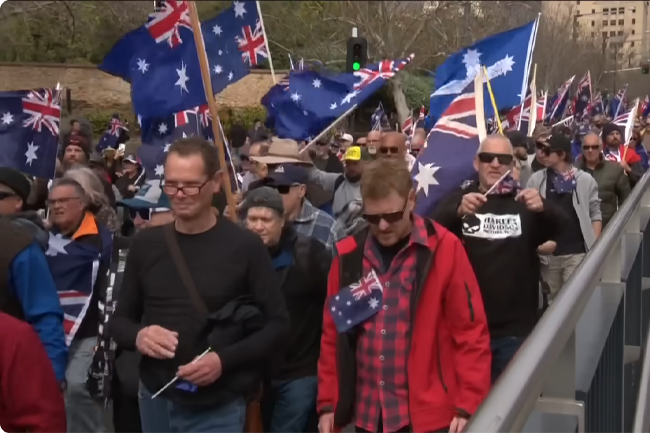
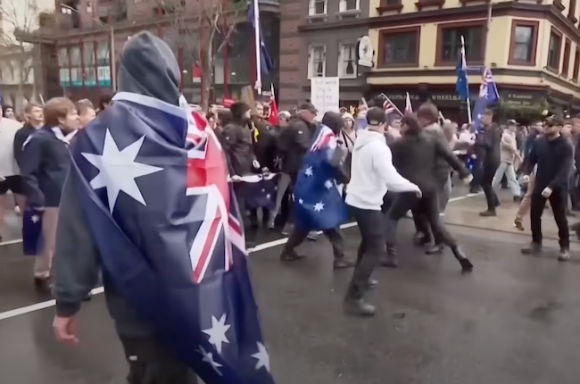
Set that against the story being sold on the streets since August 2025. March for Australia's flyers urged people to 'take our country back' and 'defend our culture'. The rallies have been rolled out again on 19 October, Australia Day and 30 August this year.
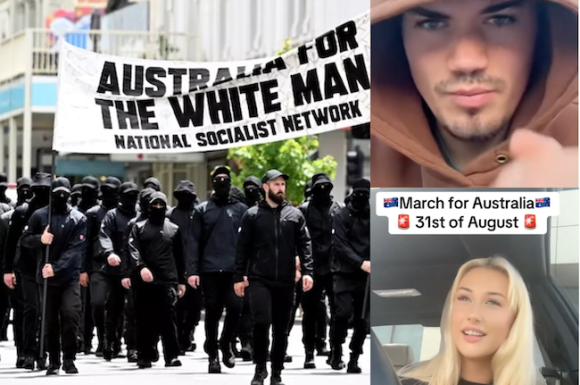
Organisers insist they're just ordinary Australians worried about housing and the cost of living. Their own early chats, as Tom Tanuki reported in these pages, put the theme more bluntly: "Australia = European = White". Thomas Sewell, leader of the neo-Nazi National Socialist Network, took the stage in Melbourne.
The numbers they pushed didn't hold up either. AAP FactCheck found their headline claim about Indian migration was false.
But the deeper lie isn't about migration statistics. It's about origins. The whole pitch rests on a founding myth: a White, British, convict-and-pioneer nation that others have since crowded into. A Black convict bleeding out in the Strathfield scrub says otherwise.
How the whitewash was made
The early colony was never as White as the story told about it. Lascar seamen, Chinese settlers, Pacific Islanders, Māori whalers and Black convicts all turn up in the records. The whiteness came later and it was manufactured.
One of the first major laws of the new Commonwealth in 1901 was the Immigration Restriction Act, the backbone of White Australia. A nation defining itself by who it kept out needed a history to match. So the national story was written as British, with everyone else either a footnote or a threat.
The bushranger legend went through the same wash. It was rebuilt around Irish-Australian larrikins, Ned Kelly above all, as a tale of the battler against the squatter and the trooper. A starving Black convict shot for a bounty of grog didn't fit the poster, so he was left off it.
The archive helped. Clerks recorded race inconsistently or not at all, and later historians read every unmarked name as White. Erasure doesn't always need a villain. Sometimes it just needs people who never thought to ask.
“Not India or Africa”
The same myth gets polished at the war memorials. Kangaroo Jack is an Indigenous influencer who wears a One Nation cap and turns up at the anti-immigration rallies. He recently filmed a clip for Gutful in front of the Eternal Flame at Melbourne's Shrine of Remembrance.
Give Jack his due. He says Australians deserve the full truth, and that Black fella and White fella died together in the trenches. That much is right: more than a thousand Aboriginal and Torres Strait Islander men enlisted, often despite rules meant to keep them out.
Then Jack draws the line. Our story, he says, is not the Palestinian story, not India or Africa. It's ours.
Jack was standing in front of a shrine to a war that says otherwise. At Gallipoli, around 16,000 Indian troops fought beside the Anzacs and about 1,400 of them were killed. Anzac letters are full of respect for Gurkhas and Sikhs.
In the Sinai and Palestine campaign, the Light Horse lived on water hauled by Africans. Some 170,000 Egyptian volunteers and 72,500 camels carried it to the front. The Camel Transport Corps lost more than 4,000 men to disease. Inside the AIF itself, more than 500 Australians of Chinese heritage served, Gallipoli sniper Billy Sing among them.
And Palestine? More than 250 Australian soldiers, mostly light horsemen, lie in the Gaza War Cemetery. For a century, a Palestinian family tended their graves; the head gardener is the fourth generation of his family to do it. This year, reports came that Israeli forces had bulldozed sections of the cemetery.
If you're going to stand at the Eternal Flame and tell people whose story Anzac is, you'd better know who's under the headstones and who has been keeping them.

Written out first
None of this should distract from the people erased first and hardest. Before there was a single convict at Sydney Cove, this continent had been home to First Nations peoples for tens of thousands of years.
In his 1968 Boyer Lectures, anthropologist WEH Stanner named it 'the Great Australian Silence'. He described a 'cult of forgetfulness practised on a national scale' in the general histories written after Federation. He was clear it wasn't absent-mindedness. It was a choice, repeated until it felt like nature.
Here in Tasmania we got our own version. For a century, schoolchildren were taught that Truganini, who died in 1876, was the "last Tasmanian". It was a convenient story for a colony that had just waged the Black War. It was also false. Palawa people survived and their descendants are still here, still having to correct the record.
Black Caesar's erasure and Indigenous erasure aren't the same thing, and shouldn't be flattened into one. But they come from the same machine: a national story that kept only the people it found useful.
Whose country?
The March for Australia mob wants a country back. But the country they describe never existed. It's a story assembled around 1901 for a political purpose and they're still marching to it.
The real founding is messier and more interesting. It's a land already owned and cared for, a gaol built on top of it, and a convict population drawn from wherever the Empire's poor washed up. Some of them were Black men who had already fought one war for their freedom and been cheated of it.
Patriotism that can't survive the truth about 1788 isn't patriotism. It's nostalgia for a myth. If you love this country, you can love it as it was: First Nations land first, then a mixed and hungry place from the first day the boats dropped anchor.
John Caesar was killed for five gallons of rum and then left out of the legend. The least we can do is put him back in it and stop letting people who never heard of him tell us who Australia belongs to.
Wayne Hawkins is a product of public schools who dropped out before earning any significant degree. His real political education came later, from more than 25 years of running businesses locally and overseas, seeing inequality up close and turning to history to understand how it got that way.
 This work is licensed under a Creative Commons Attribution-NonCommercial-NoDerivs 3.0 Australia License
Support independent journalism Subscribe to IA.


Related Articles
- 'March for Australia' losing numbers and strength
- Allowing the far-right to spearhead anti-immigration protests helped Big Australia
- Don't blame migrants for the housing crisis, blame the millionaires
- 'March for Australia' is not common-sense patriotism — it’s a Nazi-led mobilisation