In 1989, the most admired conservative on Earth asked the UN for binding limits on greenhouse gases. Twenty years later, Australia’s next conservative PM called the science “absolute crap”. Wayne Hawkins follows the money in between.
The Iron Lady’s warning
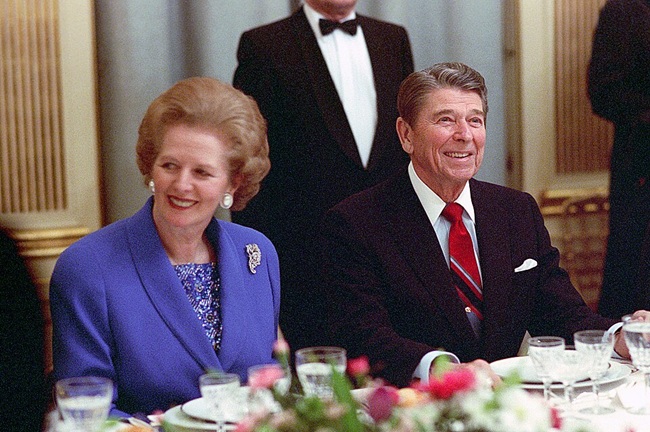
ON 8 NOVEMBER 1989, Margaret Thatcher (nicknamed The Iron Lady) stood before the United Nations General Assembly and warned the world about climate change. The next day, the Berlin Wall came down. She could have spent the moment taking a victory lap over communism. Instead, she spent half an hour on the atmosphere.
This was no stunt. Thatcher had trained as a chemist.
In September 1988, she told the Royal Society that humanity might have unwittingly begun a vast experiment with the planet. At the UN, she called for a binding international convention on greenhouse gases, with specific commitments to fill it out.
She backed the new Intergovernmental Panel on Climate Change. In 1990, she opened the Hadley Centre, which became one of the world’s leading climate research units.
She was no saint of the environment. Two days before the UN speech, Britain helped block a proposal for a 20 per cent cut in carbon dioxide emissions by 2005. Still, the Iron Lady accepted the science. She also accepted that markets had limits when the stakes were this high.
Hold that image: the conservative icon, the hero of every Young Liberal bedroom wall, demanding global climate action. Then try to find a Liberal or One Nation MP today who would give that speech and keep their preselection.
Reagan, the ozone hole and the price of a solution
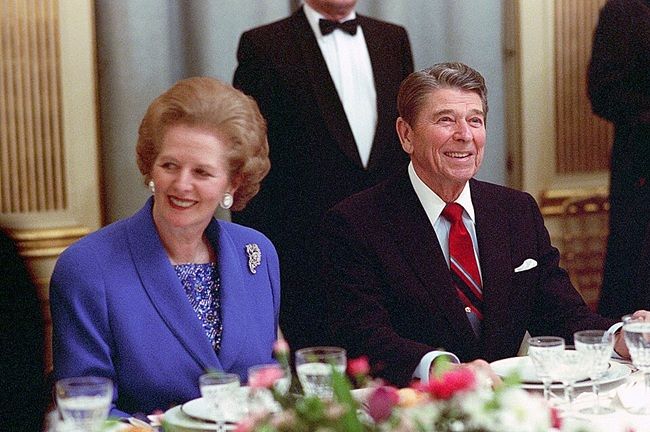
Former U.S. President Ronald Reagan gets lumped in with Thatcher, but his record is different. He was no climate campaigner and was known for brushing off environmental causes. His one big green win was the ozone layer.
In 1987, he overruled members of his own Cabinet to back the Montreal Protocol, which phased out ozone-destroying CFCs. He signed it in 1988 and called it a model of cooperation. It went on to become the most successful environmental treaty ever.
His successor went further. Campaigning in Michigan in August 1988, George H.W. Bush promised to meet the greenhouse effect with the “White House effect”. By 1990, he was backpedalling, and the White House climate conference he promised never happened.
Why did ozone succeed when climate change action stalled? The chemical companies already had profitable substitutes for CFCs, so fixing the ozone hole cost them very little. Carbon is different. There is no substitute product for a coal mine or an oil field, so climate action threatens whole business models.
When an industry has no way to profit from the solution, it pays to deny the problem.

The doubt machine
Industry moved fast. In 1989, the same year Thatcher spoke at the UN, fossil fuel and manufacturing companies set up the Global Climate Coalition to fight climate policy. Its job was not to win the scientific argument. Its job was to make the argument look unsettled. Exxon, coal companies and the American Petroleum Institute paid for sceptical scientists and funded think tanks to repeat the message.
It worked. Sociologist Riley Dunlap’s research shows Republican public opinion turned sharply against environmental policy in the early 1990s. Before then, the two US parties had barely differed on it. Dunlap and Aaron McCright documented how conservative think tanks remade global warming into a non-problem. The 1994 Republican takeover of Congress then handed them real power.
The timing matters. The Cold War had just ended, and the Right had lost its great enemy. Dunlap argues that the “red scare” was replaced by a “green scare”.
Environmentalists became the new menace: “watermelons”, green on the outside and red on the inside. That was the ideological hook. Climate action meant regulation, carbon prices and global treaties, everything free-market conservatism had spent a decade tearing down. It was easier to deny the problem than to accept the solution.
Even Thatcher was eventually brought around. In her 2002 book, Statecraft, she called climate change the 'doomsters’ favourite subject'. She said it offered a marvellous excuse for 'supra-national socialism'. The sceptics treated her recantation as a trophy, and her UN speech went down the memory hole.
Made in America, assembled in Canberra
Australia came to the playbook late, and then it flipped hard.
It is easy to forget that John Howard went into the 2007 election promising an emissions trading scheme. His Environment Minister was Malcolm Turnbull. Both major parties had a market mechanism on their platforms. For a brief moment, carbon pricing was bipartisan.
It did not last. In September 2009, at a meeting in regional Victoria, Tony Abbott told the room the science behind climate change was “absolute crap”. Ten weeks later, on 1 December 2009, he challenged Turnbull over the Rudd government’s ETS and won by one vote, 42 to 41.
Turnbull had said he would not lead a party that was not as committed to climate action as he was, and he didn’t.
That single vote shaped the next decade. On 17 July 2014, the Abbott government repealed the carbon price in a 39 to 32 Senate vote, with Clive Palmer’s senators providing the numbers.
Australia became the first country in the world to scrap a carbon price. That vote fell seven years to the day after Howard first unveiled his own emissions trading plan.
What followed was the climate wars: five prime ministers, a lost decade of energy policy, and power bills that kept climbing anyway. The American script had been imported almost word for word: the uncertainty, the “great big new tax” and the warnings about socialism by stealth.
By the 2020s, “net zero” had joined the culture-war list next to every other grievance the Right could find. Here in Tasmania it shows up in fights over wind farms and transmission lines, wrapped in warnings that someone is coming for your ute.
So who changed?
The physics didn’t change. Carbon dioxide traps heat now just as it did when Thatcher told the Royal Society so in 1988. Since then, the evidence has only piled up.
What changed was who was paying, and what it would cost them. The conservative movement didn’t reason its way out of climate science. It was paid out of it, and then taught to wear the result as a badge of identity. The people who bought the doubt did it for profit. The people who carry it now, the farmer, the tradie, the bloke at the pub, mostly do it because it has become a sign of which side they are on.
They deserve better than to be used as foot soldiers for a coal lobby that never asked about their power bills.
There is a real conservative argument for climate action, and Thatcher made it. As her former minister Lord Deben put it, you hand on something better to your children than you received. The Liberals and One Nation could pick it up tomorrow. That they won’t says less about the science than about who they now answer to.
So the next time someone on the Right calls climate action a socialist plot, hand them a copy of the Iron Lady’s 1989 speech. Then ask them what changed: the science, or the donors?
Wayne Hawkins is a product of public schools who dropped out before earning any significant degree. His real political education came later, from more than 25 years of running businesses locally and overseas, seeing inequality up close and turning to history to understand how it got that way.
 This work is licensed under a Creative Commons Attribution-NonCommercial-NoDerivs 3.0 Australia License
Support independent journalism Subscribe to IA.


Related Articles
- Climate change rebellion, anyone? Aussie Gen Z says...Meh!
- It’s not climate change – it's climate reversal
- The plan to transition Australia away from fossil fuels
- Naming the real problem with our climate
- Western liberalism and the harsh reality of climate change