Last week’s economic roundtable allows Treasurer Jim Chalmers to continue his incremental agenda now and radically transform the nation later, as Alan Austin reports.
AN IMPRESSIVE ORCHESTRA of the nation’s top bureaucrats, academic wizards, corporate chiefs and heads of agencies performed impressively under the baton of maestro Jim Chalmers in Canberra last week. The Economic Reform Roundtable delivered barely a discordant note.
The fact that none of the assembled impresarios riffed solo with any pressing complaint was a strong if unstated endorsement of Labor’s harmonious economic performance.
Hair-on-fire panic about productivity was doused. Mendacious moaning about the household recession was muted. The cost of living crisis – which IA has shown ended two years ago – was forgotten. And pathetic attempts by Coalition figures to trap Labor were dismissed.
In his final press conference last Friday, Dr Chalmers identified four areas of intended taxation reform. These were (1) a fairer go for workers, including greater intergenerational equality; (2) affordable incentives for business investment; (3) simplifying the system; and (4) ensuring sustainable revenue.
It is now likely the next election campaign will see Labor reprise negative gearing, family trusts and the tax breaks for capital gains, all long-held Labor doctrines abandoned at the last two elections.

Lower taxes on workers
An excellent policy paper presented by the Grattan Institute demonstrated that Australia currently taxes revenue from wages more heavily than income derived from property and wealth.
This was agreed to be the principal driver of intergenerational inequality, which emerged as a major theme. A nifty graph, accessible on the Institute’s website, showed this visually to the gathering. See chart below.
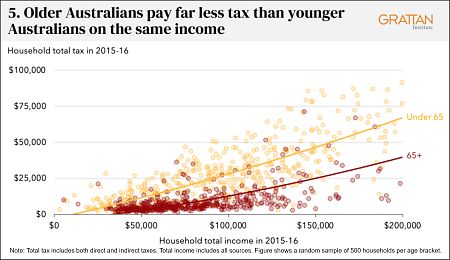
Clearly, baby boomers, represented in red, with the same incomes as younger generations, shown in yellow, pay much less tax because of the rorts built into the system over the decades.
The Government can now claim support for fixing this.
Beating off the blow-back
Labor’s challenge henceforward will be to deflect opposition to its revived reform agenda, which will inevitably come. This will be helped by emphasising these six realities.
Point 1. Australia is not comparable to other economies
The population of New South Wales, Queensland, Western Australia, South Australia and the Northern Territory combined is the same as that of the Netherlands. The area is 230 times greater.
Hence, the costs of Australia’s energy grid, telecommunications and road and rail networks are of a different order of magnitude. Small countries like the Netherlands, Denmark and Switzerland can easily build and maintain nationwide infrastructure with corporate tax rates below 30%. Australia can’t.
Point 2. Australia’s advantages are unmatched
Australians enjoy the highest quality of life in the world with a stable political system, a magnificent climate, great personal liberty and multiple other advantages.

These are masked, tragically, by Australia having arguably the worst mainstream newsrooms in the developed world, which are hell-bent on undermining reform and which succeed in distorting popular opinions on the state of the nation.
Point 3. Australia is not a high tax country
Australia’s overall tax rate is well below that of other nations generally regarded as well-managed. These include Norway, Denmark, the Netherlands, Germany, Canada and New Zealand. See chart, below.
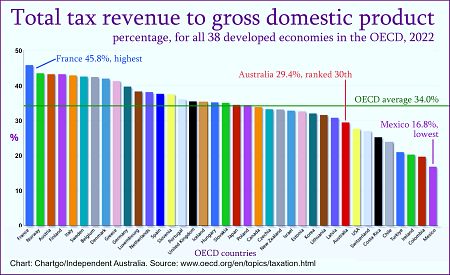
Australia’s 29.4% is well below the OECD average of 34.0%. Importantly, life in Australia is vastly better than in the eight countries with lower overall taxes.
Point 4. Australian companies are not taxed excessively
The list of official corporate tax rates of all 38 OECD members has Australia ranking equal third from the top, which looks punitive. This is deceptive.
Australia’s tax office takes 30% of corporate profits, as in Germany, Mexico and Costa Rica. Japan imposes 30.62% and Colombia 35%.
What complicates this are the additional imposts for superannuation or social security, or whatever mechanism gets corporations to contribute to employee retirement.
Australian companies contribute only 12%. Businesses in most European countries pay between 20% and 45%. See chart below.
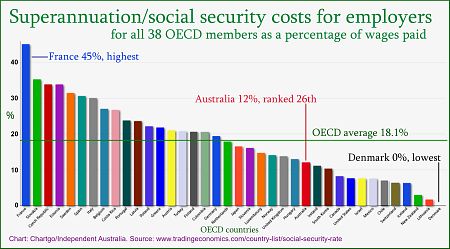
Australia also offers dividend imputation, which most comparable countries don’t and many other tax avoidance schemes. Allowing for these, Australia ranks closer to the bottom than the top.
There is no valid argument for any change to the current corporate tax rate of 30%.
Point 5: Revenue other than from income tax and GST
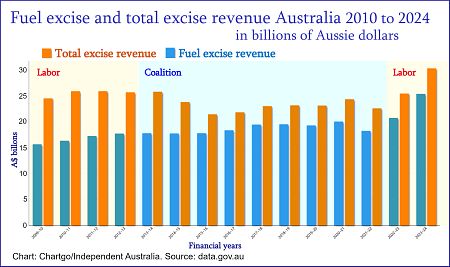
The Coalition’s refusal to collect excise revenue from the petroleum industry through its last term was one of its costliest failures.
This is now reversing, with both fuel excise and total excise up substantially since Labor’s election. See chart below.
Point 6: Greater equality improves the economy for everyone
The bright young lads at the Australia Institute made the case well in last month’s tax reform paper that the Goods and Services Tax (GST) will provide more revenue for the states, now long overdue, simply by shifting income towards the poor:
‘The anaemic growth of GST revenue in the last two decades has been caused, in large part, by rising inequality in Australia. Slow wage growth for low-income earners, coupled with rapidly rising rents, has constrained consumer spending in Australia and, inevitably, constrained the growth of GST.’
The Institute argues that extending the GST to private school fees, private health insurance and other expenditure would generate billions more each year from taxpayers who can afford it. In contrast, it claims, raising the GST rate ‘would exacerbate the inequality already caused by the exclusion of so many goods and services preferred by the highest income households’.
This is another strategic adjustment Labor can make now under its current strong electoral mandate. There are others.
It is likely maestro Chalmers will present a sonata or two in the near term. The great symphonies, however, must wait until 2028.
Alan Austin is an Independent Australia columnist and freelance journalist. You can follow him on Twitter @alanaustin001.
 This work is licensed under a Creative Commons Attribution-NonCommercial-NoDerivs 3.0 Australia License
Support independent journalism Subscribe to IA.


Related Articles
- Get ready for a Chalmers offensive: Reform will be a big win for Australia
- Why Chalmers won't be baited by media misreporting the economy
- Treasurer avoids hard reforms on regional bank closures
- Business is booming — defying newsroom doom and gloom
- Chalmers on track to join Keating and Swan as world’s best treasurer