The more Trump tightens his hold, the more America begins to resemble the authoritarian regimes we were once taught to fear, writes Dr Norm Sanders.
EVERY MORNING, school children all over America put their hands over their hearts, face the ever-present flag and recite:
“I pledge allegiance to the Flag of the United States of America, and to the Republic for which it stands, one Nation under God, indivisible, with liberty and justice for all.”
Noble thoughts, but the nation is becoming divided, and liberty and justice are definitely not for all. The Donald Trump presidency is rapidly becoming a dictatorship, much like the fate of the Weimar Republic in 1930s Germany.
The Weimar Republic, Germany's 12-year experiment with democracy, came to an end after the Nazis came to power in January 1933 and established a dictatorship under Adolf Hitler.
Donald Trump expressed the same aspirations in a 2024 video in which he dreamed of a ‘unified reich’ if he won the upcoming U.S. Presidential Election. He subsequently took it down, but waited nearly a full day to remove it.
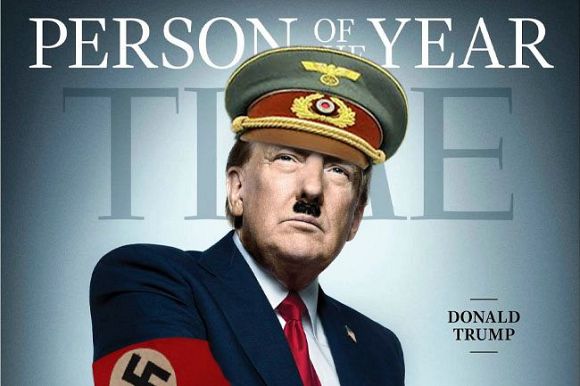
According to David Smith, writing for The Guardian:
‘Trump has reportedly said before that Adolf Hitler did “some good things”, echoed the Nazi dictator by calling his political opponents “vermin” and saying immigrants are “poisoning the blood of our country”, and responded to a White supremacist march in Charlottesville by claiming that there were “very fine people on both sides”.’
...Henk De Berg [is] a professor of German at the University of Sheffield in Britain. The Dutchman, whose previous books include Freud’s Theory and Its Use in Literary and Cultural Studies, published Trump and Hitler: A Comparative Study in Lying.
In it, De Berg compares and contrasts Hitler and Trump as political performance artists and how they connect with their respective audiences. He examines the two men’s work ethic, management style and narcissism, as well as quirks such as Hitler’s toothbrush moustache and Trump’s implausible blond hair.
De Berg happened to be renewing his study of National Socialism and rereading Hitler’s autobiographical manifesto, Mein Kampf, just as Trump was first running for the White House in 2015.
“But then I looked at their rhetorical strategies and their public relations operations, and I began to see how similar they are in many ways.”
Above all, De Berg argues, Hitler and Trump were and are political performance artists who speak only vaguely about policies – Make Germany/America great again – but know how to draw attention using jokes, insults and extreme language.
“Their extremist statements are very deliberately meant to provoke a reaction and to get them into the press. Hitler actually writes quite openly about this in Mein Kampf...”
Along with its headline-grabbing potential, the extremist language also plays well with many voters.
De Berg says:
“Most of their electorate are dissatisfied with the status quo for a variety of reasons – globalization, automation – so they want to change the system and here you have an anti-establishment candidate who is not politically correct, who says that we will sort it, who doesn’t come up with all these ‘cowardly, rotten compromises’.”
Many such voters are ready to blame a scapegoat, “the other”. Hitler blamed Jews for Germany’s defeat in the First World War; Trump launched his 2015 campaign demonising immigrants from Mexico and continues to put border security front and centre. “It decomplexifies the world. Instead of abstract social structures and historical developments, you have one specific group of people that you can blame all your problems on.”
Trump’s incoherent, meandering and zigzagging mode of speech adds to the effect. “Trump goes from the FBI to a judge to the Democrats to communists and so on. You can then say, well, clearly this guy is an intellectual nitwit, he can’t talk in a logical, argumentative way.”
He could but he realises that this vague way of tying all these people together actually gives different sections of the electorate different things they can identify with. Some might not like the FBI, others might not like immigrants and so on.”
There is, [De Berg] warns, method in Trump’s madness: the buffoonery, chaos and word salad speeches may be more calculated than they appear.
“I would like people to become more aware of how incredibly consciously Trump is going about doing what he’s doing, how incredibly cunning and devious he’s been. People should absolutely not underestimate this guy.”
Trump made more than 30,000 false or misleading claims during his four years as president, according to a count by the Washington Post. Perhaps the most egregious is “the big lie” that he, not Joe Biden, won the 2020 Presidential Election, only for it to be stolen due to widespread fraud.
De Berg writes in his book:
“The idea behind the concept of the big lie is that if an untruth is sufficiently extreme, people are likely to accept it if only because they cannot bring themselves to believe that anyone could lie in such an outrageous manner.”
But, of course, Donald J Trump can and does frequently.
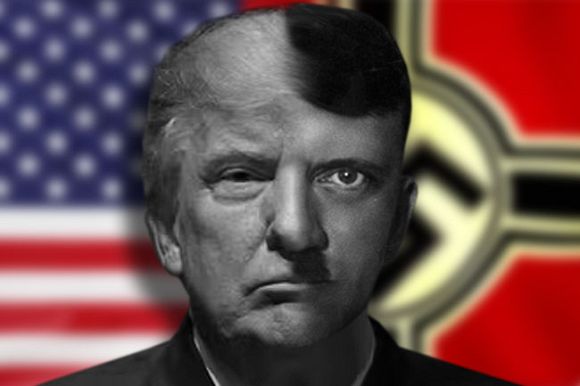
Smith writes:
‘There is also something alarmingly familiar about the way in which the Republican Party thought it could co-opt and control Trump, only to find itself capitulating and being recast in his image. One by one, the party stalwarts have fallen into line, abandoning long-held principles, while dissenters have been purged.’
Just like in Hitler’s Germany.
Also, like Hitler, Trump is creating his own police force. Under the guise of “protecting America’s borders”, Trump established Immigration and Customs Enforcement (I.C.E.).
According to Wikipedia:
‘[I.C.E.] is a federal law enforcement agency under the United States Department of Homeland Security. Its stated mission is to conduct criminal investigations, enforce immigration laws, preserve national security, and protect public safety.’
Lofty ideals, but the reality is far different. I.C.E. agents are unfettered by the normal restraints placed upon police officers. They wear masks and kidnap anyone they deem suspicious, which generally means those with dark skin.
I.C.E. agent recruiting is rapidly expanding with plans to hire 10,000 new agents. I.C.E. is pushing the message that it wants ‘patriotic Americans’ to join its ranks. They are promised $50,000 signing bonuses over three years on top of their yearly salary of $50,000 to $90,000.
Secret police are a quintessential feature of authoritarian regimes. I.C.E. is rapidly looking more and more like the Gestapo.

According to Lee Morgenbesser, writing for The Conversation:
I.C.E. is organised into two distinct law enforcement components, giving it both political intelligence gathering and surveillance capabilities.
Its Homeland Security Investigations arm includes an intelligence division, while its Enforcement and Removal Operations arm uses third-party companies such as Geo Group, Giant Oak, and Palantir to conduct mass surveillance.
Most worryingly, I.C.E. is trying to procure greater intelligence and surveillance capabilities by soliciting pitches from private companies to monitor threats across the internet.
According to a procurement document, contractors would be directed to focus on the backgrounds of social media users and use facial recognition capabilities to gather information on people. Criticisms of I.C.E. itself would be monitored, too.
Not content with having his own police force in I.C.E., The Washington Post reports:
The Trump Administration is evaluating plans that would establish a “Domestic Civil Disturbance Quick Reaction Force” composed of hundreds of National Guard troops tasked with rapidly deploying into American cities facing protests or other unrest...
The plan calls for 600 troops to be on standby at all times so they can deploy in as little as one hour, using military aircraft. They would be split into two groups of 300 and be stationed at military bases in Alabama and Arizona, with purview of regions east and west of the Mississippi River, respectively.
Another alarming development is Trump’s takeover of the Washington, DC police force.

The New York Times reports:
It is the first time a president has used a declared emergency to wrest control of the city’s police, a step that its mayor said was “unsettling”, though allowed under the law.
Congress and the executive branch have long exerted controls over the city’s budget and other decisions. But the President’s move may represent the biggest encroachment on the city’s autonomy since it was granted home rule 52 years ago.
Trump would like to try the same tactic in other Democratic held cities like Chicago and Los Angeles. This would be far more difficult for him to accomplish because the District of Columbia is not a state like Illinois or California, but a Federal territory similar to the A.C.T. in Australia.
Taking over city police forces? Rapid deployment military forces for use within the United States? Armed, masked men abducting people off the streets on behalf of the U.S. Government? Political intelligence gathering and surveillance?
Sounds very much like George Orwell’s dystopian novel, Nineteen Eighty-Four:
‘Big Brother is watching you.’
Dr Norm Sanders is a former commercial pilot, flight instructor, university professor, Tasmanian State MP and Federal Senator.
 This work is licensed under a Creative Commons Attribution-NonCommercial-NoDerivs 3.0 Australia License
Support independent journalism Subscribe to IA.


Related Articles
- From Hiroshima to Trump: The power and peril of language
- After the Biden boom comes the Trump tragedy
- CARTOONS: Epstein file redaction rumours run rife
- How Donald Trump could Make Britain Great Again
- Donald Trump's micropenis makes surprise appearance on American TV