Commentators continue to vilify the Albanese Government with nonsensical claims about the economy, as Alan Austin reports.
AUSTRALIA’S RABIDLY anti-Labor boardrooms and newsrooms are bewailing the worst productivity crisis they can recall and crying “we’ll all be rooned”.
Simultaneously they are basking in unprecedented economic good times, with record company profits, soaring executive salaries and living standards at an all-time high. These would be impossible if productivity was tanking.
Business Council knows better
ABC News ran a problematic interview last Monday with the CEO of the Business Council of Australia (BCA), Bran Black, who regularly bags the Albanese Government in the pliant media.
Inexplicably, the ABC’s presenter Melissa Mackay supported Black’s false narrative. Her intro misinformed listeners that “productivity growth is one of the most important indicators of economic strength and living standards”. No, it isn’t. It was in the 1980s. Not today.
Black claimed productivity is lower in the 2020s than in the 2010s, but exposed the falsity of his claim with this:
“When productivity is low, it reduces our capacity to increase living standards and give all Australians the opportunity to get ahead.”
How then does he explain all-time high living standards reached in each of the last three years, as proven by more than 40 datasets? The ABC did not ask him to.
Black dug his hole deeper with this:
“We don’t have the type of competitive settings in Australia that we see in other countries overseas that help drive business investment. Business investment, of course, being the primary basis for productivity growth.”
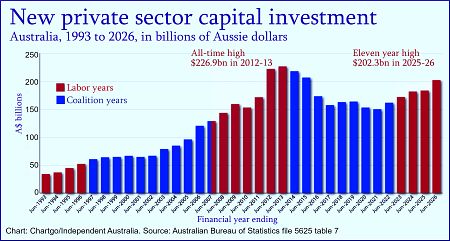
Surely he must know business investment has risen impressively through Labor’s term with 10.2% growth last year, the strongest since 2012. See chart below.
Black revealed his real agenda when invited to spruik the Business Council’s wish list:
“That includes steps like reducing regulations... comprehensive tax reform, that tackles our uncompetitive tax rates in terms of company tax, but also... our uncompetitive industrial relations system which is fundamentally out of balance.”
IA invited both the BCA and the ABC to justify their patently false claims, but received no replies.
Old formula definitely deceased
Like Monty Python’s dead parrot, the traditional productivity formula is not resting. It has expired and gone to meet its maker.
The usual formula is gross domestic product (GDP) divided by total hours worked across the economy, or a variation thereof. Easy to understand, it served well for many decades — back when all inputs and outputs were obvious and measurable.
From March 1979 to March 1981, Australia’s economy was overseen by the worst Treasurer up to that time, based on actual outcomes, John Howard.
Over those two years, GDP per hour worked declined from 56.4 index points to 56.3. That pointed to a miserable economy — which was indeed the case.
In those two years, the jobless rate reached 6.5%, inflation peaked at 11% and mortgage rates hit 12.6%. The economy went into full recession the following year.
So the formula back then helped explain a failing economy mismanaged by a grossly incompetent government.
This is no longer the case. The productivity index in June this year was 99.7, down from 105 in early 2022. Yet over that time, Australia’s economy has enjoyed its best four years since records began.

The jobless rate has been at or below 4.5% for 56 months, inflation has tumbled from 7.8% in 2022 to 3.5% now, having fallen for the last four months, and interest rates have been back in the optimum band between 2% and 5% for 49 months.
Annual GDP growth has averaged a healthy 2.95% for 21 quarters. Company gross profits ex-mining reached a fresh record of $327.2 billion in 2025-26. Annual private sector investment exceeded $200 billion in June for the first time in 11 years, up a thumping 34.7% on 2020-21 under the Coalition, as the above chart shows.
No other economy in the world has that exceptional profile plus AAA credit ratings. Only Switzerland comes close.
Why the formula is bereft of life
Multiple researchers have shown why the old productivity index is an ex-parrot, including David Stroll, Jayati Ghosh, Chad Syverson, David Byrne, Josh Martin and the OECD’s Ashley Ward.
These economists and others, including the Australian Bureau of Statistics (ABS), have explained why working from home, labour quality variation and now artificial intelligence have proven the old formula is nailed to its perch.
Hence the question: Are those who misuse it in Australia deliberately lying or merely ignorant?

Time to name and shame
Every mainstream newsroom still uses this demised polly to claim Australia’s economy is collapsing and Albo is to blame.
These include the Australian Financial Review, The Sydney Morning Herald, The Age, SBS News, ABC News, the Herald Sun, The Australian, the Daily Telegraph, the Australian Associated Press (AAP), The Nightly and The Conversation. The situation is so out of hand that the miscreants should be identified in the hope they will see the error of their ways.
While prepared now to identify the liars – after offering them a chance to recant – we must also honour those who defy the false mainstream narrative.
Nina Hendy reported in May in the Sydney Morning Herald that ‘the ruler used to measure productivity is broken’.
Lauren Ryder wrote an opinion piece in Forbes Australia in June headed, ‘What if we’re wrong about the productivity crisis?’ She concluded: ‘We have a measurement problem. Let’s at least name it correctly before we decide how to fix it.’
Ross Gittins, also in The Sydney Morning Herald, argued in July that productivity is no longer measurable and ‘the moment you introduce a real economy, with real people living in it, the claim that productivity is almost everything collapses’.
Sadly, this is a dismally short list of reputable reporters. Let’s hope it expands, so deceitful sales of late parrots decline.
Alan Austin is an Independent Australia columnist and freelance journalist. You can follow him on Twitter @alanaustin001 and Bluesky @alanaustin.bsky.social.
 This work is licensed under a Creative Commons Attribution-NonCommercial-NoDerivs 3.0 Australia License
Support independent journalism Subscribe to IA.


Related Articles
- Top 40 datasets showing quality of life in Australia steadily rising
- Australia’s incompetent newsrooms fail to report best financial year ever
- Australia’s economic slowdown shows inflation strategy is working
- Merchants of anger, fear and hatred thrive in Australia
- Real wage increases ensure living standards are rising