Spain's latest border crisis exposes Morocco's growing leverage over Europe and the unresolved conflict in Western Sahara, writes Kamal Fadel.
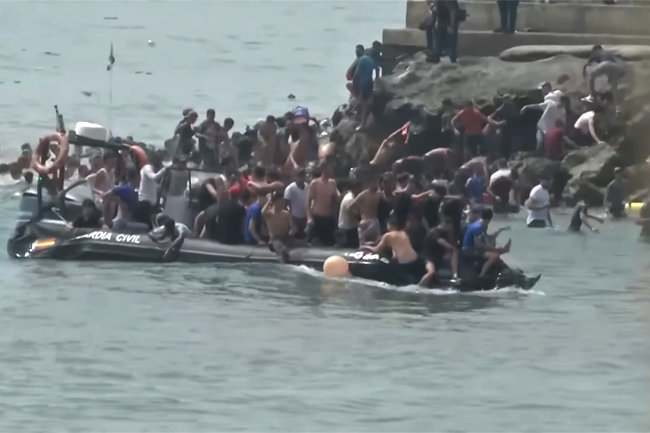
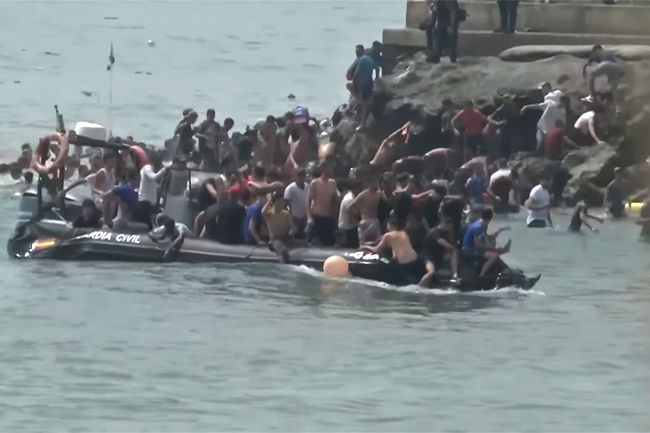
ON 30 AND 31 JULY 2026, an extraordinary number of people crossed from Morocco into the Spanish city of Ceuta.
Spanish authorities estimated that over 50,000 people entered the enclave in little more than a day. At least 70 reportedly died, some at sea and others in the chaos around the border barriers. By the following evening, most had returned to Morocco.
The images were deeply unsettling: young people swimming around barriers, families carrying children towards Spanish territory, frightened residents closing businesses and security forces struggling to cope. Prime Minister Pedro Sánchez called it an invasion and a violation of Spain’s territorial integrity.
But beyond the immediate tragedy lies a larger political question. How could tens of thousands of people travel from different parts of Morocco and converge on one of the country’s most sensitive borders in such a short time?
Witnesses said Moroccan security forces stood aside, while others suggested that some people had been transported towards the area or encouraged to cross. Whatever the level of organisation, the crisis exposed an uncomfortable truth: Spain and the European Union have become dangerously vulnerable to Moroccan pressure.

Moroccan capital Rabat understands Europe’s anxiety over migration and Spain’s reliance on Moroccan cooperation at its southern border. By relaxing that cooperation, or threatening to do so, Morocco can create an immediate crisis for Madrid and Brussels.
Whatever the immediate cause, the wider pattern is familiar. Morocco has repeatedly used European fears over migration, security, trade and regional instability to secure financial assistance and political concessions, including support for its occupation of Western Sahara.
Spain must now ask whether the recent crisis was not only an act of pressure, but also a test. Was Rabat exploring how mass civilian movement could be used against Ceuta and Melilla, as “the Green March” was used to force Spain out of Western Sahara in 1975?
A troubling echo of 1975
In November 1975, Morocco mobilised about 350,000 people in what it called “the Green March”. It was presented as a peaceful popular movement. In reality, it was a carefully organised act of state pressure against a politically weakened Spain.
The strategy worked. Spain withdrew, the Madrid Accords were signed and Morocco moved into most of Western Sahara despite having no internationally recognised sovereignty over the territory.
The events in Ceuta were not identical. Most who crossed were ordinary Moroccans driven by poverty and unemployment, who appear to have been used, or allowed to be used, as tools of political pressure.
The lesson Rabat learned in 1975 was that mass civilian movement could intimidate Spain and create political facts on the ground. The danger today is that Moroccan authorities may believe the same tactic can still work against Ceuta and Melilla.
Migration as political leverage
This was not the first time a diplomatic dispute between Madrid and Rabat was followed by a sudden weakening of border controls.
In May 2021, more than 8,000 people, including many children, entered Ceuta after Moroccan forces relaxed controls. The crisis came during a dispute over Spain’s decision to allow Brahim Ghali, Secretary-General of the Polisario Front, to receive medical treatment in a Spanish hospital.
The message was hard to miss. If Madrid took a position that displeased Rabat, Morocco could increase migration pressure and create a domestic political crisis for the Spanish Government.
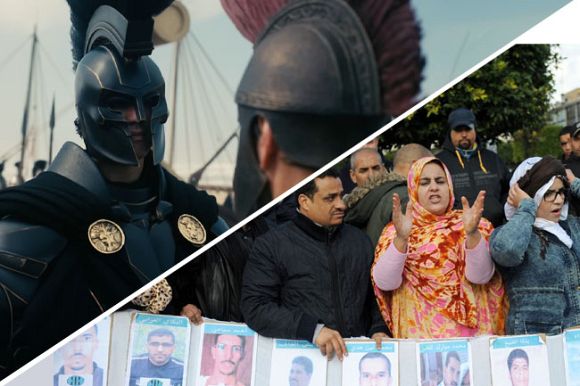
Spain later abandoned its traditional position on Western Sahara and endorsed Morocco’s so-called autonomy proposal. From Rabat’s perspective, the lesson may have been that pressure delivers results.
Whether the July 2026 crisis was deliberately organised, or quietly tolerated, it revealed the same structural weakness. Spain’s dependence on Morocco to manage migration gives Rabat considerable influence over Spanish and European decision-making.
For decades, European governments have placed migration control, fisheries, trade and intelligence cooperation above international law and human rights, persuading themselves that accommodating Morocco is the price of stability.
The result has been the opposite. Appeasement has encouraged Morocco to expect money and political concessions whenever it applies pressure.
The King’s words and Morocco’s reality
The timing was striking. As Morocco marked the 27th anniversary of King Mohammed VI’s accession, the monarch declared that his duty was to help Moroccans live free and dignified lives. Yet, at almost the same moment, tens of thousands were trying to reach Spanish territory.
People do not leave their homes, carry their children towards dangerous border barriers or swim through the sea because they feel secure, hopeful and respected.
Many young Moroccans face unemployment, inequality, poor public services and little prospect of advancement. Wealth and political power remain concentrated around the monarchy and its associated networks. Journalists, activists and human rights defenders face prosecution, surveillance and imprisonment. Sahrawis who openly support independence face even harsher treatment.
Why autonomy is the wrong solution
The scenes in Ceuta raise a question supporters of Morocco’s autonomy proposal rarely answer.
How can the Sahrawi people be asked to abandon their internationally recognised right to self-determination and accept permanent rule under a political system from which so many Moroccans themselves are trying to escape?
Sahrawis living under Moroccan control face restrictions on peaceful protest, surveillance, harassment, arbitrary detention and long prison sentences. Independent journalists and international observers are frequently denied access. Sahrawi organisations cannot operate freely and public support for independence is treated as a security threat.
An autonomy arrangement administered by the same institutions responsible for repression would not resolve the conflict. It would simply give permanent legal form to the occupation.
Self-determination cannot mean allowing the occupying power to decide the limits of Sahrawi freedom. It must give the Sahrawi people a genuine opportunity to choose their own future, including independence.
An unfinished decolonisation
Western Sahara is not simply a regional dispute, as Rabat often portrays it. It remains listed by the United Nations as a Non-Self-Governing Territory awaiting decolonisation.
In its 1975 Advisory Opinion, the International Court of Justice found no tie of territorial sovereignty between Morocco and Western Sahara capable of overriding the Sahrawi people’s right to self-determination. The United Nations has never recognised Moroccan sovereignty over the territory.
The Court of Justice of the European Union has also repeatedly held that Western Sahara is separate and distinct from Morocco. Agreements concerning the territory and its resources cannot lawfully be applied without the consent of the Sahrawi people.
No Security Council resolution has transferred sovereignty to Morocco or removed Western Sahara from the United Nations decolonisation process. Political pressure cannot create legal sovereignty where none exists.
Spain’s duty to Western Sahara
No European country carries greater historical and moral responsibility for Western Sahara than Spain.
Spain was the colonial power until 1975. The Madrid Accords transferred certain administrative responsibilities, but not sovereignty and they did not complete the process of decolonisation. Spain is still regarded as the de jure administering power.
Spain left behind a people whose future it had promised would be decided through self-determination. More than 50 years later, Sahrawis remain divided between Moroccan-controlled territory and refugee camps near Tindouf.
Spain’s 2022 endorsement of Morocco’s autonomy proposal did not bring a just settlement closer. It damaged Spanish credibility, angered Sahrawis and their allies and appeared to reward the coercive tactics seen in Ceuta in 2021.
Yet Spanish society has not forgotten its relationship with Western Sahara. Spanish remains widely spoken among Sahrawis, many of whom have studied in Spain. Strong ties exist with Spanish municipalities, trade unions, humanitarian organisations and civil society.
These historical, cultural and linguistic links are a strategic asset. Spain should strengthen them rather than sacrifice them whenever Rabat applies pressure.
Independence would strengthen Spain
An independent Western Sahara could become a natural Spanish partner in fisheries, renewable energy, education, trade, tourism and maritime security. It would give Madrid another regional ally, reducing its dependence on Morocco.
At present, Morocco’s control over migration routes, trade access and much of the north-west African Atlantic coastline gives it disproportionate leverage over Europe.
Allowing Morocco to consolidate its control over Western Sahara would make it larger, wealthier and strategically more powerful, placing it in an even stronger position to pressure Spain, particularly in disputes over maritime boundaries and access to the resource-rich waters surrounding the Tropic Seamount.
A sovereign Western Sahara would create an alternative partnership with a country that has deep historical and linguistic connections with Spain and every reason to seek peaceful and constructive relations with Europe.
Spain should therefore stop viewing Sahrawi independence as a threat to regional stability. It should recognise it as a strategic opportunity.
Supporting Sahrawi self-determination is not an act of hostility towards Morocco or the Moroccan people. Ordinary Moroccans were among the main victims of the Ceuta crisis. No government should exploit the poverty or desperation of its citizens as a diplomatic weapon.
Moroccans deserve accountable government, economic opportunity and reasons for young people to build their future at home. Sahrawis deserve the same: freedom, dignity and the right to decide their own political future.
Appeasement has failed
For years, European leaders have argued that there is no realistic alternative to accommodating Morocco. Yet every concession has made Europe more dependent and Rabat more confident that coercion will be rewarded.
Spain cannot base its security on the goodwill of a government that can turn border cooperation on and off. Europe cannot defend international law elsewhere while helping to weaken it in Western Sahara.
An independent Western Sahara would give Spain a friendly, Spanish-speaking partner in North Africa, strengthen Europe’s strategic position and complete a decolonisation process left unfinished for more than half a century.
The real choice is not between Morocco and Western Sahara. It is between continued dependence on coercion and a foreign policy grounded in law, balance and democratic values.
Appeasement has not produced stability. It has left Europe living under a Moroccan sword of Damocles. Spain and Europe should not wait another 50 years to understand that.
Kamal Fadel is the Polisario Representative in Australia and New Zealand. You can find him on Twitter: @Alfudail.
 This work is licensed under a Creative Commons Attribution-NonCommercial-NoDerivs 3.0 Australia License
Support independent journalism Subscribe to IA.