It’s time to move beyond narratives of suffering and imagine Palestinian joy, writes Yuki Lindley.
WHAT DOES IT DO to your soul to have to so publicly share your trauma? To hold up the lifeless bodies of your babies, and plead for the world to see their lives as grievable and to act accordingly?
Sadly, this has become part of what it means to be Palestinian. For generations, they have been trying to show the world their humanity, in the vain hope that change may come — this time.
In one of too many examples, during the 2018 March of Return, Palestinian families came together to enjoy picnics, fly kites, play music and dance near the Gaza-Israel fence, hoping to show the world and their oppressors their humanity, and their desire to return to their homes. Multiple independent reports, including the UN Independent Commission of Inquiry, found that Israeli snipers intentionally fired on children, medics, journalists and people with disabilities who posed no threat, amounting to war crimes.
However, the world again shrugged, “they’re always fighting over there” and let the news cycle move on.

What does this do to the soul? To be born of a people, constantly forced to perform their pain and suffering on the world stage, never afforded the dignity to grieve privately? To share one's most intimate pain, in the vain hope that the world will begin to care, that your children won’t have to bear this ongoing burden of trying to convince the world that Palestinian lives matter, too.
These are the questions that trouble me as I listen to doctor and author Jumaana Abdu speak of the double trauma Palestinians endure, of having to spill out their guts to a world trained not to see their humanity, in the vain hope that it will lead to change.
To be born Palestinian often means to become the embodiment of suffering, to have others see you through this single lens, to become only the object of pity. In her TED Talk, Chimamanda Ngozi Adichie speaks about the dangers of the single story, the way that it flattens out the complexity of a people to that of a single, incomplete story. While grief, loss and dispossession are central to every Palestinian story, we cannot forget that there is also life, celebration, and joy.
Listening to one returned doctor speak fondly of Gaza being one of his favourite places in the world, because Gazans really know how to have fun, I realised I was surprised because I, too, had fallen for the single narrative; that of life under occupation being framed by lack — of resources and self-determination. But he spoke of the resourcefulness of Gazans borne of living under an occupation that seeks to control and restrict every aspect of their lives, and of the famous Gazan hospitality and generosity, which ensured that every visitor is well fed, even while they may have to go without.
Of the tenacity of his good friend, a world-class surgeon, who, unable to leave Gaza to attend international conferences, taught himself through YouTube videos to become one of the world's best. These stories matter just as much as the stories of suffering and reveal a truer picture of the complexity of Palestinian life under illegal occupation.
The danger of the single narrative is that suffering becomes the only lens through which Palestinians are understood and expected to perform. This expectation to perform one's trauma and pain for a largely uncaring Western audience is the double trauma Jumaana Abdu reminds us of, and there can be a reclaiming of power in refusing to comply with these demands — to instead focus on Palestinian resistance, return and joyful futures.
A quote often attributed to Palestinian poet Mahmoud Darwish, who writes of a young girl, says that it is ‘time for us to move, if we can, from a topic that makes them pity us, to one that makes them envy us’.
It is this sentiment that many Palestinians, like Jumaana Abdu, would like to hold on — one that no longer focuses only on Palestinian suffering, but also looks to Palestinian futures. For if we remain stuck thinking only in terms of suffering, we lose our capacities to imagine joyful, Palestinian futures.
For those of us not directly impacted by the dehumanising and humiliating impacts of the past two years, it’s a question worth considering. At what point is enough, enough? When do we shift the focus from the suffering of Palestinians to shine a light on Western indifference? To ask uncomfortable questions about our own society, our own communities and to question why it is socially acceptable to ignore a genocide, directly supported by our own media and government? To shift the power dynamic from one where we get to imagine ourselves as white saviours, to one where we hold up a mirror to our own complicity?
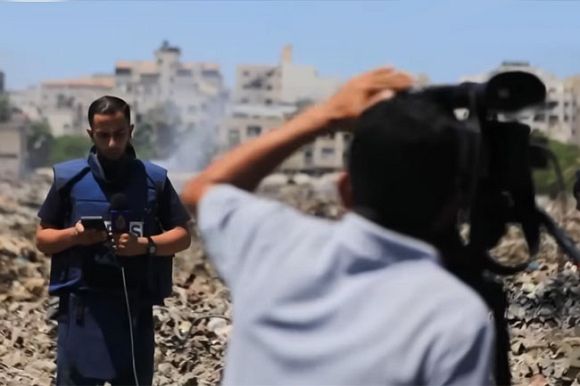
This is not to diminish the work that Palestinian journalists who gave their lives documenting their own genocide have done to show the world their humanity, but to ask the question: Where to from here? When does the showcasing of Palestinian suffering become more harmful than helpful? Will one more image of Palestinian suffering make a difference? Is it, instead, time to tell a different story? One that doesn’t appeal to the White saviour mentality, but rather centres Palestinian return, Palestinian joy and Palestinian futures?
Yuki Lindley is a student of philosophy of race, colonisation and Indigenous sovereignty.
 This work is licensed under a Creative Commons Attribution-NonCommercial-NoDerivs 3.0 Australia License
Support independent journalism Subscribe to IA.


Related Articles
- Selective empathy and the weaponisation of trauma
- CARTOONS: Australia takes a stand
- The moral cleansing has commenced for ultra-Zionists and their lackeys
- Chasm between liberal values and action exposed again
- New report highlights torture of detained healthcare workers in Palestine