

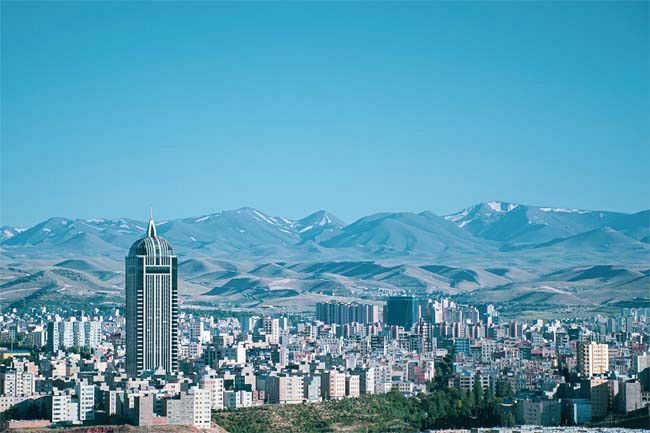
Decades of exclusion and environmental collapse have pushed South Azerbaijan beyond reform and toward the question of real political power, writes Dr Abraham Alvadi.
FOR A LARGE segment of the population of a country known as Iran, daily life has deteriorated into persistent hardship.
This hardship is not captured solely by inflation rates or unemployment figures; it is reflected in declining quality of life, eroding personal and social security and the disappearance of any credible sense of future.
A common analytical mistake, however, is to assume that this condition is uniform across the country and can be addressed through a single, standard solution. This assumption is rooted in a long-standing belief in a homogeneous, single-nation Iran.
South Azerbaijan diverges precisely at this point.

Who are the Azerbaijani people in Iran?
The Azerbaijani people of Iran – commonly referred to as those living in South Azerbaijan – constitute one of the largest non-Persian population groups in the country. They are a Turkic-speaking people whose language, Azerbaijani Turkish, is closely related to Turkish spoken in the Republic of Azerbaijan and Turkey.
Concentrated primarily in Iran’s north-west, including East and West Azerbaijan provinces – Ardabil, Zanjan, Qazvin, Hamadan and parts of Tehran – Azerbaijani people have played a central role in Iran’s political, economic and cultural history. Azerbaijani people were the founders and ruling elites of several dynasties in the last 1,000 years, including the Safavid and Qajar dynasties.
Following the collapse of the Qajar dynasty in 1925 and the establishment of the Pahlavi monarchy under strong external influence, Azerbaijani and other non-Persian identities were progressively excluded from institutional recognition as the Iranian state pursued an increasingly centralised and culturally homogenising national project prioritising Persian (Tajik) language and culture.
For many South Azerbaijani people, the question is not merely one of cultural rights, but of political agency — whether they are treated as stakeholders in governance or as a population expected to assimilate into a centralised national identity.
Crises that are lived, not merely discussed
For the people of South Azerbaijan, crises are not abstract concepts; they are tangible, lived realities. For instance, the drying of Lake Urmia is not merely an environmental issue — it has become a powerful symbol of systemic failure to protect the ecological foundations of an entire region.
Land degradation, the collapse of agricultural livelihoods, forced rural and urban migration, and the normalisation of unemployment among educated youth are now structural features of daily life. These pressures have accelerated out-migration and hollowed out local economies.

Alongside these material crises lies a deeper cultural dimension. The absence of official recognition for the Azerbaijani Turkish language in education and public administration, coupled with persistent cultural marginalisation, has intensified feelings of exclusion and existential insecurity.
These are not problems that can be solved by rhetorical change or by replacing one centralised government with another. Indeed, the transition from the Pahlavi monarchy to the Islamic Republic brought no substantive improvement in this regard.
Historical memory and the roots of distrust
South Azerbaijan carries more than a century of accumulated political experience. From its pivotal role in the Constitutional Revolution during the Qajar era, when Azerbaijan functioned as a political core of the state, to the suppression of its one-year autonomous government in the mid-20th Century under Ja’far Pishevari, from unfulfilled promises after the 1979 Revolution to decades of rigid centralisation.
This historical memory informs contemporary political consciousness. Trust does not emerge easily. Broad promises, whether from the state or from opposition movements, most of which are perceived as Persian-centric, are consistently met with a single question: What, exactly, will be different this time?
Why the Persian-centric opposition is not the answer
An often-overlooked reality is that a substantial portion of South Azerbaijan’s population does not see itself represented by dominant Iranian opposition movements. This is not necessarily due to ideological hostility, but to the absence of genuine political representation.
In many opposition narratives, South Azerbaijan’s concerns are marginalised, postponed until after a vague “regime change” or framed as secondary issues. Language rights, political power, environmental survival, regional development and cultural security are frequently reduced to abstract commitments rather than concrete policy positions.
As a result, the prevailing expectation in South Azerbaijan is to hear solutions articulated by Azerbaijani elites themselves — intellectuals, economists and political actors who understand the region’s realities from within.

Concrete demands, not emotional appeals
The questions being asked in South Azerbaijan are neither radical nor abstract:
- What is the practical plan for rebuilding a sustainable South Azerbaijan economy?
- How will water scarcity, agricultural collapse and environmental degradation be addressed in South Azerbaijan?
- What institutional mechanisms will ensure the protection and development of the Azerbaijani Turkish language?
- How will social security, cultural representation, emerging future prospects and measurable well-being be restored?
Increasingly, these questions extend beyond policy reform and toward governance itself.
The policy dimension: From reform to self-governance
There is a growing recognition in South Azerbaijan that incremental reform within a rigidly centralised state has repeatedly failed. Neither reliance on external powers nor the assumption that a change of regime alone will resolve structural inequalities is widely accepted.
Instead, political discourse in South Azerbaijan is increasingly oriented toward self-governance and governmental independence — understood not as an emotional rupture, but as a rational response to persistent exclusion.
For many, independence or far-reaching political autonomy is seen as the only framework capable of:
- ensuring accountable governance;
- protecting linguistic and cultural rights;
- managing environmental resources locally; and
- aligning economic policy with regional needs.
This is not a rejection of coexistence, but a demand for political agency.
Change without a plan is meaningless
What could genuinely alter the trajectory is the emergence of clear, realistic and accountable policy frameworks developed by Azerbaijani elites themselves. Intellectuals, economists and political leaders who can articulate governance models, whether federal, confederal or independent, that respond directly to lived realities.
If such leadership crystallises, social trust can gradually be rebuilt in South Azerbaijan. Change would then shift from reactive protest to informed collective action in South Azerbaijan and the region.
Perhaps this is the central question facing South Azerbaijan today.
It is no longer asking who is fighting whom.
It is asking: Who has a credible and tangible plan for the future of our Azerbaijan — and the authority to implement it?
Dr Abraham Alvandi is an Australian researcher and academic with a South Azerbaijani background. He is actively engaged in academic and leadership roles within the digital health sector.
 This work is licensed under a Creative Commons Attribution-NonCommercial-NoDerivs 3.0 Australia License
Support independent journalism Subscribe to IA.







