Amid a fuel crisis, Australia’s carefully staged diplomacy in Asia reveals a deeper struggle with trust, identity and its place in the region, writes Carl Gopalkrishnan.
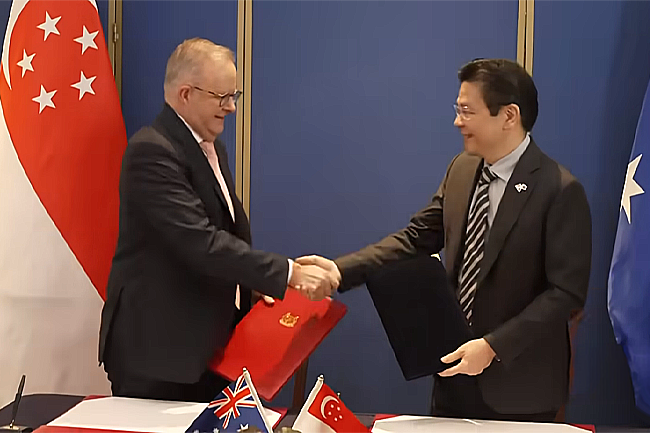
AUSTRALIA HAS ARRIVED in Singapore, Malaysia and Brunei, speaking the language of fuel security, food resilience and practical cooperation because pressure has stripped away some illusion.
A resource-rich country is discovering that abundance without confidence is not strength. The fuel crisis has exposed something deeper than logistics: a long uncertainty about how Australia imagines dependence, partnership and regional belonging at the same time.
Prime Minister Anthony Albanese and Foreign Affairs Minister Penny Wong are handling this moment with discipline, and they should. We are all in deep trouble. It is not a love marriage. In American vernacular, it is closer to a booty call conducted under diplomatic lighting: polite, necessary, carefully staged, with both sides aware that morning brings the old questions back.
Asian governments are responding with courtesy, practicality and restraint. They understand pressure. They understand the need to keep systems moving. Yet courtesy should not be mistaken for emotional investment. Across recent weeks, what comes through in editorial tone across the region is not hostility but a settled distance: Australia is still often read as a country talking loudly about itself while remaining uncertain how it is heard.

Prime Minister of Singapore Lawrence Wong’s assurance that refined fuel supplies will continue “as long as upstream supplies continue” was exact, limited and technically honest. Asian ears hear exactly what that means. It is not the language of trust. It is the language of continuity under conditions.
That matters because regional trust is not only economic. It is psychological, historical and cultural. In practice, governments in this region often note whether Australia sets its own limits voluntarily or only under pressure. This is where domestic politics enters the room, whether Canberra admits it or not.
Opposition Leader Angus Taylor’s speech deserves criticism because its timing is extraordinarily poor. At the precise moment Australia is asking Asian neighbours to imagine reliability under fuel pressure, wartime instability, and tightening supply chains, language that revives older suspicions about migration travels poorly beyond domestic party theatre. It damages more than debate. It reminds the region how quickly Australia can sound anxious, selective and historically tone-deaf when pressure rises.
Yet Taylor himself may soon be forgotten, because this kind of speech belongs to a familiar cycle of domestic reaction that burns brightly and then passes.
The more enduring question sits elsewhere.
Asia expects Albanese and Penny Wong to speak as they are speaking now: careful, practical, disciplined, useful in the short term. That registers, and it matters. What would genuinely disturb older assumptions in the region is something else: if MP Andrew Hastie were visibly capable of moving beyond his own harder inheritance into some recognisable regional literacy. That would register differently because it would challenge a deeper assumption many in Asia still hold — that Australia’s underlying political character does not really change, only its tone does.
Hastie’s personal rehabilitation, if it ever came, would not be merely personal. It would carry something mythic, because figures like him remain tied, consciously or not, to the same unresolved question that has followed Australia since Federation: whether the country can imagine security, belonging and identity without returning to older racial instincts when pressure hits.

I do not come to Andrew Hastie as a neutral commentator. As an artist, I have spent decades reading political language through symbolism, myth and the emotional afterlife of historical reference. I have used the avatar of Hastie in work presented through The Blake Society and in writing published in Critical Military Studies. That is why figures like Hastie interest me beyond party politics: they often carry more than policy inside them, whether they intend to or not. For good or bad, they mirror our traumas and unresolved national questions.
My earlier criticisms remain. They arose because historical references, civilisational language and inherited hardness were being applied to the region without enough feeling for how the region itself hears history. Yet it is also why any authentic enlargement in such a figure would matter far beyond his own career.
Australia has entered one of those periods when commentary cannot be left only to officials, party tacticians and defence language. Civilian voices matter in such moments because they often register what formal language cannot yet admit: embarrassment, fatigue, inherited fear, the strange gap between performance and feeling. Artists have always entered that space when Australia has needed to imagine itself differently. The Heidelberg painters did not write doctrine, yet they helped give emotional form to a country approaching Federation. Historical moments often require that wider field of interpretation before politics catches up.
That is what artists sometimes see before institutions do: history is not only made by policy, but by who carries old meanings and whether they remain trapped inside them. Some figures pass through a crisis as noise. Others, whether they wish to or not, become part of how a nation imagines whether it can change. That is far more powerful than policy.
I do not say that because I personally warm to Hastie. I do not. I say it because some figures carry more of a nation’s unfinished argument than others and when they shift, neighbours notice.
Australia’s booty call to Asia will be well performed. It may even produce useful short-term outcomes. What it will not produce, on its own, is the deeper belonging and freedom from anxiety Australians clearly crave.
For that, we will need something harder: a leap of faith, and perhaps a leap of love, toward what this country might yet become if moral imagination is allowed to do real work — to help create an Australia where racism becomes only another page in our history: a sad page, but one future Australians read as evidence that we were finally capable of change.
But that transformation requires a Trojan horse to help us – and the world – reimagine us. Angus Taylor is not that Trojan horse.
Carl Gopalkrishnan is an Australian artist and policy practitioner with long-standing experience in multicultural policy, social cohesion and community engagement.
 This work is licensed under a Creative Commons Attribution-NonCommercial-NoDerivs 3.0 Australia License
Support independent journalism Subscribe to IA.


Related Articles
- No intelligence, no trust: The hidden cost of Australia’s foreign policy
- Australia caught in the fool-based international order
- Most Australians in favour of neutrality
- Australia’s renewed commitment to neighbourliness is saving lives
- Australia needs to stop patronising the Pacific Island states