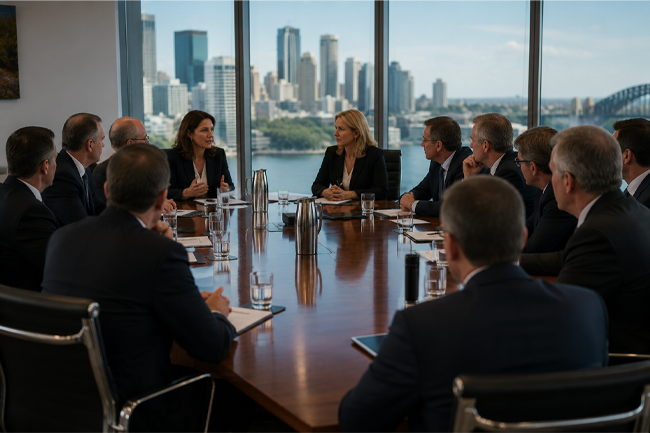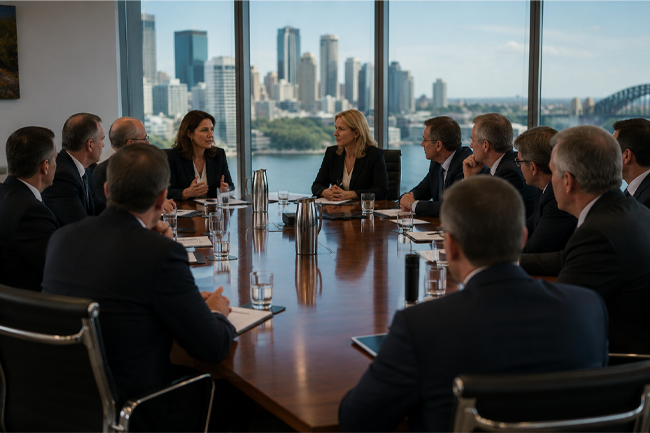
A new benchmark of Australia's largest listed companies reveals a persistent gap between gender equality commitments and meaningful action. Dr David Birchall, Kathryn Fearnley, Andrea Abreu and Taniya Thomas report.
AUSTRALIA RIGHTLY prides itself on its gender equality. It ranks 13th in the world for gender equality on the World Economic Forum’s Global Gender Gap Index and, in 2012, implemented the Workplace Gender Equality Act.
In March 2024, the Albanese Government released a National Strategy to Achieve Gender Equality and, since 2023, it has annually published an annual Status of Women Report Card to provide a snapshot of Australia’s progress toward gender equality in a range of categories, including economic outcomes, education, health, safety, housing and gender norms.
Gender equality in Australian industry is vital if we are to achieve national gender equality. Industry has a major say in economic outcomes, and gender equality in industry also includes action against workplace violence and harassment, leadership opportunities and the protection of women throughout global supply chains.

That is why the Macquarie University Business and Human Rights Access to Justice Lab decided to launch a project benchmarking 20 industry-leading companies listed on the Australian Securities Exchange (ASX) across four industries on their gender equality performance. We used the World Benchmarking Alliance’s Gender Benchmark Methodology and focused on the core areas of gender-responsive governance, representation and violence and harassment.
Companies were drawn from four of Australia's most economically significant sectors — retail and consumer services; pharmaceuticals, biotechnology and life sciences; media and entertainment; metals and mining.
Findings
The report finds systemic failures in gender equality at both company and government levels, although it also finds room for hope and makes recommendations for improvement. None of the 20 companies fully met international gender equality standards, with the highest performer achieving just over half the available score.
While nine in ten companies publicly committed to gender equality – typically through diversity policies or gender equality reports – far fewer backed those commitments with measurable, time-bound targets or actionable plans.
This gap between words and actions was a theme running through the report. Companies often said the right things, but were more reticent around setting concrete goals or policies to achieve specific outcomes.
Governance and strategy emerged as the weakest area overall, averaging just 2.35 out of a possible eight points across all sectors. Only one company engaged women as part of its risk identification and assessment process, and only two companies identified and prioritised gender-related human rights impacts as salient risks.
Gender audits and key performance indicators for workforce gender targets were rare, and almost no companies disclosed gender-disaggregated workforce data broken down by function or role — a gap that obscures inequality and limits external accountability.

Information on gender equality within supply chains was sparse. This is a critical gap because supply chains span the world and may include areas with high levels of gender violence, discrimination, or a lack of regulation. This introduces the risk that goods made by Australian companies will involve human rights violations in the manufacturing process, despite advances in the law domestically.
Companies largely left the responsibility for compliance with their suppliers and, at best, often offered guidance to suppliers, rather than meaningful oversight. No company demonstrated evidence of gender equality targets within supply chains and none showed that gender-related human rights issues in supply chains had been identified and remediated.
The report found that women were significantly underrepresented in executive leadership, with higher levels of female representation in non-executive and supportive roles. This pattern persisted even in sectors, such as retail and media, where women make up a substantial proportion of the overall workforce, pointing to structural barriers to advancement.
Companies in sectors facing greater public scrutiny, such as mining and media, showed comparatively stronger performance across most measurement areas, suggesting that stakeholder pressure and transparency obligations play a meaningful role in driving improvement.
Recommendations
Perhaps our most fundamental finding was that compliance was strongest where compliance was a legal obligation. Every company received points for having a mechanism allowing workers to raise complaints without fear of reprisal — a direct result of mandatory whistleblower protections under Section 1317AI of the Corporations Act 2001 (Cth).
Many companies extended these protections to members of the public as well. This leads to our recommendation that if the Government wants improved gender equality performance within business, it needs to make specific obligations mandatory.
To address the problem of gender violence and inequality in supply chains, we recommend that the Australian Government introduce mandatory human rights due diligence with a specific gender lens covering global supply chains, extend the Workplace Gender Equality Act to cover more businesses and introduce further incentives to ensure gender-related work rights are upheld in the workplace.
We urge companies to align with the three-step framework of the Gender Dimensions of the UN Guiding Principles on Business and Human Rights — encompassing gender-responsive assessments, gender-transformative measures and gender-transformative remedies.
Additional recommendations include prioritising transparency; strengthening stakeholder engagement, particularly from investors and civil society; improving access to remedies for those affected by the overseas operations of Australian companies; and that businesses should adopt defined, measurable and time-bound targets.
Overall, there were plenty of positive signs, but also plenty of room for improvement. We urge all Australian businesses, large and small, to consider the gender implications of their practices, to monitor and track gender metrics and to consider implementing best practice guidance, such as following the Gender Dimensions of the UN Guiding Principles on Business and Human Rights.
Dr David Birchall is a Senior Lecturer at Macquarie University Law School.
Taniya Thomas is a Graduate Lawyer at Clayton Utz and a 2025 graduate of Macquarie University, where she completed a Bachelor of Laws and a Bachelor of Psychology (with Distinction).
Andrea Abreu is a recent graduate of Macquarie University with a Double Bachelor of Law and Arts.
Kathryn Fearnley is a recent Bachelor of Laws/Bachelor of Arts (International Relations) graduate with an elective focus on human rights law.
 This work is licensed under a Creative Commons Attribution-NonCommercial-NoDerivs 3.0 Australia License
Support independent journalism Subscribe to IA.


Related Articles
- Blake Lively and Justin Baldoni in the court of public opinion
- Albanese’s team making progress on Whitlam’s promise to women
- Equal education for women essential to solving poverty crisis