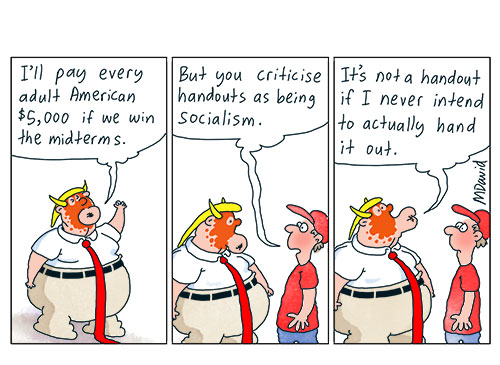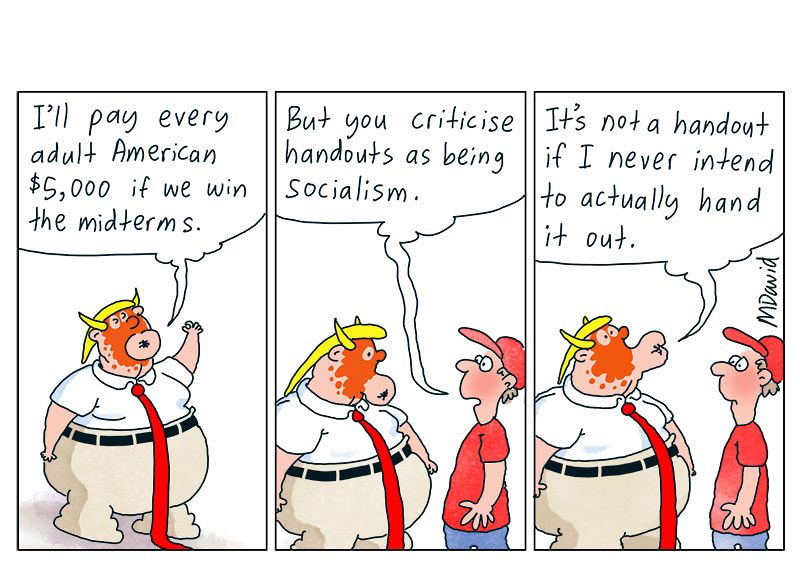
In the wake of Democratic Party victories in the midterms, Trump’s ultra-rich supporters will continue to find ways to influence policy, legislation, regulation and public opinion, writes Jeff Peck.
LAST MONTH, Americans held their fourth nationwide “No Kings” rallies. Once again, it was a call to resist the growing authoritarianism of the Trump presidency. What was largely missing in the protest, however, was a recognition of the critical role of oligarchs in enabling that authoritarianism.
An alliance of the political and economic elite is nothing new in America. Before the War of Independence in the 18th century, the wealthy were closely aligned with the Crown.
As resentment against King George III grew, they feared that any change in the status of the colonies could threaten their power and privilege.
A similar situation exists today. America’s billionaires generally oppose any change to the political balance of power. There’s ample evidence of this.
In 2024, Jeff Bezos, owner of the Washington Post, nixed the newspaper’s endorsement of Kamala Harris, while Elon Musk contributed over $250 million to Trump’s reelection campaign.
Mark Zuckerberg’s Meta cut off the No Kings Instagram account in the midst of the recent demonstrations (Meta claimed it was an error). And simply look at the assemblage of America’s richest people standing behind Trump at his 2025 inauguration.
I once played the role of the historic figure of Gouverneur Morris in Paul Foster’s stage play, Tom Paine, about the life of Thomas Paine, who, in 1776, wrote a pamphlet called “Common Sense,” which guided and gave form to the American Revolution.
Much has been written about how that work directly relates to today’s No Kings rallies, making a compelling case for democracy over authoritarianism.
However, thinking back to Foster’s play, I’m reminded that it’s important to also remember Morris because, like the oligarchs of today, he was part of a system where the financial elite – the “gentry”, as he called them – wielded great power in society.
A wealthy landholder, Gouverneur Morris was a member of the “one per cent” of his day.
And when rebellion was brewing in the colonies in the 1770s, his first instinct was to search for ways to suppress dissent — something, he realised, wouldn’t be easy.
Referring to popular leaders in the colonies, in a 1774 letter to a friend, Morris wrote:
'These sheep, simple as they are, cannot be gulled as heretofore. In short, there is no ruling them; and now, to leave the metaphor, the heads of the mobility [mob] grow dangerous to the gentry, and how to keep them down is the question.'
Today’s oligarchs have a simple answer: Spend staggering amounts of money to keep right-wing politicians, including Trump, in office.
Control of the judiciary, however, is another time-tested means of keeping the upper hand. Before the war, judges in colonial America were appointed and paid by the Crown. This made them natural allies of the King and the wealthy in society.
Morris believed that “the principal purpose of the state was protecting private property” and a strong executive and the courts were the instruments to ensure that.
During his first term in office, Trump was able to bolster that role for the judiciary by nominating three of the U.S. Supreme Court’s nine judges, who, together with three others nominated by Republican presidents, have created a conservative super-majority.
The Court has subsequently rolled back affirmative action, as well as voting and abortion rights, while loosening campaign financing laws, notably in the “Citizens United” case, which effectively removed all limits on campaign spending by corporations and billionaires.
The Court also afforded Trump king-like immunity from prosecution for all “official acts.”
Thomas Paine had a fitting riposte to that:
“When it is laid down as a maxim, that a King can do no wrong, it places him in a state of similar security with that of idiots and persons insane, and responsibility is out of the question with respect to himself.”
I leave it to you to decide if that description applies to America’s would-be king.
After armed conflict broke out between colonists and British troops in April 1775, most wealthy landholders, including Morris, did not openly side with the King.
However, many argued for the end of hostilities and reconciliation with the Crown. Thomas Paine thought this was madness.
Once blood had been shed, he said, reconciliation was impossible:
“As well can the lover forgive the ravisher of his mistress, as the continent forgive the murders of Britain."
Indeed, in the end, a peaceful settlement between King and colonists was not to be.
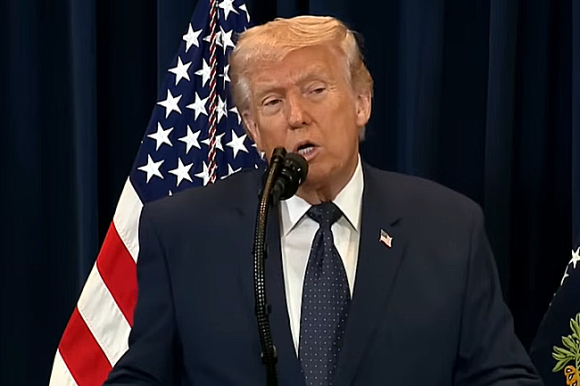
Today, with two years of increasing violence, both rhetorical and physical, on the part of the second Trump administration, that same line has undeniably been crossed.
If, once the dust settles after today’s U.S. elections and the Democrats win control of one or both houses of Congress – despite the inevitable Trump Administration’s efforts to subvert the outcome – there will no doubt be calls for détente, if not reconciliation, between the Administration and Democrats in Congress — a toning down of rhetoric and more cooperation across the aisle.
But, as with Paine’s argument, that may not be possible and hearings, investigations and impeachments will be more likely.
At the end of the War of Independence, when the new country’s constitution was being considered, America’s wealthy managed to guarantee their continued privileged position in society.
“The true and only true basis of representative government is equality of rights. Every man has a right to one vote… The rich have no more right to exclude the poor from the right of voting, or of electing and being elected, than the poor have to exclude the rich.”
However, at the Constitutional Convention of 1787, Morris made the case that only those who owned property should have the right to vote. “Children do not vote,” he said, “Why? Because they want prudence; because they have no will of their own. The ignorant and the dependent can be as little trusted with the public interest.”
That argument prevailed and although the U.S. Constitution left the right to vote in the hands of the individual states, in most cases that meant that only white male voters with property could vote.
In the wake of Democratic Party victories in the midterms, like Morris and his fellow gentry, Trump’s ultra-rich supporters will continue to find ways to influence policy, legislation, regulation and public opinion.
With virtually unlimited resources, both financial and technical (including advanced AI models), along with increasing control of the media, they will be difficult to keep in check. But the choice is clear.
As in the 1920s, American Supreme Court Justice Louis Brandeis warned:
“We can have democracy in this country or we can have great wealth concentrated in the hands of the few, but we can’t have both.”
So, Americans will need to maintain the rage and take the measures necessary to restore the promise of the great American experiment in democracy envisioned two and a half centuries ago by Thomas Paine.
Jeff Peck is a former lecturer in film history at La Trobe University.
 This work is licensed under a Creative Commons Attribution-NonCommercial-NoDerivs 3.0 Australia License
Support independent journalism Subscribe to IA.