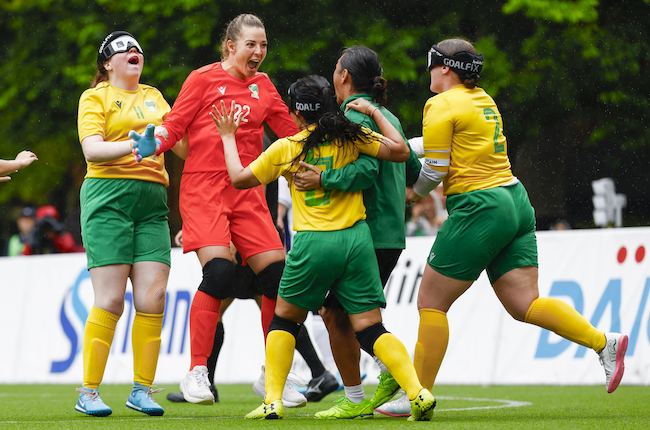
Legally blind teen Charlotte Dougherty turned her Matildas-inspired dream into reality and is now leading the push for inclusive football in Australia.
BACK IN AUGUST 2023, 17-year-old Charlotte Dougherty was transfixed by the Matildas’ journey in the Women’s World Cup.
Australia’s female football team were enthralling a nation in their run to the semi-finals of FIFA’s premier women’s international competition, and Charlotte was one of thousands of young Aussies inspired to emulate her new heroes by taking up the sport.
Yet, she was a little different — as she had always been. Charlotte had been born legally blind, with only a few metres of vision.
Despite her disability, the young Melbournian was determined to give it a go. She contacted the development officer for Blind Football Australia to find out how she could get involved.
.jpg)
Her journey since that point has been remarkable. It has led to some amazing opportunities that have resulted in her now spearheading the push to have a new type of commentary introduced to the nation’s A-League competition, with the goal of bringing the football experience to a visually impaired audience.
From the park to the national team
Charlotte had always liked sport, and as with most young Australians, she’d tried her hand at quite a few during her formative years, despite the challenges her disability presented her.
She explained:
“I grew up a sporty child in Melbourne, and despite being vision impaired I played lots of different sports as a kid."
Yet it was football (or soccer as it was known to many back then) that really ignited her passion. But was she able to participate when she struggled to see the ball as clearly as others?
Charlotte said:
“I’ve always been a football fan, but didn’t really know blind football existed until a couple of years ago."
Inspired by the Matildas World Cup run during those captivating few weeks in mid-2023, Charlotte reached out to the development officer for Australian Blind Football just weeks later.
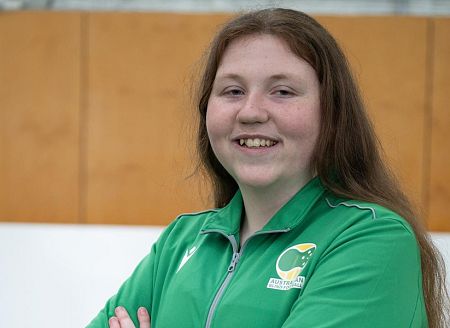
She was informed of a development hub that was being organised for early 2024 in her home city of Melbourne and went along to see if she liked it. It appeared Charlotte had a talent for the sport she had followed so fervently just months earlier, and her footballing journey really started to take shape.
Just six months later, she was invited to trial for the Women’s Australian Blind Football team and by September 2024 she was attending her first full national team camp, only months before her 19th birthday.
FIFA recognition
What happened next is like a script from a Hollywood movie. Having been chosen to represent her country in Women’s blind football, Charlotte and her teammates set off to compete in an international competition in Japan late last year. They performed well enough to qualify for the World Cup Grand Prix for Blind Football in May this year — also in Japan.
This was the first time Australia had sent a women’s team to the event, and incredibly, they came home with a bronze medal — beating England in the third-place play-off.
Yet before this event had even finished, Charlotte was being asked to participate in something that could result in being even bigger for her and her sport.
World Football’s governing body FIFA had organised a program called Integrated Dreams — the first of its kind in the sports industry to be specifically designed for the promotion of employment, entrepreneurship and networking of disabled people. They invited Charlotte to attend.
Fresh from her national team exploits, the young Melbournian spent several days in Malaysia learning about the opportunities that sport could bring young people with a disability.
At its conclusion, she was given a project —& to help promote the introduction of Audio Descriptive Commentary (ADC) of football in Australia. Quite a challenge for a now 19-year-old who had only taken up the sport two years earlier.
“I want to make football more inclusive”
Audio descriptive commentary (ADC) in football is a special service designed to make live matches accessible to blind and partially sighted fans. It was actually provided by FIFA at the Women’s World Cup in Australia, a service that Charlotte and several of her visually impaired friends took advantage of at the games they were lucky enough to attend as spectators.
ADC provides a detailed narration of the game, focusing on visual aspects like ball movement, player actions, and even fan and coach behaviour — things that are not always covered in standard commentary.
The benefits of for visually impaired viewers of the game live are significant, as Charlotte explained:
“I want to hear that a goal is about to be scored before I hear the crowd’s reaction when it is. ADC allows me to do that.”
Although ADC is now offered as standard at most FIFA events and some Premier League games in the UK, it is not yet offered at professional football games in Australia.

Charlotte’s FIFA-sponsored project is to make this happen.
She said:
“The plan to begin with is a pilot of ADC – hopefully in the NPL – before the end of their season in September. We then hope to introduce it to the A-League for the 25/26 season."
This plan is currently being discussed with football associations across Australia, and Charlotte is hopeful that the National Premier Leagues (NPL) – a national second tier of competitions that are one level below the professional A-League – will prove the perfect starting point to making ADC a viable option for visually impaired fans.
.jpg)
She goes on to explain how her project – which involves users downloading an app that they use to interact with the specialist commentary being provided inside stadiums – has been relatively well received so far, but there is still a way to go to make it a reality.
This seems a huge task for a 19-year-old, let alone one who hadn’t played organised football herself until two years ago. But Charlotte Dougherty has overcome some significant obstacles already in her young life, and flourished in spite of them.
As we end our conversation, she speaks passionately about how she wants to make sure the next generation of kids growing up with a visual disability can access the game, as well as reaping the benefits right now to better enjoy the game she loves.
She said:
“I want to make football more inclusive, be able to go to games with my friends and get the same experience as they do."
It’s a noble goal for this humble young Australian footballer.
Yet given her remarkable progress over the last two years, you wouldn’t bet against her achieving it.
Support independent journalism Subscribe to IA.
 This work is licensed under a Creative Commons Attribution-NonCommercial-NoDerivs 3.0 Australia License