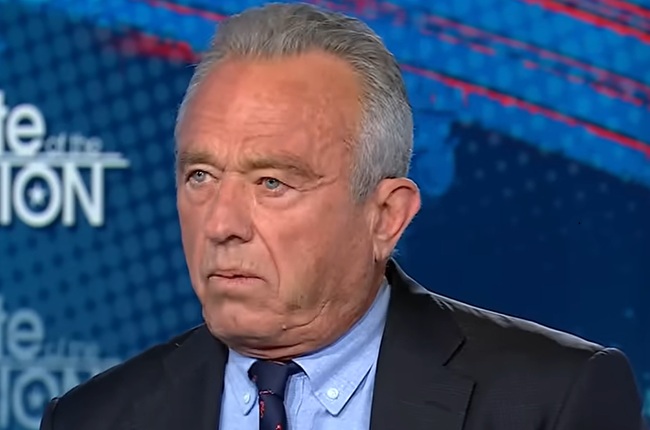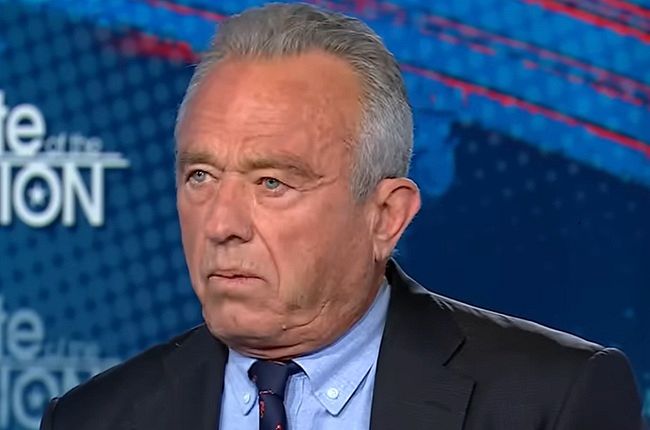
Robert F Kennedy Jr's declaration that the "primary obligation" during the next health crisis is individual liberties over collective safety is a blueprint for mass casualties, writes Dr Tyler B. Evans.
THERE IS A SPECIAL KIND of danger in an argument that sounds principled but is actually a trap.
U.S. Secretary of Health and Human Services Robert F Kennedy Jr's declaration that protecting U.S. Constitutional rights must be America's "primary obligation" during the next public health crisis is exactly that kind of trap.
It sounds like a defence of freedom. In practice, it is a blueprint for mass casualties.
Let me be direct: this is a false choice.
No credible U.S. Constitutional scholar, no serious public health expert, and no honest reading of American legal history supports the idea that individual liberty and collective safety are locked in an either-or struggle where one must categorically defeat the other. They are not opposites.
They are, and always have been, in constant negotiation — weighed, balanced, and adjudicated through law, science, and democratic process. That is the actual American tradition. What Kennedy is proposing is something different: a hierarchy where rights always win, regardless of the cost in lives.
I have spent my career on the front lines of infectious disease response — treating patients, running clinical operations during outbreaks, and standing in emergency rooms when the gap between preparation and chaos wasn't theoretical. I have watched what happens when a health system delays action to preserve political comfort.
It doesn't protect freedom. It just delays the inevitable and makes the inevitable worse.
The U.S. Constitution was never a suicide pact
Kennedy's framing implies that public health measures during COVID-19 were fundamentally a violation of U.S. Constitutional order rather than a legitimate, historically grounded exercise of government authority during an emergency. This is simply inaccurate.
Quarantine powers, vaccination mandates, and public health authority have deep roots in American constitutional law — dating back to Jacobson v. Massachusetts in 1905, when the U.S. Supreme Court affirmed that U.S. states can require vaccination to protect the community, even when it burdens individual choice.
Courts have consistently upheld the principle that liberty is not absolute when the exercise of that liberty poses direct risk to others. U.S. citizens do not have a constitutional right to expose their neighbour to a lethal, airborne virus. That is not oppression. That is how a functioning society survives itself.
The real failures Kennedy won't name
If Kennedy genuinely wanted to improve pandemic response, he would be talking about the actual failures:
- The fractured U.S. public health infrastructure that left U.S. states duplicating and contradicting each other's guidance;
- The collapse of U.S. public trust caused by inconsistent messaging;
- The supply chain failures that left U.S. hospitals without basic protective equipment;
- The socioeconomic disparities that made "stay home" an impossible option for essential American workers and low-income families;
- And yes, the flood of misinformation – some of it from Kennedy himself – that convinced people to distrust the very tools that could have saved them.
Instead, he is relitigating an old grudge against Dr Anthony Fauci while dodging the data.
CNN's chief political correspondent and Inside Politics anchor Dana Bash was correct, and no amount of interruption or condescension in a recent interview changes the numbers: COVID-19 vaccines prevented deaths.
Not by anecdote — by the accumulated weight of epidemiological studies, hospitalisation data, and mortality comparisons between vaccinated and unvaccinated populations across multiple countries and time periods.
Kennedy's demand that Bash "show him a single study" was not a serious request for evidence. It was theatre, aimed at an audience already inclined to distrust the answer regardless of how many studies were named.
Rights-absolutism is a policy, and policies have consequences
Here is the uncomfortable truth Kennedy needs to sit with: when he says the "primary obligation" is protecting U.S. Constitutional rights over U.S. public health, he isn't describing a neutral principle.
He is describing a policy choice — one that would deprioritise outbreak containment, delay mandatory reporting, weaken vaccination requirements, and hamstring the exact tools that stop diseases from becoming catastrophes. This is not an abstract legal debate. It is a decision about how many people get sick, how many get hospitalised, and how many die, before political ideology yields to epidemiological reality.
We are watching the cost of this ideology play out right now in the resurgence of measles — a disease that was eliminated in the United States in 2000, now spreading because vaccination rates have fallen amid the very misinformation ecosystem Kennedy has helped fuel for years.
Blaming this outbreak on "COVID lockdowns" rather than on the erosion of the American public's trust in vaccines is not just historically dishonest. It is a dangerous inversion of causality from the very official now responsible for the nation's vaccine policy.

What real pandemic preparedness requires
U.S. Constitutional rights and public health protection are not adversaries. They require each other. A society cannot exercise its freedoms in a state of biological collapse, and a public health response that ignores civil liberties will fail through lack of trust and cooperation.
The actual work of preparedness is harder than sloganeering in either direction.
It means:
- Rebuilding U.S. public health infrastructure and data systems damaged by years of underfunding and political interference
- Creating consistent, transparent communication frameworks that treat the U.S. public as intelligent partners rather than propaganda targets
- Strengthening – not weakening – vaccine confidence through honest engagement with legitimate concerns, distinct from amplifying disproven claims
- Establishing clear, legally vetted frameworks for emergency authority that respect due process while enabling rapid, decisive action
- Restoring the credibility of U.S. health agencies through consistency, humility about uncertainty, and resistance to political pressure from any direction
None of that is served by pretending that the U.S. Constitution requires the government to stand aside while a virus spreads unchecked. It does not. And no one serving as U.S. Secretary of Health and Human Services should be telling the American public otherwise.
The next pandemic will not wait for us to resolve this false debate.
When it arrives, the nation will need leadership grounded in evidence, not grievance — leadership that understands protecting Americans' rights and protecting Americans' lives are not competing missions, but the same mission, pursued together.
Tyler B. Evans, MD, MPH, DTM&H is Founder and CEO of Wellness Equity Alliance and the author of Pandemics, Poverty, and Politics: Decoding the Social and Political Drivers of Pandemics from Plague to COVID-19.
 This work is licensed under a Creative Commons Attribution-NonCommercial-NoDerivs 3.0 Australia License
Support independent journalism Subscribe to IA.