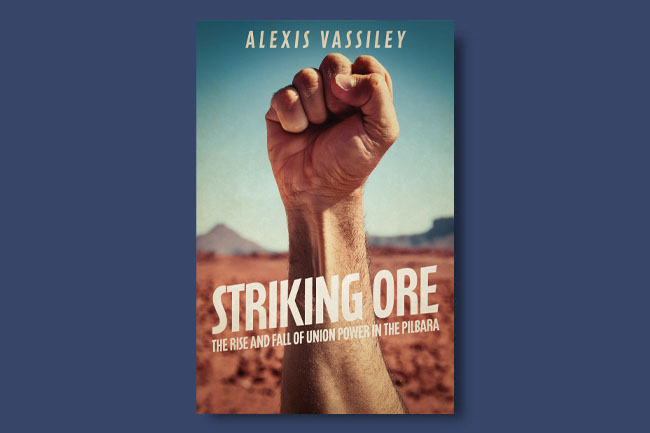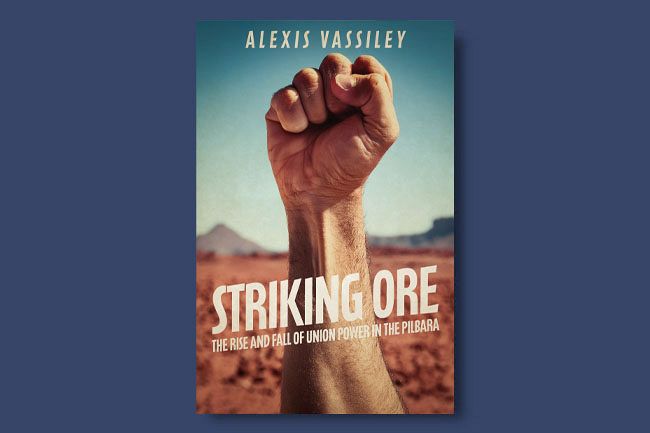
Striking Ore charts the rise and fall of union power in the Pilbara, revealing how worker solidarity won hard-fought gains and what was lost as organised labour declined, writes Zoe Williams.
UNIONS. A word quick to draw either admiration or ire.
Alexis Vassiley’s Striking Ore: The Rise and Fall of Union Power in the Pilbara is a 275-page book that covers the dramatic shifts on and in Pilbara soil since the 1960s. He takes us through the journey from a notoriously powerful union movement to the present super-profit industry plagued with work insecurity, increased suicide risk and sexual harassment.
Part 1: The rise
Vassiley opens with a notable examination of the abuses of Indigenous people and land. This steadily interplays with the advent of the mine sites, towns and workers’ movements, painting a picture of the melting pot of the Pilbara workforce.
While heavy on the dates and statistics of Pilbara life in the 1960s and 1970s, it’s the anecdotal evidence behind the numbers that illustrates the living conditions of the workers and what they were striving to improve. Clinging dust and humidity in processing, soggy food in plastic bags dumped in 40°C heat until lunch and sacking upon refusal to complete unsafe work.

Part 2: Union power
The author fleshes out the following strengths of union action (strikes):
- solidarity (workers advocating for each other across roles, sites and even countries);
- equality (women’s access to housing won by Carol Jackson and the Electrical Trades Union);
- spotlighting site conditions (putting desk jockeys in site workers’ shoes); and
- rank-and-file grassroots activism (from the bottom up and backed by community donations).
Structural shifts such as the Prices and Incomes Accord put workers in a double-bind with ALP and ACTU. Basically, remove your teeth for immediate gain, or oppose the institutions purported to support you. See how that plays out.
Robe River is explored meticulously as setting the precedent for company pushback against prior union militancy. Vassiley explains how repeated hamstringing by union bureaucracy and the Accord eventually betrayed workers. We wonder if ALP power was the catch-22 and if activism would have fared better with fangs against a coalition government…
Part 3: The fall
Here, the weaknesses are revealed. Beyond the Accord, the Iron Ore Industry Consultative Council (IOICC) was also evaluated, but my reading was that it was for management, not workers.
Vassiley continually explores the top-down pressure by union bureaucracy to prevent strikes. But rights must not only be fought for to be won, but also to be maintained, as ‘there is nothing automatic about good wages and conditions’.

Part 4: Consequences
Vassiley effectively critiques the lack of responsibility taken by mining companies and contractors in ensuring worker welfare, especially in the fly-in, fly-out (FIFO) era.
The family-friendly mine towns of the 1970s are juxtaposed with today’s round-the-clock FIFO camps, where 12-hour shifts leave little time for socialising (or unionising).
The stats speak volumes. Mining is well above the market average for workplace fatalities, asserted to be linked to the push for productivity over safety. If workplace fatalities rendered the same financial consequences as weeks-long strikes of lost production, one might wonder how much the culture would shift.
The statistics of super profits should surprise no one and affirm that mining companies can afford to invest more in their workers’ wellbeing.
Which brings our focus to suicide.
Reference was made to a 2015 Parliamentary Inquiry recommending mandatory reporting of suicides in mining, including at the camps. At the time of the author’s writing, nothing had been done. I note that WA’s Work Health and Safety Act 2020 makes no mention of suicide at all. Wheels turn slowly, as SafeWork’s Model Work Health and Safety Act in 2025 includes changes to suicide reporting, but nothing with teeth until state governments enact it. We’ve had a decade of legal stagnation.
MATES in Mining and MATES in Construction are valuable suicide-prevention organisations, but are not equipped to replace unions in handling workplace conditions and disputes.
Then there’s the matter of lower pay, work instability and vulnerability to exploitation for contractors. Vassiley illustrates their increased share of site labour (6 per cent in 1996 to 47 per cent in 2005) and disproportionate representation in accidents.
My recent reading of press releases from industry bodies (and sadly, other sectors, too) finds promotions of mental health “awareness” and lauds generous initiatives to tackle the crisis. What about the causes? Insecure work, social isolation and prolonged stress are well-documented risk factors. Is the mining sector combating suicide by adding to these risk factors?
Part 5: Conclusion
Some written statistics could be better represented by a graph, but Vassiley offers actionable advice for a more hopeful industrial future. Namely, rebuilding militant rank-and-file organisation.
While some blame Pilbara unions’ militancy for their demise, Vassiley asserts that it was the militancy that made the gains early in the game and its forced absence that caused union decline.
Ultimately, Striking Ore highlights the power of standing with your fellow worker, not only for participants in the mining industry, but for all workers of Australia.
Striking Ore, The Rise and Fall of Union Power in the Pilbara by Alexis Vassiley is available from Monash University Publishing.
This book was reviewed by an IA Book Club member. If you would like to receive free high-quality books and have your review published on IA, subscribe to receive your complimentary IA Book Club membership.
Zoe Williams is a Jill-of-all with a BA, but currently employed in a safety role in the construction industry.
 This work is licensed under a Creative Commons Attribution-NonCommercial-NoDerivs 3.0 Australia License
Support independent journalism Subscribe to IA.


Related Articles
- BOOK REVIEW: Boogie Wonderland
- BOOK REVIEW: My Dad's Gone Away
- BOOK REVIEW: Landslide — The 2025 Australian Federal Election
- BOOK REVIEW: The Turing Protocol
- BOOK REVIEW: Find Me at the Jaffa Gate