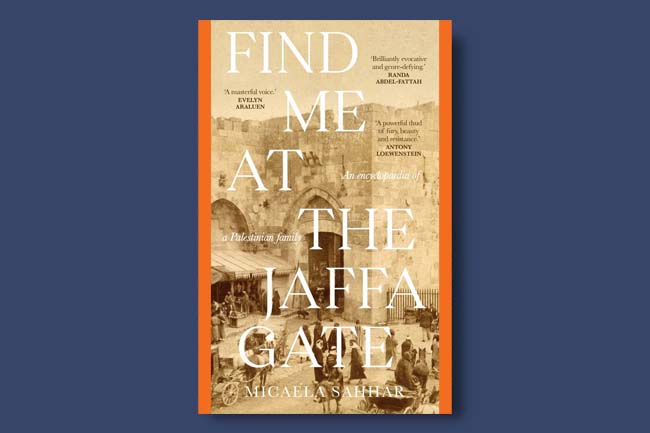
A powerful memoir traces one Palestinian family's displacement, memory and enduring connection to a homeland they were forced to leave, writes Jim Kable.
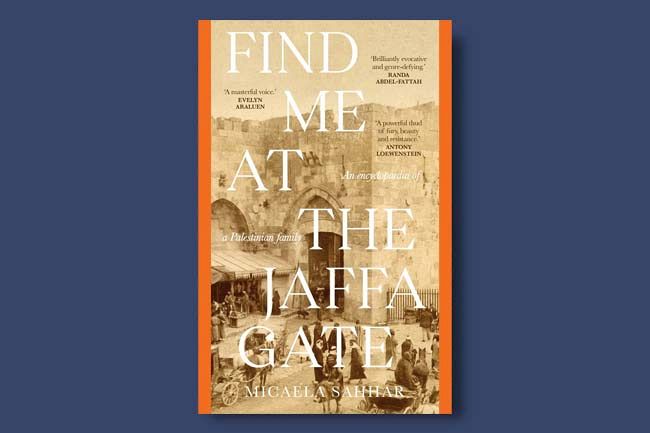
LET ME STATE at the outset of this review that Find Me at the Jaffa Gate is for me a solid contender for book of the year contender — and if the reader is unaware then please know that it has received several awards already including the 2026 UTS Glenda Adams Award for New Writing; the Non-fiction category of the 2026 Victorian Premier’s Literary Awards (VPLA); and has been long-listed for the 2026 Stella Prize.
The front cover carries the endorsements of three highly respected writer-commentators: Evelyn Araluen, Randa Abdel-Fattah and Antony Loewenstein. The book it most reminds me of – almost from the first – is André Dao’s Anam. Another book based around a grandchild searching for a family and its stories, scattered around the world, though in the case of Anam, it was fictionalised.
This is a search and reconstruction memoir by a Melbourne-born Palestinian woman whose Christian family found itself expelled by circumstances surrounding and including the Nakba of 1948 from Jerusalem. Parts of the family end up in the U.S. and Canada, parts in Australia. Some remain in Palestine.
Author Micaela Sahhar’s grandparents, her father Joey (Yousef – named for an Armenian Jerusalemite friend of his parents at the start of 1948, when they are already exiled into Amman), aunts and uncles and cousins, and the partial family tree are among the endpapers of this book, helping make plain the paternal and maternal Palestinian lines.
The tone of the resistance to being erased as Palestinians is set early on when, aged five, Micaela is told by a music instructor that not only is her name different (a distasteful difference) but that she cannot possibly be Palestinian, when she says she is.
This is a true story, she states near the beginning, made of the things the writer does not know alongside things she does, beginning with two true words: poetry and Palestine. It’s a story of three continents, she writes, and two islands.
Still, the story involves the stitching of fragments together. As the writer travels to the points of the diaspora to which her family has been dispersed, but also to the elements who are still in (Israeli) Jerusalem (where a Sahhar cousin lives, with car number plates allowing him some ease of travel in taking her to Bethlehem) and in Palestine. New Jersey and Phoenix in Arizona and California, Adelaide and Melbourne, Amman, Montréal, and Bethlehem, where someone asks her if she is chasing dreams.
Sahhar manoeuvres border crossings on foot and uncovers the ugliness of Israeli controls and of separate Wall-divided ways of road travel. Of having her search one day being interrupted by a Zionist who seems to mistake her for being Jewish until she is finally able to escape his pawing hands.
A cousin is detained for seven hours at one border crossing because the Israeli female guard wants a date with him. He shows her that he is married with a son. Her grandfather in Australia holds on to the key to the family home in Jerusalem, which they leave after attacks in the district, hospitals filled, Micaela’s father due to be born any day, for the safety of hospitals in Amman and thereafter the family is prevented from returning. This is until their eventual passage to Melbourne aboard the ship Roma in 1952.
Micaela Sahhar’s grandmother Ellen’s father, Hanna, has a restaurant in Bethlehem and later near the Jaffa Gate in Jerusalem. All his children are born in Bethlehem. Interspersed with tales of contact with relatives are stories of food – of Best Cake (hilbe), of which she becomes the inheritor – from her grandmother’s recipe. Of ma’amoul (moulding and sugaring and Eastering Arabic cakes).
There is a particularly moving section based around a poem by Taha Muhammad Ali titled Revenge.
The first verse traces all the satisfactions encompassed by revenge, though a subsequent verse comes to a different conclusion:
But if it came to light
when my rival appeared
that he had a mother waiting for him
then I would not kill him/even if I could.
The final verse:
But if he turned
out to be on his own
cut off like a branch from a tree...
Instead I’d be content
to ignore him when I passed him by
on the street — as I/convinced myself
that paying him no attention
in itself was a kind of revenge.
There are references to films (Elia Suleiman’s Divine Intervention) and books and expressions: Inshallah and fil mish mish. And in this vein, a heart-wrenching musing on the fact that several generations away from the Nakba of 1948 – three quarters of a million Palestinians then expelled from their homes and businesses and lives, stolen by the Zionists with the fears generated by the Zionist terrorist groups, Irgun and Haganah – that “there isn’t a Palestinian living who hasn’t considered the question of what they would take in the night if a Nakba should fall again — and if they could grab only one small suitcase before flight.”
The chapter titled ‘This Way to the Bomb Shelter’ is with an Israeli friend and contains references to the fear that Israelis are indoctrinated with about visiting Palestinian parts and of close contact with gun-bearing Israelis and references to Judea and Samaria from an eastern European filmmaker in the car in which they are travelling. Two films are named: Salt of This Sea and To See If I’m Smiling.
Later that same evening, with an activist friend, she is able to visit 8 Asa Street, the home built by her Pa. On the fence is what appears to be some Hebrew graffiti which translates to: “this way to the bomb shelter”. It is this same chapter which has the story of her activist friend having been in Bethlehem – something only possible if he were there as a soldier – and he explains how at age 21 he was stationed in a tank that was part of the Siege of the Church of the Nativity.
He tells Micaela that he cried in the tank and then cried all the harder as he understood all at once the brutality of service for himself and most of all for the people he was literally threatening to kill with his tank.
I will finish this review with a quotation from the book, of the first Prime Minister of Israel, David Ben-Gurion:
If I was an Arab leader, I would never make terms with Israel. That is natural. We have taken their country. Sure, God promised it to us, but what does it matter to them?
They only see one thing: we have come here and stolen their country. Why should they accept that?
Apart from the questionable promise of God to the Ashkenazim, this particular insight should be written into the uncoverings of the current Royal Commission on (so-called) Antisemitism and Social Cohesion.
Find Me at the Jaffa Gate is available from UNSW Press Ltd.
This book was reviewed by an IA Book Club member. If you would like to receive free high-quality books and have your review published on IA, subscribe to receive your complimentary IA Book Club membership.
Jim Kable was a secondary school teacher of English (including EAL), History, and Japanese, before spending most of his final two decades of teaching English in Japan, 1990s and 2000s. For a brief two years, he was a member of the now-defunct New Liberals from 2020 to 2022. He takes a keen and informed view of politics.
 This work is licensed under a Creative Commons Attribution-NonCommercial-NoDerivs 3.0 Australia License
Support independent journalism Subscribe to IA.


Related Articles
- BOOK REVIEW: How to Dodge Flying Sandals
- BOOK REVIEW: Making Progress: How good policy happens
- 'Locust and Other Poems' finds beauty, warning and wonder in everyday life
- More than words: One man's journey through dyslexia
- X Rubicon: The hidden casualties of secret wars