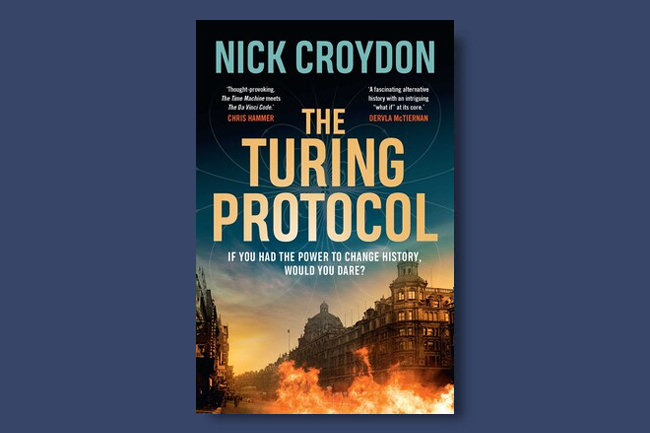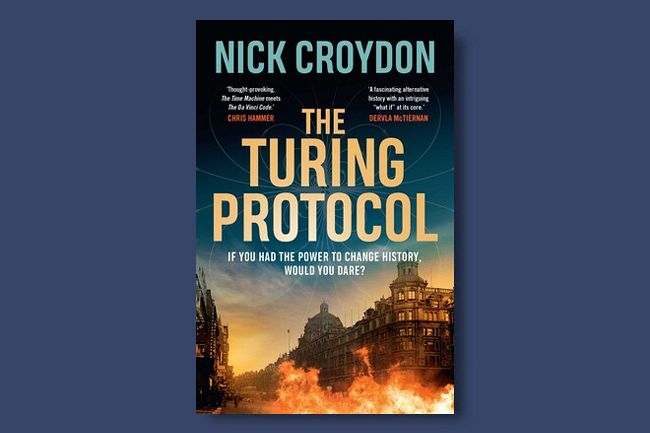
A clever reimagining of Alan Turing’s legacy blends history, espionage and time travel, but its intriguing premise is undermined by some difficult-to-swallow plot devices, writes Anne Layton-Bennett.
A NOVEL that includes the name Turing in the title suggests it will involve the brilliant mathematician and computer scientist Alan Turing, whose Bletchley Park team succeeded in cracking the Enigma Code, contributing to the defeat of Nazi Germany.
And The Turing Protocol does, while also fictionalising some aspects of his life.
Against a background of post-war global history, author Nick Croydon blends historical fact with the fictional to create a what-if thriller based on an imagined life of Turing that involves his invention of a complicated machine called Nautilus, developed during and after WWll, that is capable of sending messages back in time to avert what could be a cataclysmic threat to global peace and security.
Central to this reimagined sci-fi thriller is the unlikely premise that the homosexual Turing and his Bletchley Park colleague, friend and former fiancée Joan Clarke, slept together following a euphoric night of riotous celebrations during London’s VE-Day, resulting in the birth of a son. David was subsequently brought up in Scotland by close friends of Joan’s because, as an equally brilliant mathematician and scientist, she wanted to pursue a career, not motherhood.

Academically brilliant, when he grew up, David joined MI6 as an Intelligence Officer, while his daughter, Annabelle, was first a scientist and later a politician and government minister. In turn, they both become custodians of Nautilus, which readers learn in the opening pages of the novel is a legacy that ‘needs to be protected at all costs’.
Between 1945 and 2022, David and Annabelle grow up, marry and have children against a global backdrop of war and conflict that threatens to destroy global order. They each have to decide if the conflicts are serious enough to activate the protocol.
I’m no mathematician, so I cannot comment on the possibility a machine like Nautilus could ever be invented, but even so, this Doctor Who aspect didn’t quite work for me.
For a start, the technology remained stuck in the 1940s. My disbelief also failed to be suspended by the fact that Nautilus sat undetected in the basement of Harrods, yet was still able to be accessed unchallenged when David and Annabelle, in turn, make their infrequent visits to the famous London store to visit it.
The Turing Protocol is certainly a very easy read and is also undemanding if some of the more questionable and implausible aspects of the story are overlooked. The idea behind the novel is terrific and original, and ending it in February 2022 is clever. What will Annabelle do when global conflict looks set to escalate?
There’s no doubt our world might benefit from a time machine that’s able to turn back the clock to prevent catastrophe. But it would need to be a much more sophisticated machine than Nautilus.
'The Turing Protocol' by Nick Croydon was published by Simon & Schuster and is available from all leading book stores.
This book was reviewed by an IA Book Club member. If you would like to receive free high-quality books and have your review published on IA, subscribe to Independent Australia and receive your complimentary IA Book Club membership.
Anne Layton-Bennett is a writer based in Tasmania.
 This work is licensed under a Creative Commons Attribution-NonCommercial-NoDerivs 3.0 Australia License
Support independent journalism Subscribe to IA.


Related Articles
- BOOK REVIEW: Find Me at the Jaffa Gate
- BOOK REVIEW: How to Dodge Flying Sandals
- BOOK REVIEW: Making Progress: How good policy happens
- 'Locust and Other Poems' finds beauty, warning and wonder in everyday life
- More than words: One man's journey through dyslexia