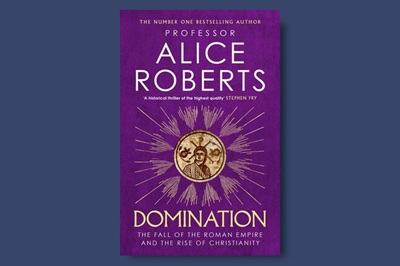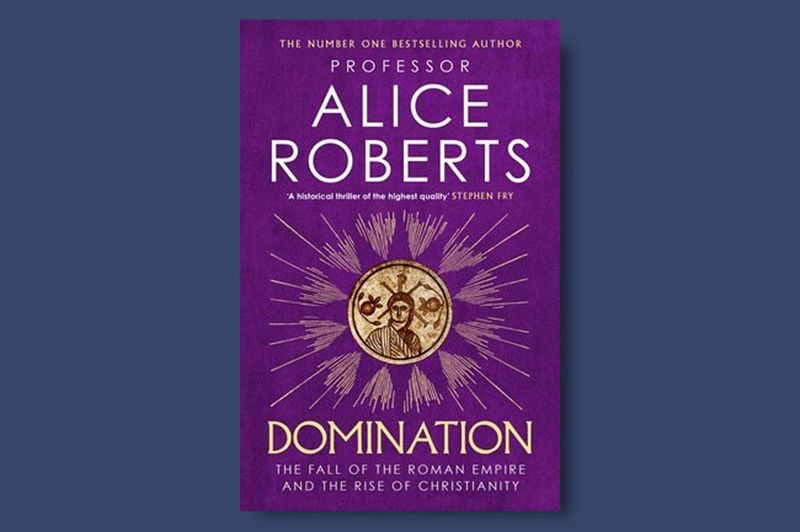
Through meticulous research, Professor Alice Roberts traces the incremental acceptance of Christian monotheism in the time of Jesus Christ to, within 300 years, filling ecclesiastic roles of bishops and clergy. Dermot Daley reviews 'Domination – The Fall of the Roman Empire and the Rise of Christianity'.
PROFESSOR ROBERTS' BOOK Domination – The Fall of the Roman Empire and the Rise of Christianity is cleverly titled, with the word "domination" deriving from the Latin "domine" meaning "Lord".
It took several chapters to see where she was going after wading through archaeological references to obscure 5th-century Welsh saints and their strange coincidence of presence in Brittany, France.
This detail seemed somewhat twee given the contentious pathways to sainthood which existed in the early days of Christianity. Professor Roberts has excellent credentials in archaeology, history, evolution, human anatomy and physiology, so perseverance was required.
The Roman Empire was an outstanding achievement, adopting and advancing the social and technical advances of Greek civilisation, as well as maintaining the continuity of polytheism, a god for every occasion.
Professor Roberts does not delve deeply into the life and politics of Jesus of Nazareth, apart from describing him as the figurehead of the early cult of Christianity who was later elevated to divine status.
However, she notes that the accepted accounts of his life were documented between 65 and 100 years after he died.
And in particular, she acknowledges the zealous evangelism of convert Saul/Paul, who avidly elaborated upon and promoted the Christian cause in his correspondence to the faithful, possibly around 40 to 60 CE, but written down considerably later, noting that by the 3rd Century, only five to twenty per cent of the population could read.

Through meticulous research, Roberts traces the incremental acceptance of Christian monotheism, identifying the initial appeal to "humble fishermen and tent-makers" in the time of Jesus Christ.
Then, within 300 years, achieving a steady uptake by an ennobled class who seemed to drift fluidly between highly placed positions in the Rome-centric civil government to high-ranking orders within the emerging Christian church, filling ecclesiastic roles of bishops and clergy.
She states that by 300 CE, only one to two per cent of the Roman Empire were followers of Christianity.
Professor Roberts provides great detail on the symbolism and the influence of Constantine, the Roman Emperor who is credited with adopting Christianity, and hence giving impetus to the movement.

Professor Roberts contends that the real power shift occurred with Constantine’s Council of Nicaea, where central tenets were adopted and Christianity became its own brand.
This tipping point signalled the formal application of the Christian values of philanthropy and charity, when it became a duty of bishops to provide lighting oil and food for the poor. The early Christians fostered monasteries and communities (offering benefits to women) that could accumulate wealth through land, and thence devise means of avoiding taxes.
Professor Roberts suggests that prosperity was deemed a mark of god’s favour, and that this entrenched Christianity as the archetype 'firm' or 'corporation'.
The fall of Rome, she reveals, was not an overnight sensation but more a relaxing of control, originating sometimes within colonised Gaul and sometimes from Rome itself.
At times, the Roman order prevailed; at other times, allegiances fluctuated between competing invaders and different Goth and Visigoth kings. Sometimes the Goths were acting as mercenaries for the Romans. Life still seemed to go on without too much turmoil for the ruling classes as well as for the peasants.

Professor Roberts admits to being at a loss to understand why the new cult of Christianity became favoured by societies enmeshed in millennia (Greek) and centuries (Roman) of polytheism, and ventured that the prize on offer by the 'One God' seemed to be simply the ‘ticket to Heaven’ promised by the Christians.
Professor Roberts has appended an impressive set of ‘Selected References’ to her highly erudite history.
Still, she does not seem to have encountered ‘The Immortality Key’ by Brian C Muraresku, which investigated sacramental rituals from the Bronze Age through the Greek and Roman civilisations, and well into the foundation of the Christian Church. This study offers profound insight into some of the ceremonies that echo in the Christian creed to this day.
As with Professor Roberts, Brian C Muraresku brandishes impeccable qualifications and anyone considering either book would benefit from including the other.
Dermot Daley is a fourth-generation Australian, living in Victoria, now retired from construction project management.
 This work is licensed under a Creative Commons Attribution-NonCommercial-NoDerivs 3.0 Australia License
Support independent journalism Subscribe to IA.


Related Articles
- BOOK REVIEW: 'Fathering' — a century of change and what endures
- REVIEW: The Butterfly Women
- The Butterfly Women: Murder and survival in colonial Melbourne
- How 'The Introvert’s Guide' helped me leave the house (and like it)
- BOOK REVIEW: 90 Seconds to Midnight