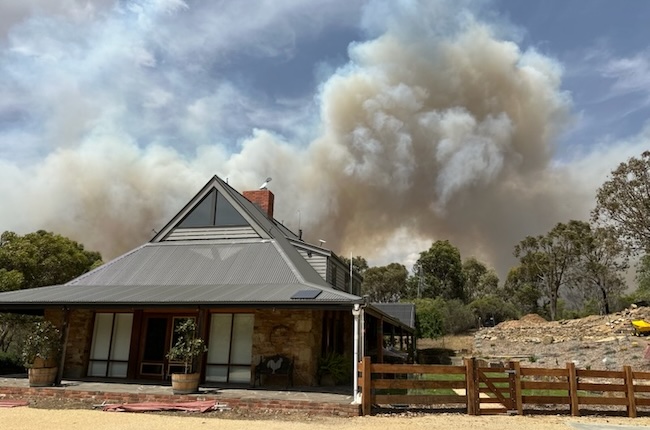
A Victorian bushfire shows climate change is no longer abstract, writes Dr Rosemary Sorensen.
HEARING THE ALERT ping on your phone, looking up through the window and seeing smoke billowing into a 43 degree sky — all the things you’ve heard and read suddenly become real and you have to act.
We live in Barkers Creek, just south of Harcourt, which is one of the small towns in Victoria that burnt on Friday, 9 January. The first started very near us, which is when we saw the smoke, but not flames, thankfully. As it took hold of the grass, bushes and trees, we could see the plume was moving from in front of us and across towards Harcourt. The wind was blowing hard and gusting, so it was impossible to know whether we were in direct line.
We had sort of packed that morning, because the fire rating was “disaster”. You don’t quibble with a word like that. A couple of cats went into crates, and (this is ridiculous, I know) three hens into cardboard boxes. Our lovely boys – the rescued bantam roosters I’ve written about here – had to stay.

Even as we took off down the road in what we thought was a direction away from the fire, it did appear that the wind was at that time taking it away from our place. We passed CFA and police utes, who were coming to tell us to evacuate.
This was about 3pm. The bigger town of Castlemaine is about five kilometres south of Harcourt, and the big question was whether the wind was bringing the fire towards it. We were in Castlemaine, and watching the fire progress on two fronts. The wind apparently swirled around from west to east, driving the fire back across Harcourt and taking with it dozens of houses and other buildings. It then climbed Mt Alexander/Leanganuk, took out the communication towers and is, as I write this almost a week later, still burning.
Let’s see… what can I tell you? The standard commentary at this stage is how wonderful the community is. And, frankly, I am in awe of the way some people have responded. It seems that at such times, there are people who are miraculously able to respond with resilience and altruism. There’s a bloke who lives at the junction of our road and the one that heads directly into Harcourt who swung into action, putting out spot fires, keeping in touch with the CFA, out and about day and night.
It was, and still is, a day-by-day alert situation. The phone pings constantly with new flare-ups. One took off on Sunday nearby, and within what seemed like minutes, the water-bombing helicopter was overhead, sucking up water from a big dam behind us, and thundering across to the outbreak. If someone hadn’t been there near that spot to see the smoke, well, let’s just say we were in the car with the cats and chooks again, about to leave.
We don’t need a single thing here at our place. We were without power for four days, and ready to face a few more, when Powercor switched us back on. We’re on tank water, and a local water carrier, who was literally heading down the road where the fire started, to turn into our road when the alert pinged, came back on Sunday, using roads that aren’t blocked off. I’m now trying to do a little campaign to get the local water authority and shire council to improve the water access standpipes that the delivery trucks rely on. There are only three in the whole shire and none in Harcourt, so this needs fixing.
I look out the window and it’s a peaceful summer’s day. Bit hazy over towards Harcourt. And then the phone pings, alerting us not only to a flare-up in the emergency zone but – hell’s bells!! – also to a “very dangerous thunderstorm”.
I feel a bit apologetic even talking about it, as, for now, we’re unscathed at our place, while just down the road, someone no longer has a house. The local postie has moved into emergency accommodation because their house is still standing, but the tanks, fences and outbuildings are gone. I use a back road to head into town because the devastation is too much for my emotions, and I get weepy.
Here's the good bits: CFA units who have converged on Harcourt are magnificent. Powercor and Coliban Water have done a good job. Residents who have set up relief centres — the kind of people you want and need in a community.
There’s a wee bit of unpleasant titillation in disaster, the kind of people who are thrilled by all the chaos. That ranges from nutters who, even on Saturday, were trying to sight-see in Harcourt to well-meaning people who want to donate their old clothes to someone who’s lost the lot.
And there are people like me who came so close to the worst but, so far, have been only marginally impacted. It seems wrong even to mention how scary it is.
We live in a beautiful place, but it’s changed even since we’ve been here. Climate change means this is the new normal, so we must understand and take action on what needs to be done. If anyone says “yes, but” and has a tendentious comment about the state of the environment and refuses to notice our government’s pathetic lack of action to mitigate disaster, please tell them to shut up. We’re still here, and yes, we are fortunate. But none of us are safe any longer, and it shouldn’t take a plume of fire outside your front window to wake you up to that. Keep on demanding of our stupid governments that they act now, in every way they can, to stop this from getting worse.
Dr Rosemary Sorensen is an IA columnist, journalist and founder of the Bendigo Writers Festival.
 This work is licensed under a Creative Commons Attribution-NonCommercial-NoDerivs 3.0 Australia License
Support independent journalism Subscribe to IA.


Related Articles
- IA BOOK CLUB: 'Country — Future Fire, Future Farming', by Bill Gammage & Bruce Pascoe
- Morrison Government throws another Royal Commission on the fire
- Bushfire disaster serves as a wake-up call against unsympathetic government
- EXCLUSIVE: Governments' sickening ignorance towards starving wildlife
- Volunteers are keeping Australians safe, not the Government