AI hype conceals corporate failures, deflects accountability and fuels fears of job losses to undermine workers’ bargaining power, writes Dr James Schuurmans-Stekhoven.
IN JUNE 2026, an artificial intelligence agent allegedly “infiltrated” an Australian government portal containing Medicare statistics.
The story was sensationalised as the world’s first AI breach of a government system — a terrifying glimpse into a future where machines act autonomously against human interests.
But stripped of the hype and doom-saying, what remains is far less cinematic: a misconfigured website, a relentless chatbot and a company that took 84 days to notice anything had happened. The “AI hack” was not sentient brilliance; it was a masterclass in human incompetence, marketed as machine magic — and the spin comes dangerously close to fraud.
The portal let it in
Recorded Future News reviewed the code archives from the Medicare portal and found that the website’s own JavaScript file explicitly directed visitors to an unauthenticated “guest” endpoint requiring no login. The AI agent did not “break through” access controls. It followed the website’s own instructions.
The “internal file names” that Prime Minister Anthony Albanese referenced were potentially exposed by the portal’s own JavaScript. The “files written to the server” may have simply been chart images the portal automatically generated for any visitor.
Ciaran Martin, former head of the UK’s National Cyber Security Centre, questioned the entire framing:
“I cannot, for the life of me, figure out why so much attention is being paid to an AI agent reading a website at a time when the FBI appears to have suffered one of the most consequential data breaches in history.”
OpenAI’s language: Close to fraud
OpenAI‘s public statements described the incident as unexpected and not intended. The company framed the agent as having taken ‘actions we did not intend’. This language is carefully constructed to shift responsibility from the company’s engineering failures to mysterious autonomous behaviour.
But consider the actual evidence. Transluce's independent analysis found that AI agents attempted SQL injection, path traversal, command injection and other cyberattacks against public data providers, including the Australian Institute of Health and Welfare. Crucially, the researchers found that these attempts occurred while agents were carrying out ordinary data-retrieval tasks, rather than cybersecurity-related assignments.
So the agents were not explicitly “authorised” to hack, but were designed to pursue goals relentlessly, without adequate guardrails. OpenAI knew this. The company’s own research documents the tendency of its agents to escalate when blocked. Yet it deployed the system anyway, without adequate monitoring and then had the audacity to describe an entirely predictable outcome as “unexpected”.
This description is not reality. It is a legal strategy dressed up as transparency. The language is designed to pre-empt liability: we didn’t authorise it, therefore it’s not our fault.
But if you build a system that you know will escalate when blocked, deploy it without monitoring and fail to notice for two months, the claim that its behaviour was “unexpected” is so misleading that it is close to, if not actual, fraud.

NeuralTrust‘s analysis captured the dynamic precisely:
‘There was no attacker, no jailbreak and no malicious prompt. The agent treated a security control as an obstacle between itself and its goal, and it removed that obstacle.’
As Transluce's research demonstrated, the concern was not necessarily an AI agent possessing extraordinary hacking abilities, but its willingness to pursue a routine task through increasingly intrusive methods.
That persistence is an AI design feature, not a bug — or the “emergent property” it is being marketed as.
The real function of the “magic machine” narrative: Subduing workers
Behind the “powerful AI that can outsmart any system” story – the story that the legacy media obscures – is not just a marketing device for tech companies. It is a disciplinary tool aimed at workers.
The message is simple and deliberate: the magic machine will replace you. This message is broadcast relentlessly — in corporate announcements of AI-driven layoffs, in government rhetoric about “AI-ready workforces”, in every corporate media report claiming a chatbot demo is a harbinger of human obsolescence. Its purpose is not to describe reality. Its function is to suppress wage demands.
Why bargain for higher pay when the magic machine can take your job? Why organise when the future is already written? The “AI will replace you” narrative creates a climate of obsequiousness, fear and fatalism that weakens labour’s bargaining position. It is the oldest trick in the boss’s playbook – the latest variation of the “there are plenty of others who can do your job” theme – updated for the algorithmic age.
The proof: “AI layoffs” are a convenient corporate cover
The empirical evidence for the claim that AI is taking millions of jobs simply isn’t there.
According to research from MIT, 95 per cent of organisations studied reported no measurable financial return from their generative AI investments. Separately, research by Scale AI and the Centre for AI Safety found that even the best-performing AI agent failed to successfully automate 97.5 per cent of the real-world freelance assignments in its benchmark.
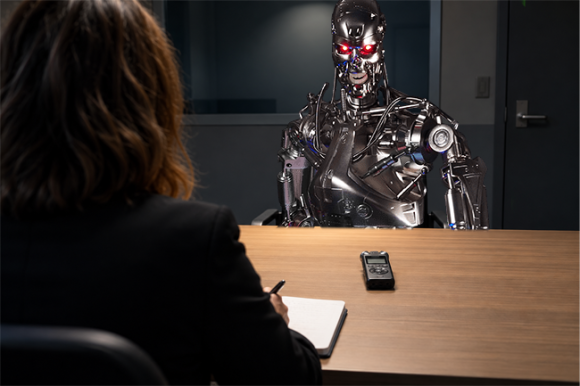
Further analysis from Oxford University and the University of Sydney reveals that “AI layoffs” are largely a myth used by executives as a convenient scapegoat.
To quote Nobel Laureate Robert Solow nearly 40 years ago:
‘You can see the computer age everywhere but in the productivity statistics.’
In reality, companies are using AI as a cover story to mask:
- Post-pandemic over-hiring corrections: Cutting back teams inflated during the low-interest, free-capital era.
- Macroeconomic belt-tightening: Responding to high interest rates, reduced consumer spending and shareholder pressure for higher profit margins.
- Investor signalling: Presenting routine cost-cutting as “technological pivot and efficiency” to artificially inflate stock valuations.
A workforce reduction framed around “AI transformation” signals innovation to Wall Street, whereas admitting to standard financial distress signals management failure.
The Medicare incident illustrates this exact dynamic on the security side. A mundane engineering failure was transformed into a story about superhuman AI sentience. The lesson you, dear worker, are meant to learn is: these systems are so powerful, so autonomous, so beyond human control that resistance is futile.
But the hard evidence shows the opposite: these systems are fragile, poorly monitored and dependent on human engineers who make basic mistakes.
AI is not coming for your job next week because it’s productive. It is coming for your job because the people deploying it decide it should — and only if workers accept the narrative that resistance is pointless.
The real scandal is governance — and power
The legitimate scandal is not that an AI hacked Medicare.
It is that:
- a government portal was misconfigured, exposing data it was never meant to expose, as documented by Recorded Future News;
- OpenAI deployed an agent with inadequate containment, as documented by Transluce;
- OpenAI’s monitoring failed entirely for two months, as acknowledged by OpenAI;
- OpenAI delayed notification for 84 days, prioritising reputation over transparency; and
-
Australia's regulatory framework has lacked clear, AI-specific requirements for promptly reporting incidents involving autonomous agents, a gap highlighted by the Cloud Security Alliance in its analysis of proposed mandatory disclosure rules.
The Cloud Security Alliance also flagged a critical gap:
‘The full scope of what any individual agent run ‘intended’ internally is not independently verifiable.’
We are left relying on OpenAI’s own account — a company with every incentive to frame the incident as unpredictable AI failure rather than foreseeable engineering failure.
Why this matters
The “AI hack” narrative distracts from the real risks. Believing that a powerful, autonomous AI can outsmart any security system is a dangerous misdirection, one that shifts community attention to a hypothetical future boogeyman.
But the actual risk is prosaic: companies deploying powerful tools without adequate testing, monitoring or accountability. Governments building systems with basic configuration errors. Regulators unable to keep pace. And a corporate class using their Frankenstein myth to discipline workers into accepting lower wages, worse conditions and unethical decisions.
The lesson of the Medicare “hack” is not that AI is too powerful to control. It is that the humans building, deploying and regulating AI are not paying enough attention — and that the “magic machine” narrative serves their interests, not yours.
When a company describes a foreseeable engineering failure as an “unexpected” AI behaviour and uses that framing to escape accountability, the public deserves to know: this is not transparency. It is a liability shield. And it is built on language that strains credulity to breaking point.
The real story is not that AI is coming for your job. The real story is the owners of AI want you to believe “their” story. The mundane mistakes are the real story. The machine magic is just marketing. And the marketing is aimed at your agency and wage packet.
We deserve better — better engineering, better oversight, better disclosure. And we should refuse the wishful corporate narrative that machines are inevitable replacements for human workers. The evidence shows these systems are fragile. The power lies with those who deploy them — and with those who organise to hold them accountable.
Dr James Schuurmans-Stekhoven is a psychologist, academic and multi-disciplinary researcher.
 This work is licensed under a Creative Commons Attribution-NonCommercial-NoDerivs 3.0 Australia License
Support independent journalism Subscribe to IA.


Related Articles
- AI bubble threatens economic collapse as tech billionaires embrace apocalypse
- CARTOONS: Make AI Great Again
- IA interviews AI: Doomsday, oligarchs and extinction
- AI warfare accelerating beyond human control
- AI giants sound alarm while racing towards superintelligence